

The general consensus is that the Reserve Bank of Australia will cut interest rates at tomorrow’s (18 February) meeting but the US Federal Reserve is sticking to its view that there is no need to rush.
The big four banks are confident the RBA will deliver a 25 basis point interest rate cut to 4.1% at its February meeting, with the RBA indicator placing the likelihood at 90%.
US Federal Reserve Chair Jerome Powell, meanwhile, in his semi-annual testimony before Congress late last week reiterated his stance that there is no reason to rush to cut interest rates further.
ANZ Senior Economist Tom Kenny says Powell did not engage on the impact of President Donald Trump’s policies, saying it is too soon to measure their economic impact and the Fed will follow the data.
“On the potential inflationary impact of tariffs, he reminded Congress that in 2019 the Fed cut rates, in part because the uncertainty generated over Trump’s trade policies was proving to be a headwind to growth,” Kenny notes.
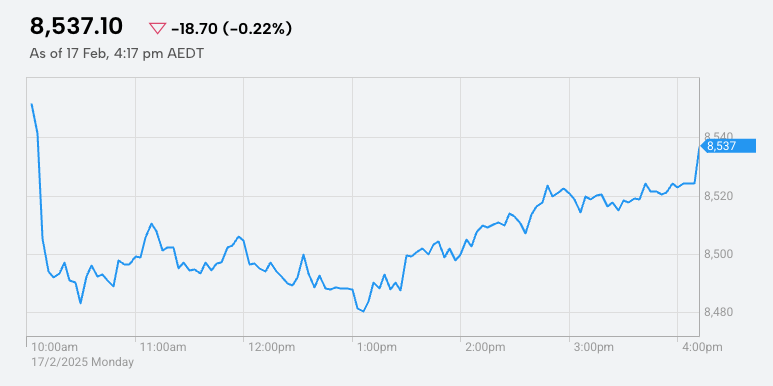
Ahead of the RBA rate decision, the S&P/ASX 200 closed down 18.7 points, or 0.22%, at 8,537.1 points.
The index is up 0.3% over the past five days and is about 0.91% off its 52-week high.
Six of the 11 sectors ended the day in the red. Energy tumbled 1.57%, the financial sector slid 1.26% and materials gave back 0.4%. Utilities was the best performing sector, gaining 1.48% on Monday (17 February) and 0.97% over the past five days.
Steel giant BlueScope Steel (ASX:BSL) rallied 12.98% to $25.25 after Moody’s Ratings analyst Liam Li said the Trump administration’s proposal to impose 25% tariffs on steel will be a net positive for BlueScope, given that the company generates a significant portion of its earnings in the US market.
“This will likely outweigh the impact on its Australian business that exports to the US, where the Australian government is seeking an exemption, as well as the potential for increased competition from imports,” Li said.
The comments follow the release of BlueScope’s results for the first half of the 2025 financial year. Although the company reported a $260.2 million year-over-year decrease in net profit after tax to $179.1 million, Li expects earnings to improve in the second half of fiscal 2025.
“BlueScope’s results for the first half of fiscal 2025 were in line with our expectations. Its declined earnings reflect lower steel spreads in the US and Australia, continued softness in Australia’s residential construction activity and ongoing inflationary pressures,” Li says.
He predicts the steelmaker will benefit from a likely recovery in steel spreads in the US, improved residential sector demand in Australia, and initial savings from its cost and productivity program.
“The company’s credit metrics remain strongly positioned and we forecast it will maintain significant headroom against our rating tolerance of debt/EBITDA below 2.25x,” Li noted.
Despite the drop in profit, BlueScope still committed to a $0.30 per share fully franked interim dividend and an up to $240 million on market share buyback.
The S&P/ASX200 is Australia’s leading share market index and contains the top 200 ASX-listed companies in terms of market capitalisation, and accounts for about 80% of the country’s equity market. The index is designed to measure the performance of the 200 largest index-eligible stocks listed on the ASX by float-adjusted market capitalisation.
It is recognised as the institutional investable benchmark in the country.
Write to Angela East at Mining.com.au
Images: ASX & RBA