


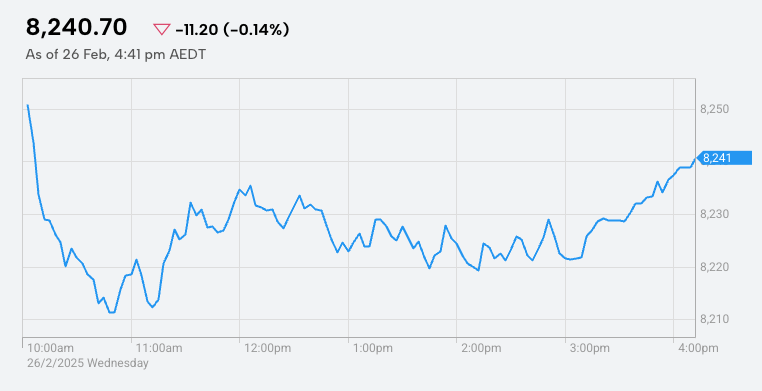
The S&P/ASX 200 closed down 11.2 points, or 0.14%, at 8,240.7 points following the release of January inflation data, recouping some of its earlier losses.
The index has lost 2.12% for the last five days, and sits 4.35% below its 52-week high.
The January monthly Consumer Price Index (CPI) indicator remained at 2.5% in January, below market expectations of 2.6% but above the ANZ’s predictions of 2.1%.
Monthly trimmed mean inflation edged up to 2.8%, from 2.7% in December 2024.
ANZ Senior Economist Adelaide Timbrell says the continued electricity rebate roll-off in Queensland, as well as the exclusion of fashion and household goods – which fell in price in January – in the February monthly CPI indicator measurement both add to risk of a stronger inflation print in February.
“Our current Q1 inflation forecast is 2.3% year over year for headline and 2.9% year over year for trimmed mean,” she says.
Six of the 11 sectors ended higher despite the broader market drop.
Materials was the hardest hit on news US President Donald Trump is now considering tariffs on copper.
Energy was the best performing sector, gaining 1.29% on Wednesday (26 February) and 2.07% over the past five days. Industrials closed up 0.51%.
Iron ore miner Fortescue (ASX:FMG) tumbled 6.23% to $16.86 while Champion Iron (ASX:CIA) slid 5.42% to $5.41.
Uranium miners also had a difficult session, with Boss Energy (ASX:BOE) retreating 4.41% to $2.60, Paladin Energy (ASX:PDN) dropping 4.39% to $6.97 and Deep Yellow (ASX:DYL) off by 4.07% to close at $1.06.
The S&P/ASX200 is Australia’s leading share market index and contains the top 200 ASX-listed companies in terms of market capitalisation, and accounts for about 80% of the country’s equity market. The index is designed to measure the performance of the 200 largest index-eligible stocks listed on the ASX by float-adjusted market capitalisation.
It is recognised as the institutional investable benchmark in the country.
Write to Angela East at Mining.com.au
Images: ASX & Unsplash