



The S&P/ASX 200 fell nearly 4% in February and has continued its run down into March.
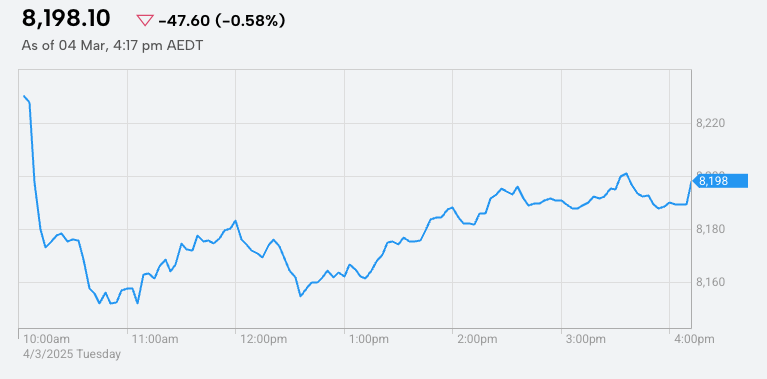
The index ended Tuesday (4 March) down a further 47.6 points, or 0.58%, at 8,198.1 points.
The index has lost 0.65% in the past five days, and has wiped off its year-to-date gains.
All sectors except health care ended in the red. Energy tumbled 3.17% after the Organization of the Petroleum Exporting Countries remained committed to its April production increase of 138,000 barrels per day.
ANZ says the consensus was that the group would postpone the restart, something that had already been done three times since the agreement was struck in June 2024.
The increase is the first of a number of planned monthly increases to reverse the previous 2.2 million barrels per day in voluntary production cuts made by major oil producing nations like Saudi Arabia and Russia.
Utilities fell 2.27% while materials closed down 0.67%.
The bottom performing stocks were diversified miner Mineral Resources (ASX:MIN) and uranium play Boss Energy (ASX:BOE), which fell 10.24% and 9.85%, respectively.
Major American investment group BlackRock sold down its stake in Mineral Resources and is no longer a substantial backer.
Lynas Rare Earths (ASX:LYC) and gold miner Regis Resources (ASX:RRL) escaped the pull of the broader market to close out the session up 2.91% and 2.22%, respectively.
The S&P/ASX200 is Australia’s leading share market index and contains the top 200 ASX-listed companies in terms of market capitalisation, and accounts for about 80% of the country’s equity market. The index is designed to measure the performance of the 200 largest index-eligible stocks listed on the ASX by float-adjusted market capitalisation.
It is recognised as the institutional investable benchmark in the country.
Write to Angela East at Mining.com.au
Images: ASX & Unsplash


