


ABx Group (ASX:ABX) believes it holds a province of clay-hosted rare earth elements mineralisation that is “exceptionally enriched” in terbium and dysprosium, which it says makes the province globally significant.
The discovery comes as the $10.53 million market capitalisation company has acted in response to three recent global events – the US issuing executive orders to incentivise processing of critical minerals, including REE in the USA; China restricting exports of rare earths, notably dysprosium and terbium, critical for military technologies and offshore wind turbines; and support for bold exploration initiatives by the Tasmanian government’s Exploration Drilling Grant Initiative (EDGI) grants.
ABx says its Tasmanian rare earth projects are suited to these opportunities because they are shallow, ionic absorption clay rare earth resources enriched in terbium and dysprosium. The company’s Deep Leads rare earth project near Exton in northern Tasmania contains an 89 million tonne resource grading 844 ppm total rare earth oxides (TREO) from only 29% of the mineralised outline.
Notably, desorption tests conducted by ANSTO found the highest extractions under relatively neutral conditions reported from any clay-hosted resource in Australia. Furthermore, the deposit contains 36ppm Tb + Dy, which ABx says is the highest grade of any ionic clay REE deposit in Australia and among the highest globally.
“This positions ABx well to help diversify the global terbium and dysprosium supply chain,” the company reports.

ABx notes that it already has strong relationships with planned processing operations in the US, such as Ucore (TSX-V:UCU).
Meanwhile, eight scout holes targeted by ABx’s REE exploration method were drilled in an area 52km east of ABx’s Deep Leads REE resource. Three of the eight holes intersected REE mineralisation that meet the cut-off grade used to estimate the Deep Leads resource, with the intercept in hole TB008 being highest grade.
Once ABx’s rare earth resources grew substantially, ABx developed a sophisticated exploration technology which was tested at four REE sites. This exploration technology identified several rare earth targets in ABx’s unexplored tenements EL27 and EL28 over 52km east of ABx’s Deep Leads REE resources.
The eight-hole scout drilling campaign tested two of the targets using a low-impact auger drill rig, which sampled shallow layers but did not always reach bedrock.
The EL27/2022 Temple Bar tenement is immediately south of ABx’s Portrush rare earth discovery, where hole PR033 returned similar ‘high-grade’ assay results of 2m averaging 3,057ppm total rare earth oxides (TREO) at 10m depth, including 1m at 4,812ppm at 11m depth, which is similar to these new discovery results.
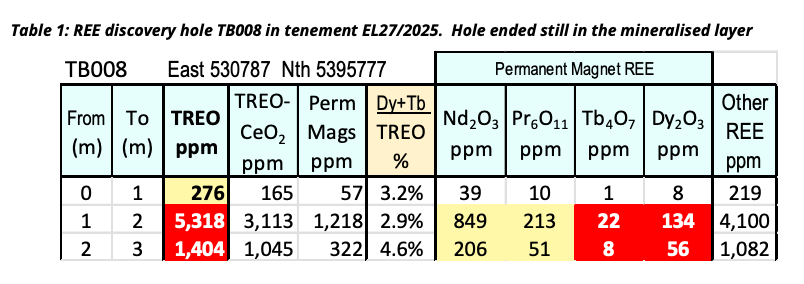
Holes TB008 and TB006 have the same geology as the Portrush mineralisation and the rare earths are near surface, immediately beneath a thin soil. Both holes ended in mineralisation.
The mineralisation in hole TB002 is most similar to the Deep Leads type of mineralisation. The area has excellent infrastructure and is about 30km south of Launceston city by sealed roads. The land is mainly sheep and cattle grazing properties.
ABx has more than 15 years’ experience working with graziers, always leaving the land better than found and operating in accordance with sound agricultural practices.
CEO Dr Mark Cooksey says because this tenement is very large, an easily transported trailer-mounted low-impact geotechnical auger rig was used, which could not always penetrate the full depth of the rare earth clay horizon. Nevertheless, these auger samples have confirmed that ‘high-grade’ rare earth mineralisation has been discovered in this area.
“ABx is stunned and delighted by discovering this shallow, high grade rare earth mineralisation so early in its exploration of the eastern tenements. It is especially exciting that all of ABx’s rare earth resources and discoveries in northern Tasmania are exceptionally high grade in dysprosium and terbium,” Cooksey says.
“No other Australian company holds an entire rare earth province that is so enriched in dysprosium and terbium, which is potentially globally significant. Our mission is to devise a low cost, low impact method of exploiting this rare earth province.
“China’s latest move to restrict exports of critical heavy rare earths, especially dysprosium and terbium, sends a clear message to the global market. ABx is in a unique position with a high-grade, clay-hosted rare earth deposit in a stable jurisdiction, with particularly high concentrations of dysprosium and terbium, that are vital for the production of military technologies and offshore wind turbines.
“This is recognised by the industry, for example our MoU to supply rare earth feedstock to Ucore which is planning a Strategic Metals Complex in Louisiana with the support of the US Government.”
Meanwhile, ABx will explore new ground with strong geological potential and advance its strategy to become a long-term supplier of rare earths. Cooksey says these developments put ABx at the forefront of Australia’s rare earths sector at a time of escalating global demand.
Write to Adam Orlando at Mining.com.au
Images: ABx