


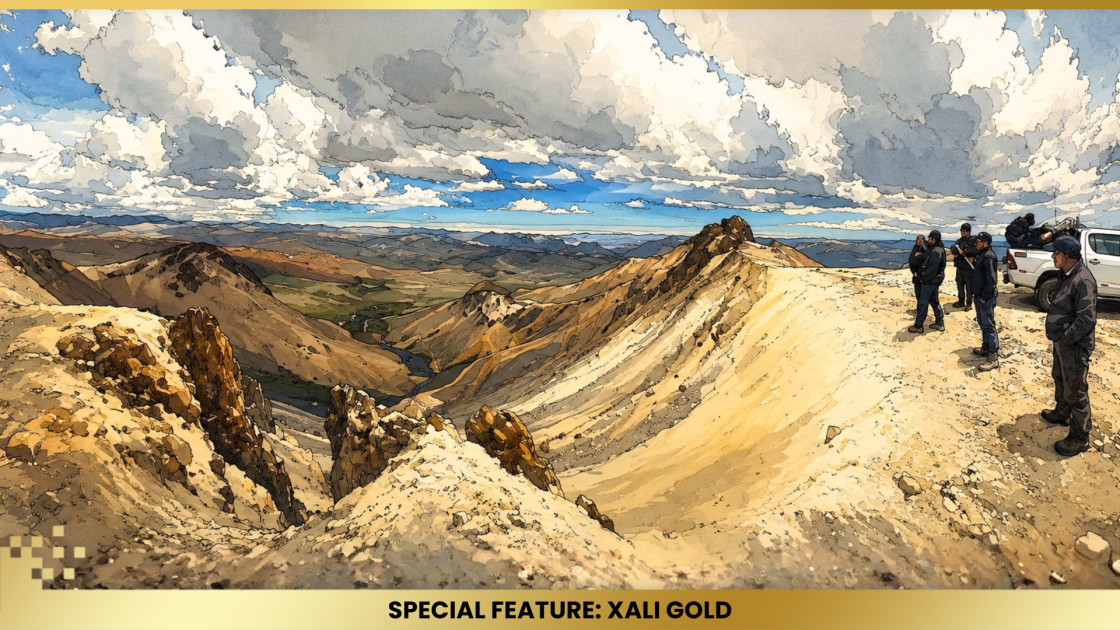
This article is a sponsored feature from Mining.com.au partner Xali Gold. It is not financial advice. Talk to a registered financial expert before making investment decisions.
Peru has long ranked among the world’s great mining nations, with its prolific gold and copper belts continuing to attract explorers seeking the next major discovery.
For Xali Gold (TSX-V:XGC), that opportunity is taking shape at the Pico Machay Gold Project, an advanced-stage asset in central Peru where years of historical exploration have outlined a sizeable gold resource and identified significant upside beyond the known deposit.
Backed by recent validation work and encouraging new sampling results, the company believes Pico Machay is moving steadily towards becoming a near-term development opportunity.
Leading that strategy is President and CEO Joanne Freeze, whose three decades of exploration experience in Peru provide technical confidence and a deep understanding of one of South America’s most prospective mining jurisdictions.
Having worked in the country since the 1990s, Freeze has seen Peru emerge as a global mining powerhouse and believes its next generation of discoveries will come from projects capable of building on strong historical foundations.
A project with history and upside
Pico Machay is no grassroots exploration play.
The 4,700-hectare project lies within the northern extent of the Southern Peru Epithermal Gold-Silver Belt, a globally significant geological province that hosts major gold deposits. These include the Pierina mine, owned by Barrick Gold (NYSE:B), and Yanacocha, South America’s largest gold mine, owned by Newmont (ASX:NEM).
Pico Machay also sits just 63km south of Minera IRL’s (CSE:MIRL) Corihuarmi gold mine in an established mining district that has supported operations for decades.
Exploration has already outlined a measured and indicated resource of 264,600 ounces of gold (Au) contained within 10.6 million tonnes grading 0.78 grams per tonne (g/t) Au, alongside an inferred resource of 446,000 ounces across 23.9 million tonnes grading 0.58g/t Au.

Discovered in 1997, Pico Machay was explored extensively by several companies, including Aquiline Resources, which completed drilling campaigns, metallurgical test work, and engineering studies targeting a low-strip-ratio, open pit heap-leach operation before the company was acquired by Pan American Silver (NYSE:PAAS).
For Xali Gold, acquiring an advanced-stage project with substantial work already completed significantly shortens the path towards development.
Much of the exploration completed to date focused on only one section of the mineralised system.
Nine additional exploration targets remain largely untested, offering considerable scope to expand the project’s overall resource base.
Freeze believes that the combination of Historical resources and exploration upside makes Pico Machay a compelling asset within the company’s portfolio.
“What the results show is that we have continuous gold mineralisation, which we knew because we’re in the middle of the resource, but we have higher grades than we were expecting,” Freeze says.
Validating historical work
One of Xali Gold’s first priorities after acquiring Pico Machay was confirming the integrity of the existing exploration database.
The company completed detailed due diligence involving site inspections, verification of drill collar locations using GPS, examination of geological outcrops, review of historical reverse circulation chip samples stored in Lima, and collection of new validation samples from across the project.
In total, 26 verification samples were collected, including surface rock chips as well as pulp and coarse reject samples from previous drilling campaigns.
According to the company, the work confirmed the quality of the historical geological model and the reliability of previous assay data.
The validation program also reinforced confidence that the historical dataset is sufficiently robust to support preparation of an updated National Instrument 43-101 mineral resource estimate, which is currently underway.
For Xali Gold, updating the historical resource represents an important milestone as the company advances towards future engineering studies.
Encouraging new results
While historical work provides the foundation, recent exploration is adding fresh confidence to the project’s development potential.
In June, Xali Gold reported the first assay results from an underground (UG) and surface channel sampling program designed to better understand mineralisation continuity across areas that had not previously been systematically sampled.
Among the standout results were 2.22g/t Au over 45.1m from UG Channel One, including 4.17g/t Au over 20m.
Another UG channel returned 4.41g/t Au over 13.7m, including 6.45g/t Au over 6.5m, while a surface channel intersected 2.28g/t Au over 40m.
At the time of reporting, assays had been received for only 51 of the 197 samples collected during the program, representing about a quarter of the total dataset.

Freeze says the results provide another important layer of geological understanding.
“While channel sampling differs from drilling, the systematic nature of the program and the ability to sample continuously across recently exposed mineralised zones provide valuable insight into the grade variation and continuity of mineralisation at Pico Machay,” she says.
“The results received to date further strengthen our confidence in the project.”
The remaining assays are expected in the coming weeks and will contribute to both the resource update and the company’s planned preliminary economic assessment (PEA).
Peru remains a global destination
Having spent much of her career working in Peru, Freeze believes the country’s greatest advantage remains unchanged.
“It was already a mining country,” she says.
“But when international exploration really started accelerating during the 1990s, the discoveries that followed completely changed perceptions of Peru.”
She points to world-class discoveries that established Peru among the world’s leading mining jurisdictions, helping create jobs, attract investment, and build one of the most experienced mining workforces in South America.
Today, that mature mining ecosystem continues to benefit companies developing advanced-stage assets such as Pico Machay.
Although permitting and project development require patience, Freeze believes Peru’s geological potential continues to outweigh the challenges.
“Those discoveries really put Peru on the map,” Freeze says.
“They demonstrated just how prospective the country is.”
For Xali Gold, Peru’s established mining history, existing infrastructure, and experienced workforce complement the geological opportunity presented by Pico Machay.
Building relationships for the long term
Alongside technical work, Xali Gold has placed considerable emphasis on community engagement.
The company inherited positive relationships established by previous operators, giving it an important foundation from which to continue building trust with local stakeholders.
Freeze says successful mining projects depend on understanding local priorities rather than imposing external solutions.
“The communities know what responsible mining can deliver,” she says.
“They want opportunities, but they also want to preserve their way of life.”
Rather than focusing solely on exploration-related employment opportunities, Xali Gold has been working with local communities to identify longer-term initiatives aligned with traditional livelihoods.
Those discussions have included supporting alpaca and vicuña fibre production, assisting community events, and exploring practical opportunities to improve education, training, and local economic development.

“The goal isn’t to replace the government,” Freeze explains.
“It’s about helping communities build stronger, more sustainable futures while respecting the lifestyle they want to maintain.”
The company also continues to employ local workers during exploration programs while maintaining ongoing dialogue with community representatives as project activities progress.
Looking towards development
With a modern resource estimate approaching completion, fresh sampling results continuing to arrive, and several exploration targets awaiting drill testing, Xali Gold believes Pico Machay is entering one of the most significant stages in its history.
Unlike many early-stage exploration companies, Xali Gold is advancing a project supported by decades of geological work, historical engineering studies, and a resource base that already provides a platform for future development.
The upcoming resource update and PEA will help determine the project’s next phase, while additional exploration offers the potential to expand mineralisation beyond the areas historically drilled.
For Freeze, the opportunity reflects the qualities that first attracted her to Peru more than three decades ago.
The geology remains exceptional, the mining culture is still deeply established, and projects with strong technical foundations continue to offer meaningful development potential.
As Xali Gold advances Pico Machay towards its next milestones, the company believes it is well positioned to contribute another chapter to Peru’s long history of gold discovery.
Write to Bruno Venditti at Mining.com.au
Images: Xali Gold


