


As Americans headed to the polls yesterday for the midterm elections, gold edged lower, with spot prices settling near US$3,927 ($5,627) per ounce.
Analysts are closely watching the election results. They point out that a Democratic sweep of the House could put pressure on the US dollar, impacting the ability of the Trump administration to pass laws.
“If the dollar falls, that’s one way gold could potentially find some support,” said Fawad Razaqzada, market analyst at Forex.com.
The link between elections and gold is often driven by uncertainty, as investors weigh the potential impact of political outcomes on fiscal policy, the US dollar, and broader market sentiment.
Financial platform Monetary Metals notes that the relationship between elections and gold is more complicated than just identifying which party wins. That said, historical election data provides an interesting backdrop with which to study the trends.
Gold prices often shift before, during, and after elections. However, in the US specifically, there hasn’t been a consistent pattern regarding the commodity’s performance.
Investor expectations typically hinge on an election outcome’s anticipated impact on monetary or fiscal policy.
What historical data says about gold and elections
Monetary Metals has tracked past data on gold’s performance in the days around an election, noting that it is “remarkably inconsistent”.
It references a dataset covering the gold’s cumulative behaviour between 1980 and 2024, covering 23 different US election cycles. It showed that the 72 hours surrounding an election — from the day before to the day after — saw gold rising 12 times, falling nine times, and remaining unchanged twice.
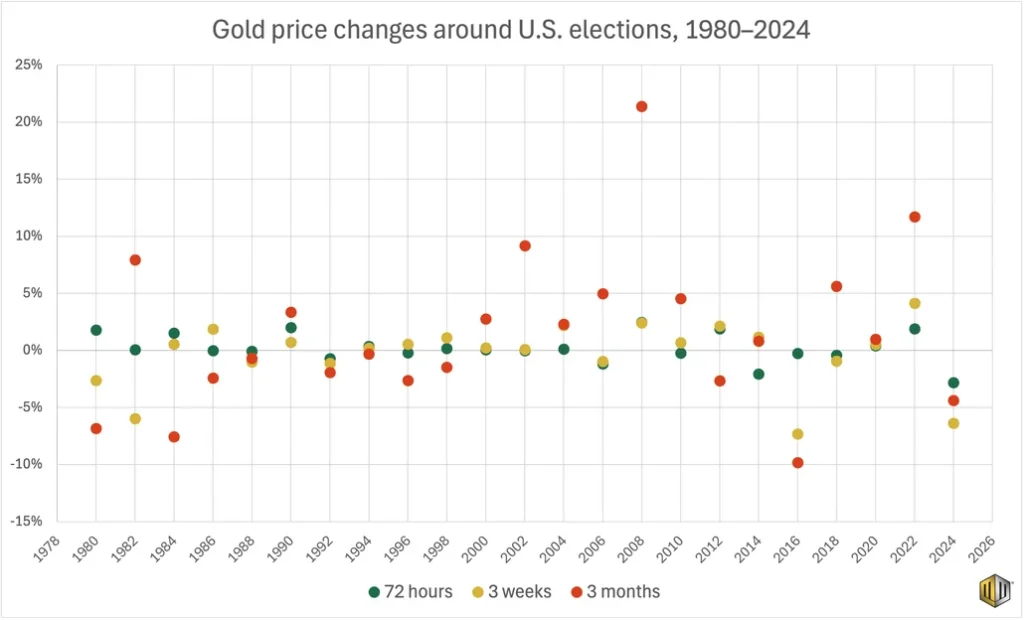
According to Monetary Metals, the largest increases occurred in 2008 and 1990. During these years, gold rose 2.46% and 2.02%, respectively. Meanwhile, the largest declines occurred in 2024 and 2014, which saw drops of -2.28% and -2.06%, respectively.
While elections can drive sharp price changes, Monetary Metals notes that the five decades of data show no consistency in that direction.
Looking farther afield, the platform also tracked gold’s performance from October to December in an election year, with elections always taking place in November.
Between these months, gold rose in 12 of 23 election years, with the average price change at around 1.52%. The strongest rises occurred in 2008 (21.40%) and 2022 (11.71%), while the largest decline was recorded in 2016 (-9.83%).
The swings in 2008 are notable. The election during this year transpired amid a global financial crisis, which led central banks to slash interest rates to historic lows and implement loose lending standards to stabilise global markets.
Monetary Metals has also tracked gold’s price in relation to party politics, noting that there was no consistency when either Democrats or Republicans took majorities.
The platform has likewise looked at gold’s response during midterm elections versus presidential elections. Based on its review, the midterms produced stronger average returns, especially over that three-month (October to December) window.
Write to Amy Rotman at Mining.com.au
Main image: Reuters


