


Part two of a three-part series on strategic communication in the resources sector.
By Tristan Gray
2024 was a bad year for mine fatalities in Australia. Ten people lost their lives, almost double the previous year, and 39% above the five-year average. Mining is the third-deadliest industry in the country, with a fatality rate of 3.4 deaths per 100,000 workers. Across all industries, 2023–24 produced more than 146,700 serious workers’ compensation claims.
Behind those numbers sits an uncomfortable truth that every site manager knows but few say out loud: a great deal of mine safety still depends on whether the right person, on the right shift, explained the right thing in the right way. And that, says communications strategist Darryl Anderson, is exactly the kind of problem that good content is built to solve.
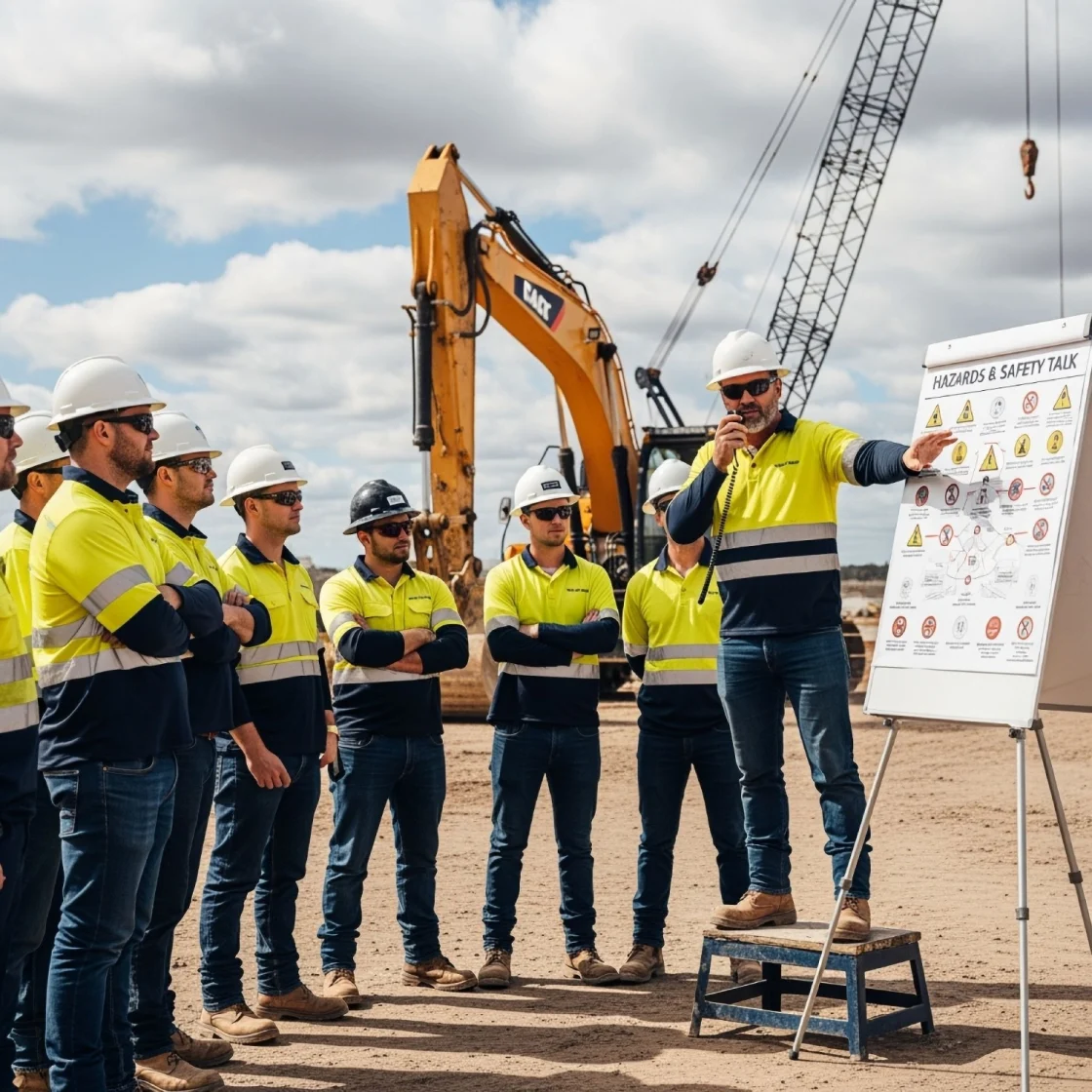
“Toolbox talks and other onsite training use up resources; they use up a person’s time,” says Anderson, Chief Executive of Anvil Media. “They can also be very, very inconsistent, and sometimes they contain things that are wrong. They can’t be relied on to present things in the best way.”
The case for taking the human variable out
Anderson’s argument is not that frontline supervisors should be replaced; it is that they should not be the single point of failure for a safety-critical message. A toolbox talk delivered by a brilliant trainer on a day shift is a different product from the same talk delivered, tired and rushed, by a stand-in on a night shift at a mine 2,000 kilometres away.
“Video content that’s carefully written and produced is 100% compliant 100% of the time, and 100% scalable,” he says. “You’ve got the same machines, the same workshop systems, the same protocols in five mines around the country. You can get it right every time, scale it right across your network, and you reduce your reliance on people’s personality and their ability to do training well.”
Crucially, he doesn’t see this as making the trainer redundant. He sees it as freeing them up.
“You’re not removing the idea of the toolbox talk, you’ve still got a person,” he says. “But you show the video, and then the talk becomes more productive and more directive. Everyone’s seen the same thing, so you get more out of the conversation.”
It is the same logic that has driven the broader shift to video-based induction across the sector: One Anvil client, building-maintenance firm GDP Group, replaced face-to-face onboarding with an eLearning module built around roughly 20 short videos. It has been completed more than 1,000 times since 2022, delivering identical training to workers anywhere in the country and saving the company thousands of hours of in-person instruction.
There is also a hard economic case beneath the safety case. The widely cited, if directional, finding that viewers retain around 95% of a message delivered by video, against roughly 10% from text, originates in a small survey by agency Insivia rather than a controlled study. But the pattern it describes is consistent across the research: people remember what they see and hear far better than what they read.
In a safety context, retention is not a marketing metric. It is the difference between a procedure that is followed and one that is forgotten.
When the story is the strategy
In the first article in this series, Anderson made the case that strategic communicators should be wary of defaulting to storytelling, that “it’s all about the story” is often the lazy answer. Safety, he says, is where that rule has its most important exception.
He points to a project for equipment giant Komatsu that was built around a real-life workplace incident: a service technician working underneath a truck, releasing a protection plate from beneath the sump.
“The little safety chain had fallen off, so as soon as he released the bolt, the protection plate crashed down on his head,” Anderson recounts. “He had a helmet on, and that saved him, but he still needed to be hospitalised. The guy didn’t die, but they could have. And the impact it had on his family and workmates was very real.”
The video told that story, but it did more than dramatise a near-miss. It walked through what happened afterwards: the review, the analysis, what changed, and how the company’s “stop and take five” process is meant to work even when an incident looks minor.
“On that occasion, story was very much the answer,” he says. “But coming back to my point about story versus strategy, it was a strategic use of story.” The emotional weight earned the audience’s attention; the procedural content did the actual safety work. A pure piece-to-camera reciting the policy would have done neither.
Showing what can’t be filmed
Some safety messages can’t be delivered by pointing a camera at the real thing, and this, Anderson says, is where the medium earns its keep through animation and graphics.
“If you’ve got a machine with a hole you shouldn’t put your hand in because there are great dirty gears in there that’ll mangle it, you can’t film what that looks like inside,” he says. “So you animate it. That’s how you show why you shouldn’t put your hand in the hole.”
The same applies to abstractions, the split-second mental context behind a decision to act safely, or the way a system fits together, that simply cannot be photographed but can be drawn.
The flip side is that plenty of safety content remains stubbornly physical and is best shown, not merely described. “If you need to show three points of contact going up a ladder into a haul-pack truck, two hands and one foot, then two feet when you move your hands. that’s very show-and-tell,” he says. The skill is in knowing which job each media tool is for. Most operations don’t have that judgement in-house.
The multilingual, multi-shift reality
Australian mine sites are increasingly multilingual, multi-shift, and high-turnover — conditions that punish inconsistent messaging. Historically, producing safety content across languages meant shipping English scripts to translators and waiting days for them to come back.
Anderson says that bottleneck is dissolving.
“We used to send English scripts out to translators and wait. Now, at a first pass, you can do that straight in the edit suite,” he says, citing a current project featuring a Chinese-speaking interviewee where his team generated the translation in-house and sent it to the client purely to correct, rather than to create from scratch.
He is careful not to oversell it. “Machine translation is not 100% the answer“, he says. But the steps to an accurate, properly subtitled or dubbed safety video are now far more streamlined. That makes consistent messaging across a diverse workforce cheaper and faster to achieve than it was even a few years ago.
None of this removes the regulator from the room. Mining is heavily regulated, and content has to satisfy work health and safety legislation while still holding the attention of the frontline worker it’s meant to protect. Anderson’s answer is that those two goals are not in tension when the content is built properly — a compliant message that nobody watches is worth as little as an engaging one that’s wrong. The skill, as in investor relations, is in the strategy that comes before anyone turns on a camera.
Next in this series: the hardest communication challenge in mining — earning and keeping a social licence with the communities and traditional owners who live where the industry operates.
References
- Safe Work Australia, Key Work Health and Safety Statistics Australia 2025 and Mining industry dashboard — 2024 mining fatalities, fatality rate, serious claims. https://data.safeworkaustralia.gov.au/insights/key-whs-statistics-australia/latest-release
- Mining.com.au reporting on 2024 mining fatalities (10 deaths, 39% above five-year average). https://mining.com.au/deadly-start-to-2025-global-mining-fatalities-surge/
- Insivia, Why does video convert better than text? — origin and limitations of the 95% vs 10% retention figure. https://www.insivia.com/why-does-video-convert-better-than-text/
- Anvil Media, Video That Converts — GDP Group induction case study (20 short videos, 1,000+ completions since 2022).

