


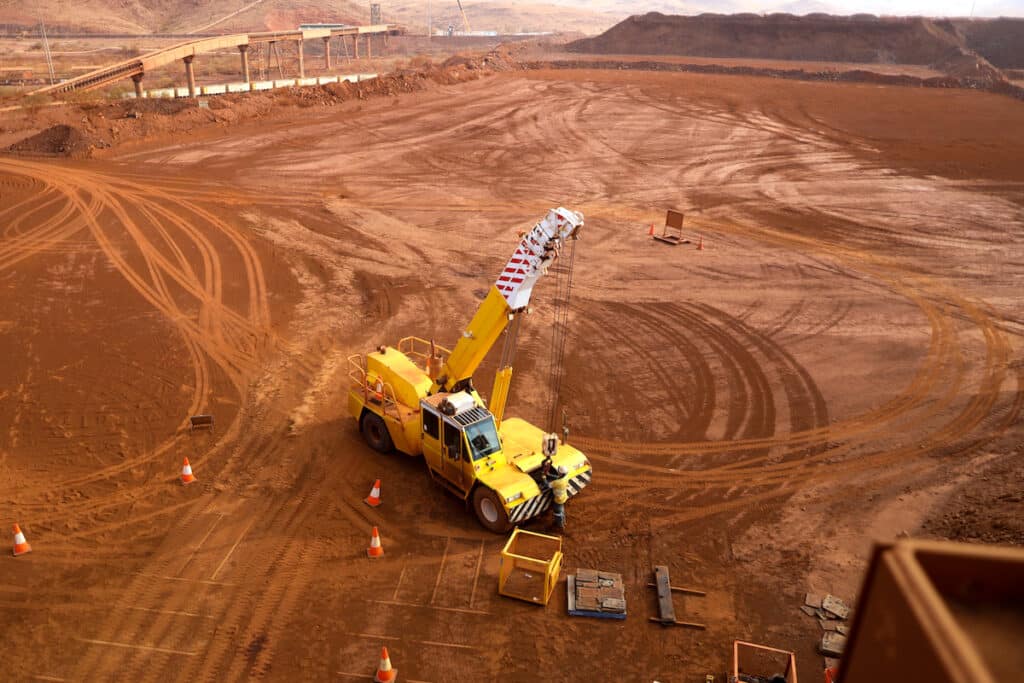
In December 2024, a 40-tonne Franna crane rolled over at a Queensland coal mine while relocating a 20-tonne crawler track. Investigators found the crane had been operating at more than 250 percent of its rated capacity at the time it went over. Incidents like this rarely come down to a single dramatic failure. They come down to a gap somewhere in the chain: a load that wasn’t verified, a blind spot the operator couldn’t see around, or a capacity limit nobody was actively monitoring in real time.
Regulators covering the resources sector have flagged the same pattern repeatedly. High potential incidents involving lifting and rigging, chain blocks, lever hoists, loads being drifted overhead, keep surfacing in the same categories: workers struck or nearly struck by suspended loads, and equipment pushed past what it was rated to carry. A dropped load, a tip-over, or a collision doesn’t just risk injury. It can shut down a section of a mine for days, which turns a safety failure into a production one almost immediately.
Crane Safety Products, based in New South Wales, has built its business around closing that gap, not through a single product but through the combination of load verification, load monitoring, and vision systems that together address why lifting incidents actually happen.
Why Lifting Incidents Keep Recurring
The three failure points regulators keep citing map fairly cleanly onto three distinct gaps in equipment.
The first is unverified capacity. A crane’s rated load is a design figure, not a guarantee, and that rating only holds if the equipment has been proof tested and the load itself has been accurately weighed before it leaves the ground. Skip either step and the operator is working from an assumption rather than a measurement.
The second is the absence of real-time monitoring once the lift is underway. A rated capacity printed on a data plate doesn’t account for wind loading, ground conditions, or a load that shifts mid-lift. Without a system actively tracking actual load against safe working limits as the lift happens, the crane’s own limits become theoretical.
The third is visibility. Cranes have structural blind spots by design, and mine sites add uneven ground, other mobile plant, and pedestrians into the mix. Most struck-by incidents involving suspended loads trace back to someone, the operator, a dogman, or a nearby worker, not seeing what was directly in the crane’s path.
Verifying the Load Before It Ever Leaves the Ground
Crane Safety Products has built one of the country’s larger supply lines for water load bags, used to proof test cranes, davits, gangways, and lifting platforms before they’re put into service. Filling a bag with water to simulate a rated load lets a site confirm equipment actually holds the capacity it’s certified for, rather than trusting a certificate that may not reflect current condition. The same testing principle extends to load cells and load pin instrumentation, supplied through partners including Euroload and Delphi Measurement, which give sites a way to independently confirm weight rather than relying on the crane’s own indicated figures.
That verification step matters more on a mine site than almost anywhere else, because the consequence of a wrong assumption isn’t a delayed shipment. It’s a rollover.
Monitoring the Lift as It Happens
Verification before the lift is only half the picture. Crane Safety Products distributes Rayco Wylie’s monitoring systems, which track load against rated capacity throughout the lift itself and are built for straightforward calibration and operation without specialist software. Onboard weighing technology from partners like Outset extends the same principle to earthmoving and haulage vehicles, giving sites continuous visibility of load and tyre condition rather than a single static reading.
The value of this kind of system isn’t the technology itself. It’s that it removes the gap between what a crane is rated to lift and what an operator actually knows about the load in the moment, which is precisely where the Grosvenor-style overload incidents originate.
Closing the Blind Spot
The third piece is vision. Crane Safety Products is one of Australia’s larger suppliers of Dakota Micro’s ruggedised camera systems, built to survive the vibration, dust, and moisture of a working mine site rather than failing at the moment they’re needed most. Wireless hook block cameras from HoistCam put a live feed of the load itself into the operator’s cab, while blind spot and pedestrian detection systems from Motec, Brigade, and SEEN Safety address the ground-level visibility gap around mobile plant more broadly.
None of these systems replace competent rigging or a properly planned lift. What they do is remove the specific conditions, an unverified load, an unmonitored capacity limit, an unseen hazard, that keep showing up in the incident reports regulators publish year after year.
A Single Point of Accountability
Sites running lifting operations typically end up sourcing load testing, monitoring electronics, and camera systems from separate vendors, each with its own service contact and lead time. Crane Safety Products, established in 2014, has built its model around consolidating that supply chain into one accountable relationship, sourcing components from more than a dozen manufacturing partners while maintaining local support and a strong preference for Australian-made product where it exists. For a site trying to close the gap between what a crane is rated to do and what actually happens during a lift, that consolidation is often as valuable as any single piece of equipment on the list.
Image Credit: cranesandlifting.com.au

