

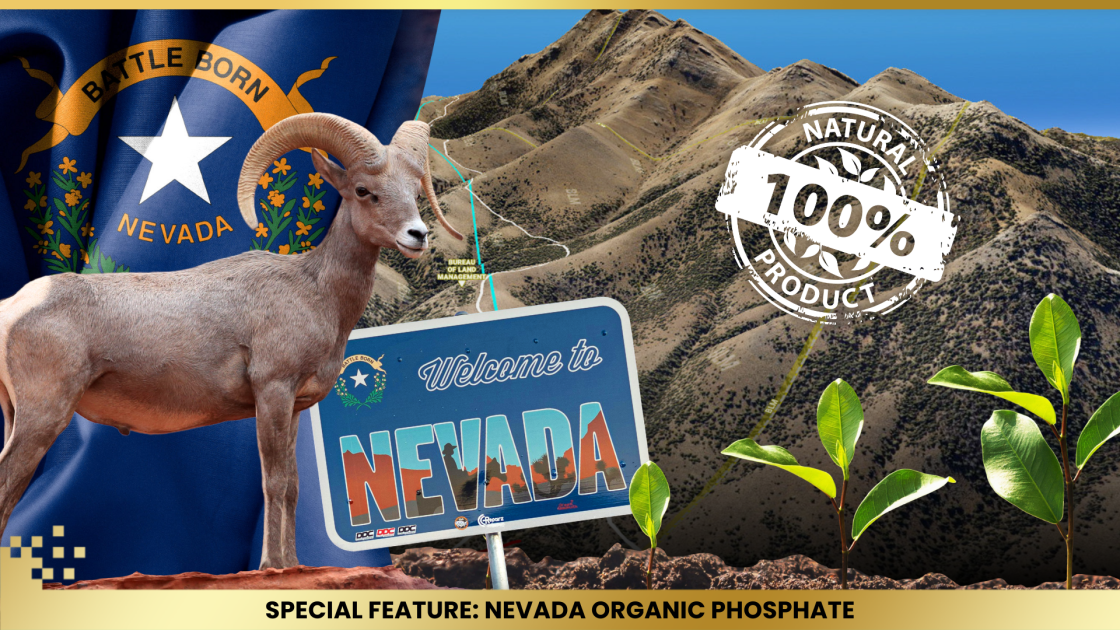
This article is a sponsored feature from Mining.com.au partner Nevada Organic Phosphate. It is not financial advice. Talk to a registered financial expert before making investment decisions.
Nevada Organic Phosphate (CSE:NOP) is positioning itself at the forefront of a significant shift in global agriculture with the accelerating demand for clean, organic, environmentally responsible fertiliser.
Nevada Organic Phosphate has what they believe to be the only organic sedimentary deposit of organic phosphate in the world of any consequence. Robin Dow, Chairman and CEO of Nevada Organic Phosphate notes that there is some organic phosphate production in Brazil, a project of about 50-75 million tonnes, which is consequential to Brazil but won’t impact the market elsewhere.
“The phosphate market tends to be a localised market,” Dow says.
Globally, the market for phosphate fertiliser, predominantly mono- and diammonium phosphate is approximately 75 million tonnes per year, with most production coming out of China. The rest of it comes mainly from India, Gabon, and Morocco.
“The phosphate you get from sedimentary deposits like those in Morocco are contaminated with cadmium thorium uranium, which is really radioactive,” Dow says.
Dow explains the beneficiation process for these types of deposits which can take, for example, five tonnes of phosphate rock and, after beneficiation, you end up with one tonne of pure phosphate acid and four tonnes of phospho-gypsum, which is radioactive and cannot be used.
Additionally, with mono- and diammonium phosphate, the molecules are soluble in the rain, so the chemical acid can run off into lakes and rivers and often causes huge algae blooms.
What Nevada Organic Phosphate has, on the other hand, is pure organic direct application raw rock phosphate.
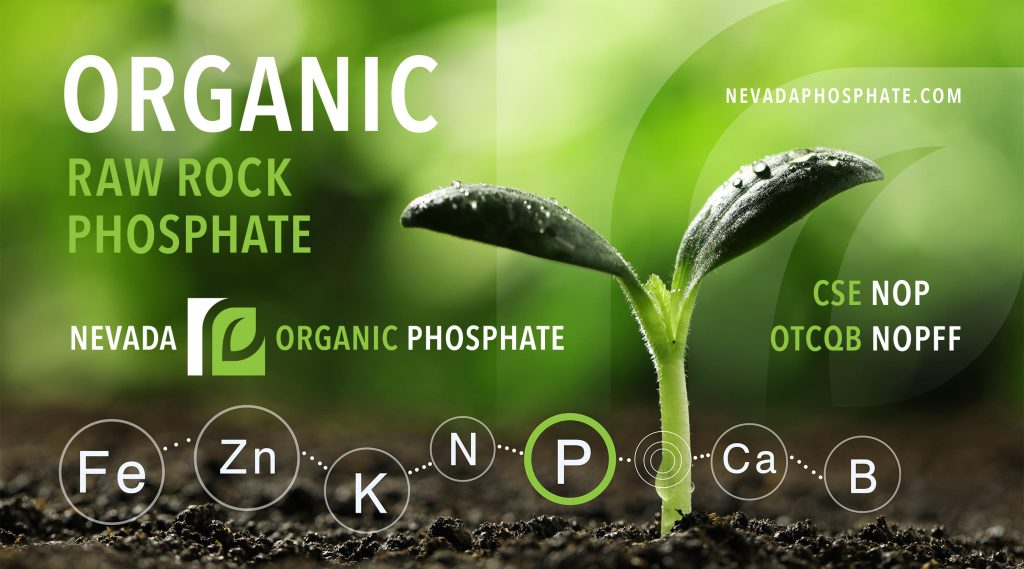
How direct application phosphate works
Dow explains that this means that the phosphate the company has doesn’t have any heavy minerals in it and it doesn’t need to be processed.
Nevada Organic Phosphate and Dow have a mantra for how to run this business.
“We dig it up, grind it up, bag it up, and ship it out,” says Dow.
“We take the phosphorus-bearing rock and grind it down to pebble size rocks. We load those rocks into a four cube bag, pick up that bag with a forklift, take it across the street to the Union Pacific Railyard, and put it in a rail car.
“When the rail car is full, we ship it off to California or the Carolinas, or Georgia, whichever organic opportunity works.”
Dow explains that with the company’s Murdock Mountain Project in Nevada, Nevada Organic Phosphate has about 13% phosphorus pentoxide. That gets blended down to 8% and then can be spread directly on the fields.
“The microbes in the soil break down the rock into sand. It regenerates the soil and then that activity also creates carbon capture,” Dow says.
Dow says that the company believes it may be the only major organic phosphate producer in the world.
This is important because organic farmers need organic inputs and the only alternatives at the moment are bone meal and processed manure.
The rise of organic farming in the US
The organic movement is growing and, within the US at the moment, it fits very well with today’s political environment and the ‘Make America Healthy Again’ movement, which is big on organic food options.
Dow says that Nevada Organic Phosphate is really leading the charge on organic farming using phosphate.
“We’re going to have the only large sedimentary organic phosphate deposit in the world and it’s right here in our backyard,” Dow says.
“It’s simple to mine with no waste, no water consumption, and the product that’s mined is consumed 100%.”
On 18 January, US President Trump invoked the Defense Production Act on elemental phosphorus and herbicides, noting the criticality of phosphorus in defence supply chains and as crucial for military readiness and national defence.
Putting elemental phosphorus on the map of critical minerals highlights the growing focus on the agricultural sector and the necessity of having domestic supply.
Inside Murdock Mountain
Murdock Mountain is based in Nevada, an incredibly mining-friendly state. That said, the Bureau of Land Management (BLM) owns between 40-60% of the land there.
Dow explains that there are two different types of opportunities in Nevada, locatable minerals such as gold, silver, and base metals which you can stake, or leasable minerals such as phosphate, potash and oil and gas, which are leasable.
Nevada Organic Phosphate already has one lease that’s in process with the drill permit already approved, with another three in application.
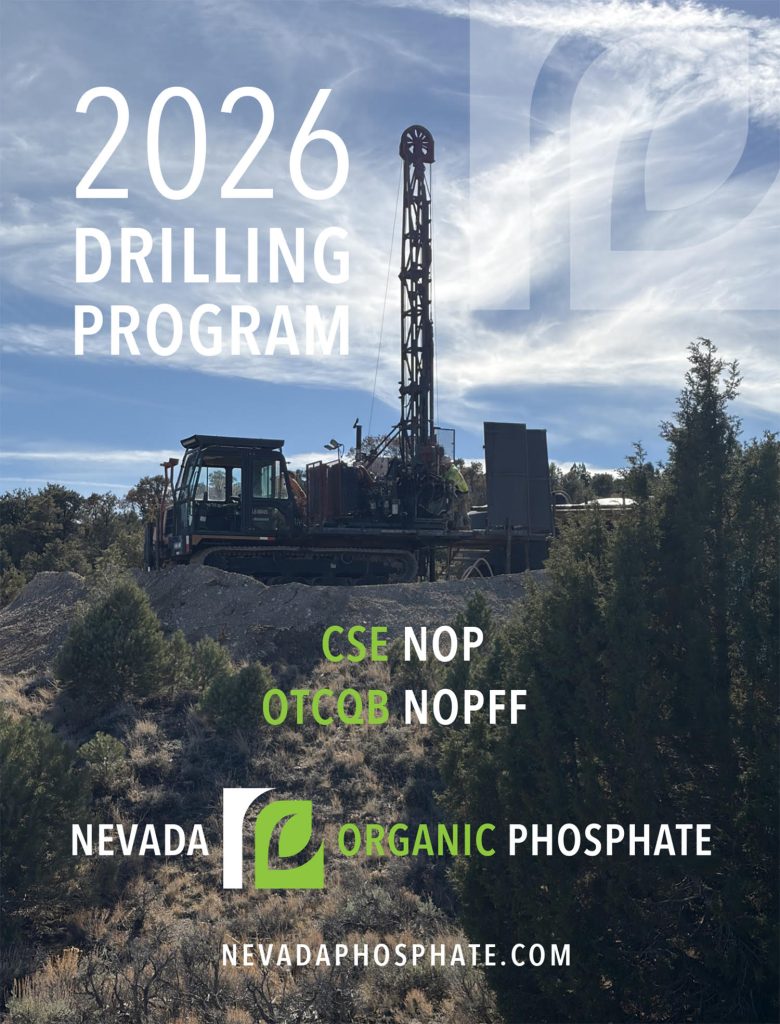
With the one drill permit in hand, Nevada Organic Phosphate plans to start drilling in April 2026.
In the meantime, the company is focused on fixing the road and getting drill pads in place in order to be able to start drilling on 1 April. The plan is to finish drilling between six and eight holes on 6km of Area A, and then subsequently moving on to areas B, C, and E when the second permit is received, then permits three and four will push drilling to the north.
With the first set of drilling the company had a successful run with six holes over 1.5km. Dow notes that it gave them a good sense of where the mineralisation occurs.
Dow also says that the results were homogeneous across all six holes, with the top of the first hole and all succeeding give holes resulting in a 4m intersection at 13% phosphorus pentoxide. Within the bottom of the sixth hole, the results indicated a 4m intersection with 17% phosphorus pentoxide.
Dow says that the company hopes to continue to see that second layer coming through with the next set of drillholes, which could lead to a doubling of potential from approximately 200 million tonnes to four or 500 million tonnes.
“What we found is homogeneous and contiguous,” Dow says.
“Everything was side by side and the trend of the phosphorus was the same no matter where we drilled, except in hole 6 where we got the extra 17%.”
Building the case for a world-class deposit
Nevada Organic Phosphate has plans in place to step up exploration once the winter season is over.
“We don’t talk about development right now because we’re still in the proof of concept phase,” Dow says.
“We’ve proved it’s phosphate, proved it’s organic, and now we have to prove how big it is.”
Nevada Organic Phosphate is fairly well funded for this next phase of exploration, though Dow notes that they will need to raise a few million more as work progresses.
“Once we finish this next 30km, everybody will know who we are and what we have,” Dow says.
“We’ll have a world-class, world-size opportunity in Northeast Nevada that nobody else has, and that the organic market demands.”
Write to Amy Rotman at Mining.com.au
Images: Mining.com.au & Nevada Organic Phosphate