



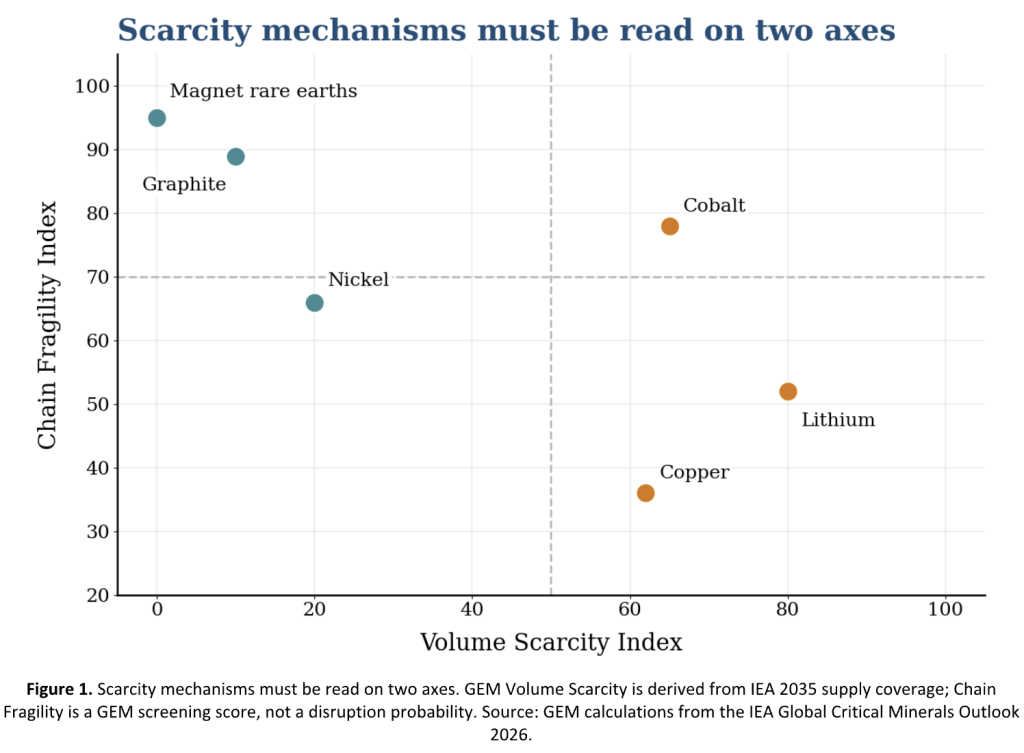
GEM Mining Consulting analysed six critical mineral supply chains, revealing two distinct problems: whether enough primary tonnes are likely to exist and whether those tonnes can reach users in the required product form.
Using the International Energy Agency’s (IEA) 2035 supply outlook and a GEM screening framework, copper, lithium, nickel, cobalt, battery grade graphite, and magnet rare earths were all analysed.
The expected 2035 mined or raw supply covers only 68% of primary lithium requirements, 74% for cobalt, and 75% for copper. Yet, graphite and magnet rare earths appear close to or above aggregate requirements, while remaining heavily exposed to dominant processing hubs and weak diversified supply routes.
GEM Mining says the word scarcity describes different investment and policy problems.
Against this backdrop, mining companies searching for new sources of copper, lithium, nickel, cobalt, graphite, and rare earths are becoming increasingly important in addressing future supply challenges.
The differing challenges across these mineral chains highlight that there is no single solution to securing future critical minerals supply. For resources such as copper, lithium, and cobalt, the focus is increasingly on requiring more dependable project delivery, as reported by GEM Mining.
From exploration and resource definition through to financing, permitting, construction, and production, companies advancing projects in these sectors will be critical in bringing new tonnes of supply online to meet projected demand.
Copper
Global copper demand is projected to surge more than 70% from 2021 to 2050, driven largely by data centres and the energy transition.
To date, roughly 700 million tonnes (Mt) of copper has been produced globally, as previously reported.
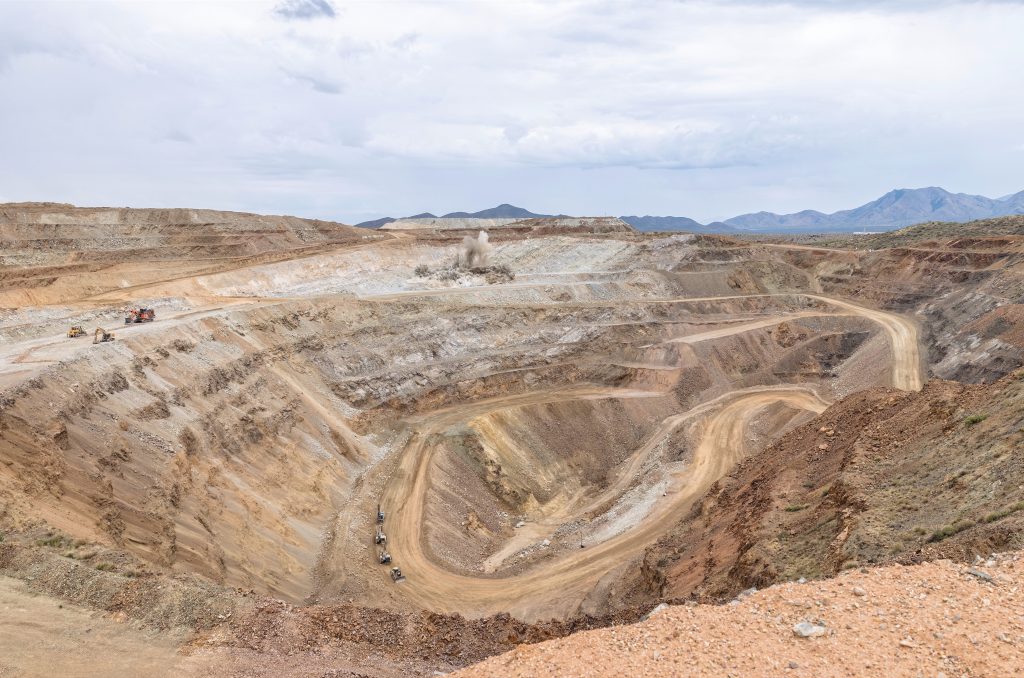
With demand forecast to continue rising, Gunnison Copper (TSX:GCU) is one of many emerging producers, following the start of production and sales at its Johnson Camp mine in the US.
The Johnson Camp mine began production in 2025 and is currently producing copper cathode from run-of-mine oxide material and Nuton bioleaching technology and sulphide material.
Gunnison Copper is also developing its namesake project, located in Arizona, which is a fully vertically integrated operation producing finished copper cathode onsite.
A previously conducted preliminary economic assessment outlines the project to have a post-tax net present value of US$2 billion ($2.83 billion) and an internal rate of return of 22.5% at a long-term copper price of US$4.60 per pound.
Gunnison will produce 99.999% pure copper cathode, with an average annual copper cathode production of 174 million pounds for the first 15 years. This is equivalent to more than 11% of the current US domestic refined copper metal production from mineralised material. The total copper production is estimated to be 3.2 billion pounds over a 21-year period.
Lithium and cobalt
Global lithium demand is also projected to double between 2025 and 2030, reaching around 3.7Mt of lithium carbonate equivalent from 1.6Mt.
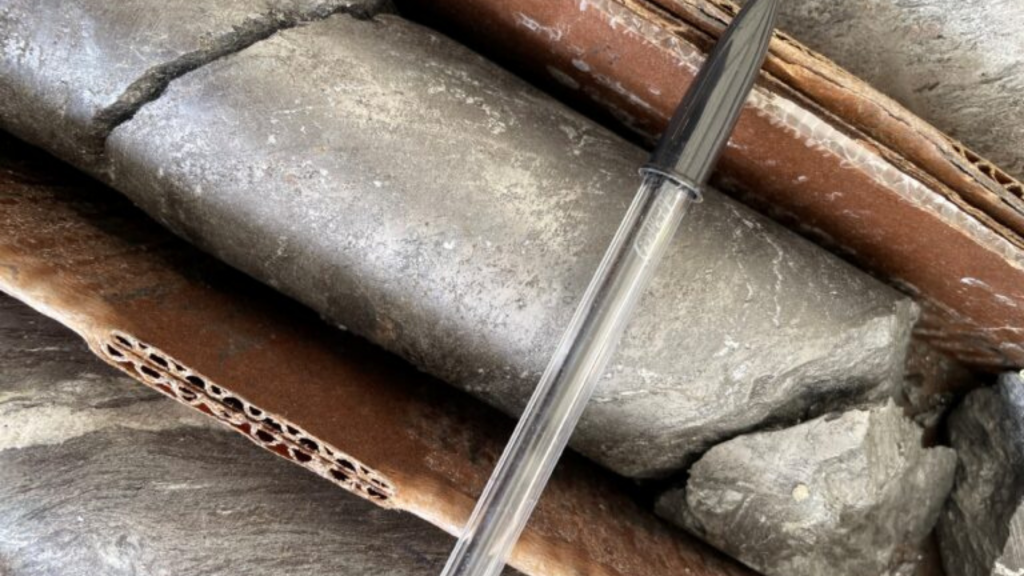
On the exploration front, Lake Winn Resources (TSX-V:LWR) is focused on developing and advancing the Little Nahanni Pegmatite Group (LNPG) Project in Canada.
Little Nahanni, covering 97km2, consists of a system of branching swarms of dykes that extend over 7km of exposed strike length and up to 500m in width.
CEO Patrick Power says the project provides exposure to lithium, tantalum, and tin.
“Our focus is to advance an exploration and drill program on LNPG that better defines the scale and potential of this pegmatite system,” Power says.
As reported, Lake Winn is planning to undertake drilling at the project this year, to test the Alpha Prime target. Alpha Prime was recently identified as a high-priority pegmatite target, extending 7km in strike length and 80–120m in width.
Geophysics and soil sampling indicate potential continuation of the known Nahanni pegmatite system into underexplored ground.

Meanwhile, cobalt production is constrained by strict export quotas and concentrate bans prompted by the Democratic Republic of the Congo, which produces around 80% of the world’s supply.
According to the Energy Transitions Commission, cobalt demand from electric vehicles alone could increase six-fold by 2030, with total cobalt demand expected to increase two to three times current levels.
Cobalt Blue (ASX:COB) is an Australian mining and minerals processing company developing an integrated critical minerals platform. The company’s platform spans resource development, refining, and technology innovation.
The company’s Kwinana Refinery is Australia’s first cobalt refinery, aiming to produce cobalt sulphate for lithium-ion batteries and cobalt metal. Further, Cobalt Blue’s Broken Hill Cobalt Project in New South Wales is a large development asset, designed to supply vertically integrated feedstock to Kwinana.
With federal major project status renewed in July 2025, Cobalt Blue is continuing to advance environmental approvals and feasibility studies at Broken Hill.
Broken Hill hosts a global resource of 126.5Mt @ 867 parts per million cobalt-equivalent for 87,000 tonnes of contained cobalt, 9.51Mt sulphur and 17,000 tonnes of nickel.
Graphite and rare earths
Meanwhile, graphite and magnet rare earths face a very different challenge in comparison to copper, lithium, and cobalt. Supply security for these resources depends not only on new discoveries, but also on the development of processing capability, specialised technology, equipment, and customer networks outside dominant global hubs, as reported by GEM Mining.
For companies operating in these sectors, the ability to build integrated supply chains and move beyond the mining stage is considered the key differentiator.
Graphite One (TSX-V:GPH) is focused on advancing a fully integrated US supply chain anchored by the Graphite Creek deposit in Alaska, with processing planned in Ohio.
On 20 July, US President Trump announced an executive order expanding federal efforts to strengthen domestic sourcing of critical materials essential to national defence and advanced manufacturing.
The US is currently 100% import dependent on natural graphite, which is one of the most strategically important critical minerals supporting defence systems, batteries, AI infrastructure, grid-scale energy storage, and advanced manufacturing.
CEO Anthony Huston says the company has been executing a strategy built around the premise that the US requires a secure, fully domestic graphite supply chain.
“We are building an integrated US graphite platform designed to connect America’s largest known graphite resource with domestic advanced anode materials manufacturing and, ultimately, recycling,” Huston says.
For rare earths, Ionic Rare Earths (ASX:IXR) focuses on a circular, traceable supply chain by pairing magnet recycling technologies with heavy rare earth separation.
The company’s Makuutu Project, located in Uganda, is described as ‘one of the largest’ ionic adsorption clay deposits in the world. The project is expected to become a long-life producer of strategic elements that will support global policies focused on establishing alternative, sustainable rare earths supply chains.
Makuutu’s basket contains a high proportion of magnet and heavy rare earths, including a near-perfect split of magnet rare earths: neodymium, praseodymium, dysprosium, and terbium.
Nickel
Nickel further demonstrates the complexity of critical minerals markets, where overall availability does not translate into supply chain resilience, GEM Mining says.
While aggregate supply may appear sufficient, concentrated refining capacity and limited diversification continue to present challenges.
Vale SA (NYSE:VALE) operates major integrated mining and processing facilities in Canada and Brazil, as well as downstream refineries in Wales and operations in Asia.
In December 2025, Vale’s subsidiary Vale Base Metals and Glencore Canada (LSE:GLEN) signed an agreement to jointly evaluate a potential brownfield copper development project in the Sudbury Basin. The project comprises a mine extension to develop copper and nickel orebodies and is in the Feasibility Study stage.
The project is an extension of Glencore’s underground Nickel Rim South mine and will develop access and infrastructure for mine orebodies from existing infrastructure.
Vale has also created a new consortium of owners that will invest up to US$200 million to secure the future of nickel mining and jobs in Thompson in north-central Manitoba, Canada.
Exiro Minerals, Orion Resource Partners, and Canada Growth Fund will form a new company alongside Vale Base Metals to invest in the Thompson Mine Complex. Vale will own an 18.9% minority stake, while the other three companies will own 81.1% collectively.
Vale also signed an offtake agreement for the nickel concentrate produced at the Thompson mill to maintain its strategic position as a Canadian nickel producer.
These differing market dynamics are creating opportunities across the mining sector. From explorers to seeking the next generation of critical mineral discoveries, to developers advancing projects towards production, and established producers looking to expand capacity and strengthen supply chains.
“Reserves are not supply. A tonne becomes strategic only when it can be financed, permitted, mined, processed, qualified, and delivered through a resilient chain,” GEM Mining says.
“That is why copper can face the clearest global volume deficit while graphite and magnet rare earths remain the most fragile supply chains.”
GEM Mining Consulting is an industrial engineering company focused on driving the development of the mining industry through solutions in management and economics.
Write to Aaliyah Rogan at Mining.com.au
Images: iStock, Gunnison Copper, Lake Winn Resources, Graphite One, and Global Nickel Market


