


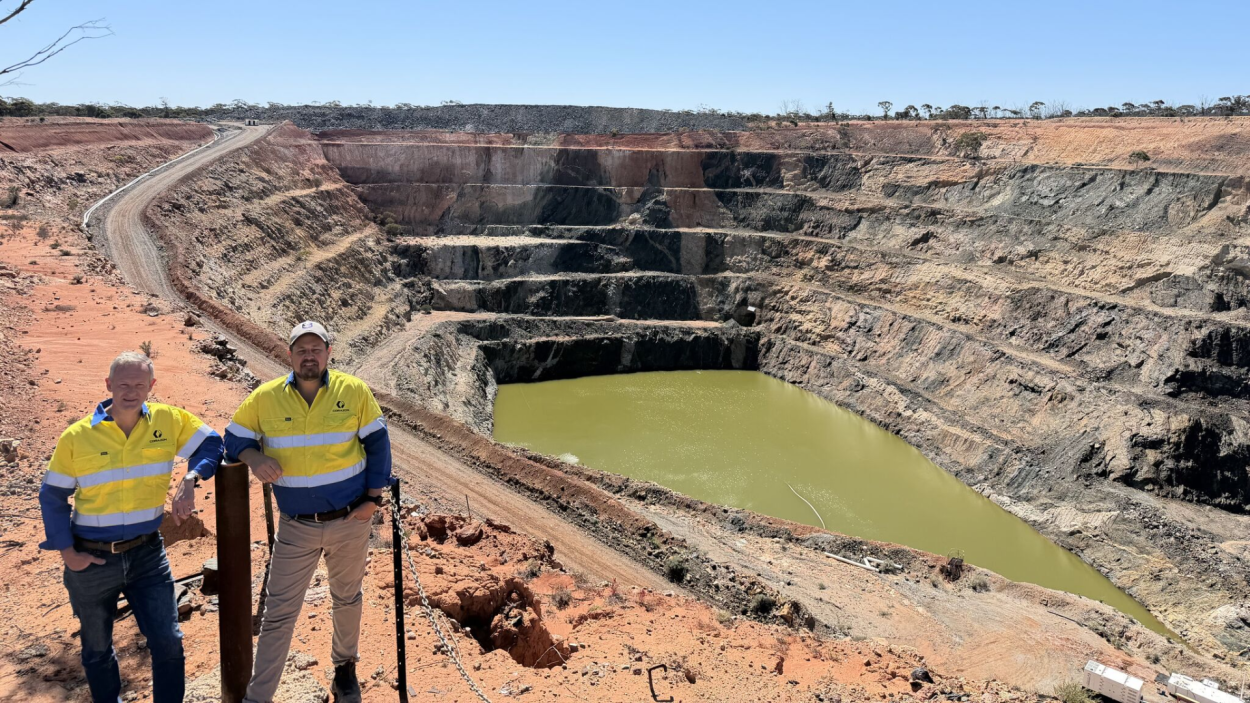
Corazon Mining (ASX:CZN) plans to drill-test a northern target and re-assay soil samples for gold at its Chalice Gold Project in Western Australia after identifying three new anomalies in a reinterpretation of 377 multi-element samples.
Kali Metals (ASX:KM1), which holds the lithium rights over Mining Lease M15/786 in Western Australia’s Higginsville district, collected the samples in 2025 during lithium exploration.
Corazon corrected the dataset for regolith and mapped geology before conducting hotspot analysis for gold pathfinder elements. The samples were not originally assayed for gold, meaning the targets are based on pathfinder elements alone.
The approach works because gold at Chalice was deposited in two stages, each leaving a distinct signature.
The main stage, which accounts for about 95% of the deposit, contains copper and tungsten. The second stage is characterised by bismuth, molybdenum, tungsten, and tellurium.
Both geochemical signatures are present in the soils, with tungsten anomalous at all three targets.
The Northern Extension (Target A) is the strongest of the three. The 600m-by-800m bismuth-molybdenum-tungsten anomaly lies along the projected strike of the Chalice orebody, coincides with Target A identified in Corazon’s recent structural review, and remains open to the north.
Of its 24 samples, the company considers 20 as hotspots, carrying the highest tungsten and molybdenum values in the survey.
The anomaly is more than twice as strong in residual laterite as in transported colluvium, pointing to a possible bedrock source. Carbonate-rich soils masked the anomaly in the raw data. However, as it lies downslope of former mine infrastructure, Corazon has not ruled out sheetwash contamination.
Historical drill holes are generally shallower than 50m, with none extending beneath the granite sheet interpreted to overlie the host position.
East of the pit
The Eastern Corridor is a 2.2km belt of felsic volcaniclastic sediments about 2km east of the pit, containing two undrilled bismuth-molybdenum-tungsten anomalies.
A single sample returned the highest zinc, lead, and cadmium values in the dataset, alongside detectable silver. The sphalerite-galena-like signature could indicate sulphides but requires further sampling to confirm.
About 600m east of the pit, El Paso is a 1.4km tungsten-copper-arsenic anomaly, with 20 of 37 samples classified as hotspots. The target partly overlaps a trend identified by earlier drilling.
All three sit within the granted mining lease, so any mineralisation found could feed future resource updates.
Chalice hosts a mineral resource of 2.18 million tonnes (Mt) @ 2.74 grams per tonne gold (Au) for 191,000 ounces, alongside an exploration target of 9.7–12.3Mt @ 1.9–2.1g/t Au for 600,000–830,000 ounces, inclusive of the existing resource.
The company notes that the exploration target is conceptual and the soil results do not themselves indicate economic mineralisation. A 7,500m reverse circulation program is already testing extensions south of the pit.
Managing Director Simon Coyle says the reinterpretation provides the company with a practical targeting tool and scope to grow the resource within its existing lease.
“We will move quickly to drill-test the Northern Target and to follow up the soils with gold assays,” Coyle says.
Corazon Mining is a Western Australian gold explorer with a portfolio spanning three projects across the state’s established gold provinces.
Write to JC Villarba at Mining.com.au
Images: Corazon Mining


