
Canada’s mineral production leaves much to be desired when measured against the vast resources the country sits on.
That is the main finding of a study by Benchmark Canada, a new initiative from the Macdonald-Laurier Institute, which highlights the country’s shortcomings in tapping its mineral wealth.
By weighing Canada’s share of global reserves against its share of actual production across eight critical minerals, the study finds that the country significantly underperforms in four of them: lithium, cobalt, graphite, and rare earth elements.
Canada holds 4.3% of the world’s lithium reserves, for example, but accounts for just 1.9% of global production. Similar disparities exist for cobalt and graphite.
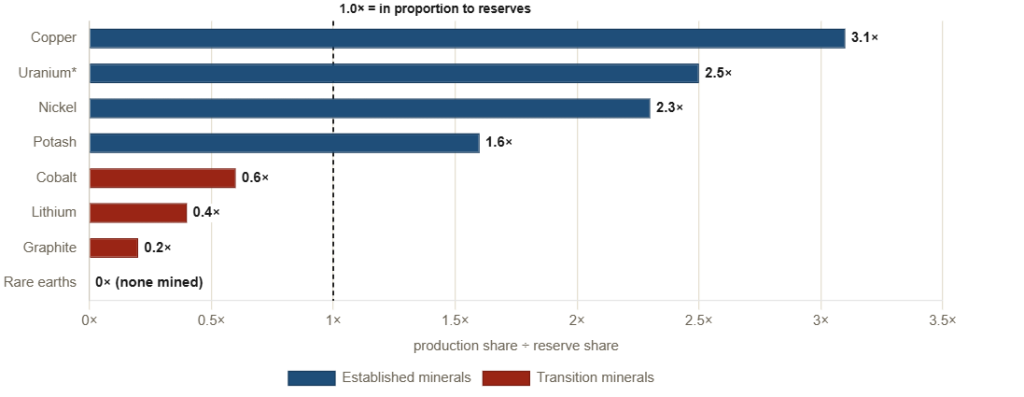
More crucially, it produces no rare earths despite holding 1.1% of global reserves — the largest share in North America.
This highlights that Canada remains well short of its capabilities when it comes to producing the minerals that the energy and defence sectors increasingly depend on.
Canada does, however, punch above its weight in the production of so-called ‘legacy’ minerals — copper, uranium, nickel, and potash — all of which have well-established domestic mining industries.
Room for improvement
The findings expose a weakness in Ottawa’s ambitions to position Canada as a global critical minerals powerhouse, particularly as Western economies look to diversify their supply chains.
John Steen, director of the University of British Columbia’s Bradshaw Research Institute for Minerals and Mining, tells the National Post:
“We’re potentially a great provider, particularly as we reorganize international supply chains, but there’s a long, long way to go.”
President and CEO of the Mining Association of Canada Pierre Gratton notes that Canada has expanded its uranium and potash operations and opened new gold mines over the past two decades.
However, exploration for other critical minerals has lagged.
“We have lost ground in the last 30 years as a producer of some of the critical minerals the world is crying out for,” Gratton says.
Against this backdrop, accelerating the exploration and development of critical minerals projects must become a priority if Canada were to live up to its mining potential.
At the forefront of this effort is a growing number of Canadian junior mining companies looking to unlock new sources of critical minerals.
Q2 Metals: Quebec’s emerging lithium heavyweight
Among the companies making significant strides in Canada’s lithium sector is Q2 Metals (TSX-V:QTWO). The company’s Cisco Lithium Project in Québec’s James Bay region has emerged as a major hard-rock lithium discovery.
Covering more than 41,000 hectares, Cisco sits within the traditional territory of the Cree Nation of Nemaska. The project benefits from its proximity to established road, railway, and port infrastructure.
Since acquiring Cisco in 2024, Q2 Metals has rapidly advanced the project. Notably, the company established an inferred mineral resource of 297.4 million tonnes (Mt) grading 1.36% lithium oxide (Li2O), equivalent to approximately 10Mt of lithium carbonate.
The company recently delivered its first Preliminary Economic Assessment (PEA). The PEA outlines a potential mining operation with an after-tax net present value (NPV) of C$13.5 billion ($14.26 billion) using an 8% discount rate.
The study envisages a conventional open-pit operation developed in two stages, capable of producing an average of about 1.7Mt of spodumene concentrate annually over a 28-year mine life. Initial capital expenditure is estimated at C$2.93 billion.
The PEA results have further reinforced Q2 Metals’ claims that Cisco has the potential to become the ‘world’s biggest lithium mine’.
Q2 Metals points out that the project economics make Cisco ‘competitive’ with some of Australia’s leading lithium operations, pointing to its ‘low’ operating cost, estimated at C$256.16 per tonne of concentrate.
In comparison, the Greenbushes in Western Australia — one of the world’s largest hard-rock lithium mines — has an operating cost of $418 per tonne of spodumene concentrate. Further, its annual production is 1.35Mt, according to the latest filing by joint owner IGO (ASX:IGO).
“The technical merits of the Cisco deposit — in terms of scale, grade, and continuity — have combined with its proximity to transportation infrastructure to create a project of major scale,” CEO Alicia Milne says.
At the same time, exploration continues to demonstrate the potential for resource expansion.
Recent drilling results announced in October include 134.5m @ 1.2% Li2O and 101.6m @ 1.02% Li2O, extending near-surface mineralisation northwards.
Q2 Metals is now transitioning towards the project’s next phase, which includes further definition drilling, engineering, and environmental studies.
Having reached the PEA stage, Cisco represents an opportunity for Canada to substantially expand its participation in the global lithium market.
Lithium X2: Building North America’s lithium independence
Another Canadian company advancing a potentially ‘large-scale’ source of lithium for North America is Lithium X2 Mining (TSX-V:LIXX), formerly known as Surge Battery Metals.
Unlike Q2 Metals, the Vancouver-based company is looking south of the border, where it is advancing the Nevada North Lithium Project (NNLP) in partnership with Australia’s Evolution Mining (ASX:EVN).
Lithium X2 holds a 67.5% interest in the project, located in Elko County, Nevada, US. The company also acts as its manager, with Evolution holding the remaining 32.5%.
The project hosts lithium mineralisation within claystone, offering an alternative to conventional hard-rock and brine deposits with potential cost benefits.
Lithium X2 considers Nevada North to be one of the ‘leading’ lithium clay deposits in North America. Currently, the project hosts a reserve base of 218.3Mt with a lithium grade of 3,928 parts per million.
Based on this reserve, the company released a Prefeasibility Study in October outlining a potential operation spanning 42 years. This includes an after-tax NPV of US$9.81 billion ($14.74 billion), an internal rate of return of 23.6%, and a payback period of 4.2 years.
“The PFS demonstrates that the NNLP can become a competitive source of domestic lithium production for America’s growing battery industry,” Lithium X2 CEO Greg Reimer says.
Prior to releasing the PFS, Lithium X2 commenced a new drilling campaign to support a bankable Feasibility Study. At the same time, the company also secured an agreement covering the project’s long-term land and water access.
Lithium X2 has also made progress on the processing side. Recent metallurgical test work with Canadian processing specialists successfully produced lithium carbonate with a purity of 99.95% from Nevada North material.
The company plans to build its processing plant in two phases. Each phase would add one production line designed to produce approximately 55,900 tonnes of battery-grade lithium carbonate a year.
Lithium X2 completed its corporate rebranding in November and is pursuing a potential Nasdaq listing in 2027 while advancing NNLP towards development.
Although NNLP would not directly contribute to Canada’s domestic mine production, it illustrates the role Canadian mining expertise and capital could play in building a more integrated North American lithium supply chain.
Scotia Metals: Opening a new lithium frontier
While much of Canada’s hard-rock lithium exploration has historically centred on Québec and Ontario, Scotia Metals (CSE:SMET) aims to establish Nova Scotia as another centre for the battery metal.
The company’s flagship Acadia Lithium Project covers about 372km2 within the South Mountain Batholith. Exploration there has historically focused on gold and tin.
However, lithium remains relatively underexplored despite the batholith’s geological similarities to regions elsewhere in the world that host pegmatites.
The company’s landholding extends along more than 80km of prospective strike surrounding the known Brazil Lake deposit.
Explored by Australia’s Lithium Springs, Brazil Lake is host to a spodumene-bearing pegmatite deposit with an established resource of over 10Mt grading 1.2% Li2O.
Scotia Metals’ exploration to date has yielded surface results across five boulder trains, where the company identified 32 spodumene-bearing boulders returning grades of up to 3.4% Li2O.
These findings have helped the company narrow down potential drilling targets. Scotia Metals interprets the boulders as evidence of nearby bedrock sources of lithium mineralisation.
In November, Scotia Metals commenced its maiden diamond drilling at the Green Wolf target, designed to identify the source of the spodumene-bearing material.
The program was initially scheduled for January 2027, but the company decided to push ahead with drilling earlier.
“[The drilling] will tell us whether the high-grade spodumene sitting on surface has a source in bedrock on our licences,” CEO Rodrigo Roso says.
The company’s exploration strategy is supported by Nova Scotia’s established transportation infrastructure, access to Atlantic shipping routes, and proximity to North American industrial markets.
Should drilling confirm lithium mineralisation in bedrock, Scotia Metals could help establish a new exploration district in Atlantic Canada, broadening the reach of the country’s battery metals industry.
SAGA Metals: A diversified critical minerals play
Also targeting Canada’s eastern provinces is SAGA Metals (TSX-V:SAGA), which has assembled a diversified portfolio spanning multiple critical minerals.
Located near Cartwright in Labrador, the company’s flagship Radar Titanium-Vanadium-Iron Project has been the focus of an extensive resource definition campaign throughout 2026.
Titanium and vanadium are strategically important materials used in aerospace, defence, steel manufacturing, and energy storage. Iron products can serve a range of industrial markets.
Recent drilling at Radar’s Trapper Zone returned broad intervals of mineralisation, including 495.6m @ 37.86% iron oxide, 5.51% titanium dioxide, and 0.273% vanadium pentoxide.
Having received its final assays from the resource definition program in October, SAGA Metals is targeting the delivery of a maiden mineral resource estimate for the Trapper Zone shortly.
Meanwhile, the company is expanding its rare earth exploration through the Wolverine Project in central Labrador. SAGA has compared Wolverine to two globally significant deposits, including Torngat Metals’ Strange Lake Project in Québec.
In October, SAGA completed a 22-hole diamond drilling program totalling 3,241m at Wolverine. All holes intersected altered rock that the company considers prospective for rare earth mineralisation.
Laboratory assays remain pending to determine the grades and significance of the intersections, with the results expected to support a mineral resource for 2027.
Beyond Radar and Wolverine, SAGA Metals holds the Double Mer Uranium Project in Labrador and the Legacy Lithium and Garneau Titanium projects in Québec, giving the company further opportunities to explore for critical minerals across both provinces.
Viridian Metals: Targeting the next generation of battery metals
Also in Labrador, Viridian Metals (CSE:VRDN) is targeting a combination of copper, nickel, and cobalt through its flagship Kraken Project.
The three metals are central to various aspects of the energy transition, with copper underpinning electrification and power infrastructure, while nickel and cobalt are key components of certain high-performance battery chemistries.
The Kraken property spans 185km2 and is the site of historical work by Noranda/Kennecott and Teck Resources (TSX:TECK.B). The area includes a 45km contact between an ultramafic intrusion and basement rocks.
Viridian has identified an extensive magmatic sulphide system at Kraken and mapped more than 60 geophysical conductors across the project. To date, the company has drill-tested only a handful of them.
Exploration has focused on the Kraken Main Zone, which features a prominent 5km conductor hosting numerous ‘high-grade’ targets.
In September, the company unveiled an initial exploration target of between 41–61Mt grading 0.35%–0.52% copper equivalent (CuEq).
Viridian notes that this target, which is conceptual at this stage, is based on drilling prior to 2026. Its current program is focused on expanding and better defining the mineralised system at Kraken Main.
Recent drilling results released in November included 21.2m @ 0.62% CuEq, with additional broad intersections highlighting the potential for mineralisation surrounding the main sulphide accumulation.
Following a recent C$5.77 million financing tranche, Viridian says it is fully funded for a maiden resource drilling program in 2027, with an updated exploration target scheduled for January.
Its goal is to define a target resource of 100–200Mt at the Kraken Main Zone.
The company also plans to undertake metallurgical testwork to better understand potential metal recoveries, laying the groundwork for evaluating whether Kraken’s near-surface mineralisation could support a large-scale mining operation.
Nine Mile Metals: Revitalising a historic mining district
In New Brunswick, Nine Mile Metals (CSE:NINE) is looking to breathe new life into one of Canada’s most historically significant base metals districts — the Bathurst Mining Camp.
The region was once home to the Brunswick No.12 Mine, one of the world’s largest underground base metals operations. It remained in production for nearly five decades before closing in 2013.
Nine Mile Metals is applying geophysical surveys and exploration data to identify previously overlooked volcanogenic massive sulphide (VMS) deposits containing copper, zinc, lead, silver, and gold.
Much of recent exploration activity has centred on the historic Wedge Mine and its surrounding 6.5km prospective mineralised trend.
The company is currently undergoing a 10,000m drilling campaign – the largest in its history – testing extensions of known mineralisation and new targets.
Recent results have led to multiple ‘high-grade’ VMS zones, including one hole reported in October that returned 11.65m @ 7.13% CuEq, including 4.8m @ 10.46% CuEq.
The most recent results included 12m @ 3.33% CuEq and a separate interval of 7m @ 4.4% CuEq, containing 8.35% zinc.
The company also mobilised a second drill rig to accelerate exploration at the Tribag-West Wedge target area. Concurrently, it is expanding the project through the acquisition of additional mineral claims.
With work towards a mineral resource estimate at Wedge underway, Nine Mile Metals is looking to demonstrate how modern exploration can unlock additional mineral wealth within an established Canadian base metals camp.
From geological potential to strategic supply
Collectively, these companies illustrate the breadth of opportunities available to Canada’s junior mining sector when it comes to critical minerals, spanning emerging districts and historically productive regions.
While some are advancing through economic studies, others are still working towards establishing maiden resources or making their first significant discoveries.
Progress towards production will ultimately depend on access to capital, permits, infrastructure, and the ability to recover metals economically. As the Benchmark Canada study highlights, Canada’s mineral wealth can contribute to global supply only when these projects reach production.
For Canada, the challenge is no longer simply demonstrating that it possesses the minerals the world needs. Rather, it is in creating the conditions under which those minerals can be economically extracted, processed, and delivered to global markets.
Write to Jackson Chen at Mining.com.au
Main Image: Mining.com.au