Australia is well-renowned for its mineral exploration, so it comes as no surprise that the country’s largest state is described as a nationwide powerhouse for the mining sector.
Spanning 2.53 million square kilometres, Western Australia is home to over three million people, with more than 20,000 of those residents directly employed by the resources sector, according to the Australasian Institute of Mining and Metallurgy.
The state produces numerous minerals, spearheaded by iron ore, generating $122 billion in sales and a near-record output of 864 million tonnes in the 2024–25 financial year, followed by gold with $29 billion in sales and 6.7 million ounces produced in the same period.
With a prominent reach in gold, Western Australia hosts around 60% of the country’s gold resources.
As a state that covers the entire west coast and accounts for around one-third of the country, Western Australia’s mining hubs are spread across numerous regions, each with different assets.
It’s in the name
Sitting in the southeast corner of the state and covering 770,488km2, the Goldfields–Esperance region says it all in its name.
The Goldfields–Esperance region is the largest of nine regions in Western Australia, and is the site of the state’s first mining boom.
Gold was discovered in Kalgoorlie in 1893 by Irish prospectors Paddy Hannan, Tom Flanagan, and Daniel Shea, setting off a gold rush. Still to this day, Kalgoorlie is a major mining centre, located 594km east of Perth.
Operating in the Goldfields–Esperance region, Auric Mining (ASX:AWJ) is a gold producer with a portfolio of assets.
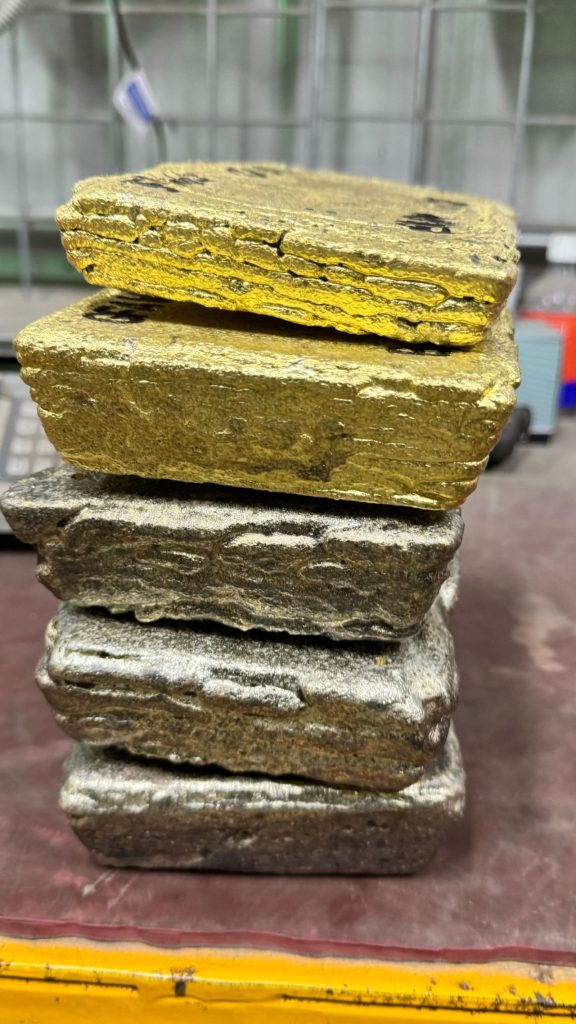
The company’s landholding spans the Jeffreys Find Gold Mine, the Munda Gold Project, the Spargoville Project, and the Chalice West Gold Project, all located in the Goldfields–Esperance region.
According to Managing Director Mark English, “location is the key, not volume,” of a company’s landholding.
“Better geology is better than size,” English tells Mining.com.au.
“Location and geology are the key drivers.”
For Auric Mining, the company is more than content with its landholding in the Goldfields–Esperance region.
“We are totally focused on Coolgardie, Spargoville, Widgiemooltha, Higginsville. That’s more than enough for us,” English says.
This very region accounts for over 60% of the state’s gold production since the gold rush of the 1890s.
A golden duo
Another prominent gold area within Western Australia is the Gascoyne region, which has a high-volume of exploration activities.
The region is home to multiple gold deposits and prospects, often paired with its neighbouring region, Murchison, with explorers such as Danakali (NSX:DNK) focused on bringing that gold to light.
Danakali is a precious and critical minerals explorer with assets spanning from Western Australia’s Gascoyne and Murchison regions all the way to the Arabian-Nubian Shield.
The explorer has applied for 1,433km2 of exploration licences across eight separate projects in the Western Australian regions. The projects cover a range of geological settings prospective for gold, copper, base metals, and a range of critical minerals.
To date, Danakali has been granted 10 of its 23 tenements applications, offering 634km2 of land with further grants expected in the coming months.
Ready to stay ahead of the market?
Get stories like this, delivered direct to your inbox.
For Danakali, Gascoyne goes beyond gold exploration.
“The Gascoyne region is an under-explored area that has emerged in recent years as a highly prospective zone with a wide array of mineralisation styles,” the company states.
Last week (25 June), the company completed its field reconnaissance and soil sampling campaign, spanning four prospects within Gascoyne and Murchison, as reported by Mining.com.au.
Samples retrieved from this campaign are currently undergoing analysis at a laboratory.
Also exploring in Western Australia’s Gascoyne region is Corazon Mining (ASX:CZN), with its Two Pools and Feather Cap projects.
Corazon may be branching beyond Gascoyne, after the company signed a binding agreement to acquire a project in the Goldfields–Esperance region last month.
The company will acquire the Chalice Gold Project from a wholly owned subsidiary of Westgold Resources (ASX:WGX) for $25.7 million.
The neighbouring Gascoyne and Murchison regions are often grouped together as a single tourism and bioregion zone, though they offer distinct geographic areas.
Murchison has historically delivered over 17 million ounces of gold, with current producing operations including Meeka Metals (ASX:MEK), which began producing at its region-named project last year.
The Murchison Gold Project hosts a resource of 1.2 million ounces @ 3 grams per tonne gold on granted mining licences. Mining is underway at the project, with gold production ramping up after its first gold pour in July 2025.

Australia’s Midwest
When you hear of the Midwest, many think of one of the US’s four census regions, made up of 12 states and renowned for its agriculture, unique food traditions, and hospitalities.
Australia’s Mid West region on the other hand covers nearly one fifth of Western Australia and around 470,000km2, with a thriving gold geology.
Great Boulder Resources (ASX:GBR) is one resources company focused on exploring minerals near the Mid West town of Meekatharra.
Centred on its Side Well Gold Project, Great Boulder returned multiple ‘high-grade’ gold hits outside the resource area within Side Well just last month, as reported by this news service.
Drilling has extended the known mineralisation at the project within the current 1 million ounce gold resource, defining ‘high-grade’ gold between the main Mulga Bill corridor and Mulga Bill East.
The company also confirmed continuity of gold mineralisation between the Mulga Bill and Eaglehawk deposits from this drilling campaign.
Highlights from drilling include 21m @ 7.24g/t gold from 99m; 9m @ 14.10g/t gold from 91m; 4m @ 23.6g/t gold from 134m; and 6m @ 8.04g/t gold from 156m.
Meanwhile, Great Boulder plans to begin drilling at the Peak Hill Gold Project — just north of Side Well and 100km north of Meekatharra — after the company acquired the asset from Westgold Resources’ wholly owned subsidiary, Aragon Resources, in May 2026.
The Peak Hill Project is located in the Northern Murchison Goldfields, within trucking distance of multiple processing facilities.
The project comprises seven granted mining leases, one granted exploration licence, and seven miscellaneous licences for infrastructure, with a total mining tenure of 106km2.
Gold mineralisation at Peak Hill is currently hosted within five main deposits, with a JORC 2012 mineral resource estimate of 9.4 million tonnes @ 1.6g/t gold for 481,000 ounces of contained gold.
Great Boulder believes that Peak Hill is extremely prospective and offers the potential to increase the known gold endowment for the company with near-mine and brownfield exploration opportunities.
Beyond the iron
The Pilbara is home to two of Western Australia’s most crucial export industries, iron ore and liquefied natural gas. Though, the region still has a thorough pull in the state’s gold industry.
Spanning 507,896km2, the Pilbara is described as “always busy” due to the mining boom centered around the towns of Port Hedland, Newman, and Karratha.
And one explorer certain on the region’s mineral endowment is Pilbara Gold (ASX:PGL).
Pilbara Gold, formerly known as Kairos Minerals, is focused on advancing its flagship Mt York Gold Project, along with its portfolio of gold projects across the Pilbara and Eastern Goldfields.
The company underwent its rebrand in April 2026, after completing the name change requirements with the Australian Securities and Investment Commission.
Speaking to Mining.com.au at the Gold Coast Gold Conference on 25 March, Managing Director Peter Turner said the name change is reflective of the company’s focus on its main asset, Mt York.
“Pilbara Gold because it’s what we do and where we are,” Turner told this news service.
The company describes Mt York to have a lot of growth potential, backed by a restructured board and management team, which includes mining engineer Martin Reed as a non-executive director, as well as experienced metallurgist and project manager Jeff Bowen as Study Manager, as reported.
With drilling ramping up at Mt York, Pilbara Gold last reported to have completed 5,680m of diamond drilling across the Main Hill, Main Hill Extension, Gossan Hill, and Gilt Dragon areas after the program took off in April.
The first batch of results from completed diamond drilling are expected next month, while three rigs are operating double-shift at Mt York.
The Midas touch
With all that exploration and production focus on gold, Trading Economics reports the price of the precious metal to be down 1.74% today (30 June), to round off H1 2026.

Gold is sitting at US$4,016.60 ($5,843) this morning, which prices the metal down 10.51% monthly within a 21.51% increase for this year over year.
However, the price is nothing to be concerned over. At the Gold Coast Gold Conference 2026, held at the QT Hotel in Surfers Paradise in March, guest panelist Noah’s Rule Managing Director Sean Russo shared a piece of advice with attendees: “Buy gold. It’s a great time to buy.”
Russo shared this sentiment amid a 17.11% monthly decrease in the metals price, which was backed by Legacy Minerals (ASX:LGM) Managing Director Christopher Byrne.
Byrne explains that there was still a “very strong consensus” across the conference floor, regardless of price jitters.
“I think that people certainly see some pretty unprecedented events occurring at the moment, but the macro thematics really haven’t changed,” Byrne tells this news service.
“Critical minerals, gold, and silver are still sort of safe havens.
“Even with the losses and all the drops in the gold and silver prices, we’re still looking at decade level highs — that macro thematic remains very strong.”
Write to Maddison Elliott at Mining.com.au
Images: Mining.com.au, Auric Mining, Great Boulder Resources & Unsplash