


The Organisation for Economic Co-operation and Development (OECD) has released a new report outlining Africa’s essential role in critical mineral supply chains. It highlights a paradox of abundance and marginalisation as African countries seek to derive greater benefits from their natural resources.
The global drive for critical minerals is accelerating. However, the OECD report notes that Africa’s potential within this growing economy remains relatively untapped, with most of its critical mineral exports either raw (24%) or semi-processed (72%).
The report also highlights that while Africa has abundant mineral resources, only a handful of countries on the continent rank among the world’s leading producers. The Democratic Republic of the Congo (DRC) dominates global cobalt production, South Africa and Gabon are leading manganese producers, and Guinea accounts for 25% of global bauxite output. South Africa also maintains a leading role in the production of platinum group metals (PGMs) and chromium.
Foreign investment in African markets is largely focused on upstream activities, reinforcing the continent’s role as a supplier of unprocessed minerals. The report notes that coordinated initiatives and regional cooperation are needed to unlock further value from Africa’s critical minerals. Industrial, investment, and fiscal policies could provide much-needed support for developing local manufacturing industries.
Africa’s critical minerals opportunity
Cobalt production is concentrated in the DRC, which accounted for 76% of global mined output in 2024, with smaller contributions from Zambia and Madagascar.
The OECD report notes that cobalt demand is set to increase by almost 70% by 2040, largely driven by the growth of the electric vehicle (EV) industry. However, production from the current project pipeline is expected to decline after 2030.
“The risk of interrupted cobalt supply, illustrated clearly with the DRC’s 2025 cobalt export ban, is hastening technology innovations away from cobalt to low-cobalt or no-cobalt battery alternatives, which will reduce demand for cobalt in the coming years,” the report states.
Cobalt supply will continue to be dominated by the DRC, although its share is expected to decline as co-product production from other key minerals grows, notably nickel in Indonesia and copper in the DRC and Zambia.
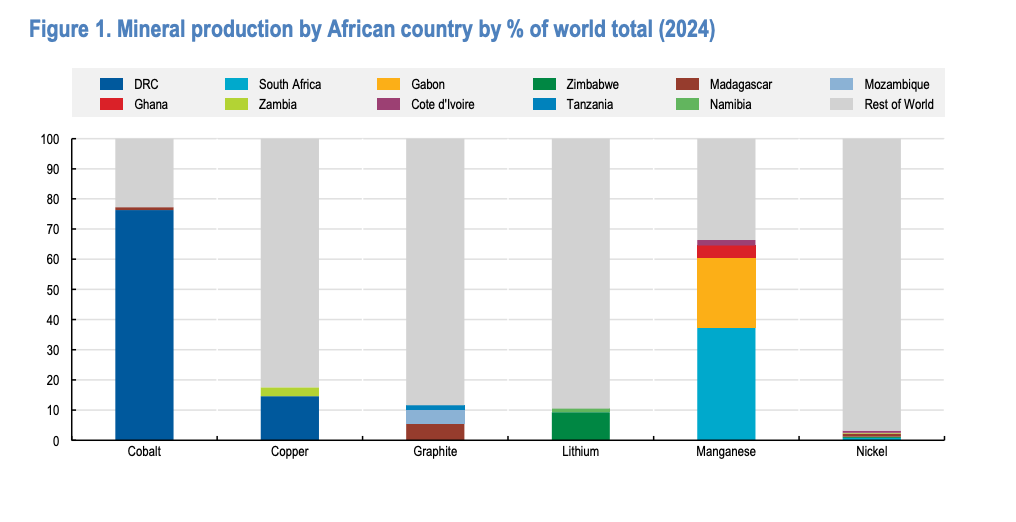
The report also highlights key dynamics around copper, graphite, lithium, manganese, and nickel.
Demand for copper is set to increase by over 37% by 2040, driven by the energy and EV sectors. The DRC is expected to become the world’s second-largest copper supplier within that time, accounting for 14% of global supply, behind Chile at 26%.
Africa is set to become the second-largest producer of graphite by 2040, behind China, with Mozambique and Madagascar projected to account for 23% of global supply.
The hurdles facing Africa’s mineral ambitions
Underinvestment in exploration remains a key challenge for the continent.
Africa’s share of global exploration expenditure declined from 16% in 2004 to 10.4% in 2024.
This decline is largely driven by political instability and increasing resource nationalism, which are creating a less favourable environment for investors.
Local value addition offers significant growth opportunities for African economies but remains largely constrained by financial pressures and global market dynamics.
“Upgrading from extraction to refining or component manufacturing requires significant long-term capital, technical skills, enabling infrastructure, easy market access, and cheap, reliable energy — conditions still scarce in most African economies,” the OECD report says.
“New processing facilities, including in Africa, face extraordinary difficulties competing with established facilities that have far greater economies of scale, cheaper inputs, and which benefit from clustering of different mineral processing operations and closer proximity to consumer markets.”
The report notes that the cost of capital for processing projects remains elevated due to perceived risks. Many midstream and downstream beneficiation projects remain economically unviable in the current market.
The authors warn that without strong public-private partnerships to provide more affordable funding and inputs, most countries will continue to export raw concentrates.
Governance gaps and the informal nature of artisanal and small-scale mining (ASM) present further challenges for Africa’s mining sector. While ASM provides essential livelihoods and supplies metals such as gold and cobalt, its informal nature means it remains associated with unsafe working conditions, child labour, environmental damage, and violence.
Closing the gap between resources and returns
The OECD report notes that the gap between mineral resource endowment and economic benefit for African countries remains substantial. This reflects constraints across exploration, governance, infrastructure, finance, skills, market access, international trade, and investment regulation.
“The challenge is not simply to extract more minerals, but to capture a greater share of the value they generate,” the report says.
“The current mineral boom offers an opportunity to address these constraints, but doing so requires coordinated action by African governments, regional institutions, international partners, and supply chain actors.”
Gaps in data weaken a government’s bargaining power, prompting significant moves, particularly in the DRC, to take control of data through geological and geophysical mapping programs, as previously reported.
The report argues that efforts to add value locally are hampered by shortcomings in electricity, transport, finance, skills, and economies of scale.
While export bans are being introduced to support domestic processing initiatives, their effectiveness will depend on local conditions and implementation.
At the international level, African producers face both constraints and opportunities to strengthen their negotiation position in the growing critical minerals economy.
“Tariff escalation, carbon border measures, older bilateral investment treaties, and World Trade Organisation rules on export restrictions can affect African countries’ efforts to develop processing and manufacturing,” the OECD report says.
“At the same time, competition among China, the European Union, the United States, Gulf states, and other partners creates opportunities for African governments to negotiate arrangements that reflect their development priorities.”
Africa’s critical minerals offer significant opportunities to grow the continent’s productive capacity, expand regional trade, and increase the economic value generated from its resources.
What’s now needed is for individual countries to define and pursue their development priorities, enhance regional cooperation, and strengthen the terms of their international partnerships.
“Progress does not depend on a single policy instrument. It requires approaches that reflect different national circumstances while addressing shared constraints in infrastructure, finance, market access, and industrial capacity,” the report says.
The OECD recommends improved dialogue between mineral-producing and mineral-consuming economies to address differing priorities, policies, and socio-economic concerns. This would help build the resilient and responsible critical mineral supply chains needed to support the global transition and growing demand from defence and manufacturing.
At the same time, it would help ensure that countries supplying these minerals can pursue their own development goals and capture greater value from their resources.
Write to Amy Rotman at Mining.com.au
Main image: Unsplash


