The uranium market could be approaching a new contracting cycle as nuclear utilities face growing pressure to secure future supply after years of below-replacement purchasing.
According to a recent report by Sprott, utility contracting remains well below the volumes required to replace annual reactor consumption, leaving an increasingly large portion of requirements uncovered beyond the end of the decade.
The issue is particularly evident in Europe. Sprott estimates that even if utilities exercise the full-volume flexibility available under existing contracts, uranium coverage falls from 100% in 2030 to 81% in 2031, 78% in 2032, and just 36% by 2034. Conversion coverage falls even further to 20% by 2034.
While those shortfalls appear several years away, Sprott notes that uranium is typically secured through long-term contracts before moving through conversion, enrichment, and fuel fabrication. Utilities therefore need to procure material years before it is ultimately loaded into a reactor.
Russian reliance adds pressure
Europe’s continued reliance on Russian nuclear fuel services further complicates the outlook.
According to Sprott, despite efforts to diversify following Russia’s invasion of Ukraine, Russian deliveries to European Union utilities increased across major fuel-cycle categories in 2025.
Russian uranium deliveries lifted by 7%, conversion deliveries increased by 9%, and enrichment sales climbed 12%. Russia retained around 16% of the EU uranium market, 24% of conversion, and 23% of enrichment.
Sprott also points to Kazakhstan as a key factor in the emerging supply competition. The country accounts for around 39% of global uranium production, but a significant portion of its output is already committed to China and Russia, and increasingly India, under long-term arrangements.
US contracting gap
The outlook is potentially even more pressing in the US, which operates the world’s largest nuclear fleet with 94 reactors and around 97 gigawatts of capacity.
Sprott’s analysis shows that, assuming utilities exercise all available flexibility under existing contracts, maximum US uranium coverage falls from around 98% of requirements in 2026 to 60% in 2030 and just 9% by 2033.
The US also remains overwhelmingly dependent on foreign uranium.
According to figures cited by Sprott, domestic material accounted for just 7% of utility deliveries in 2025, compared with around 93% from foreign suppliers, led by Canada at 32%, Kazakhstan at 28%, and Australia at 15%.
Contracting remains low
The broader contracting picture is also tightening.
Sprott reports that, as of 10 August, approximately 37 million pounds of uranium had been contracted globally in 2026, although the figure does not yet include two purchase agreements announced by India.
On that basis, the market is on track for a 14th consecutive year of below-replacement contracting.
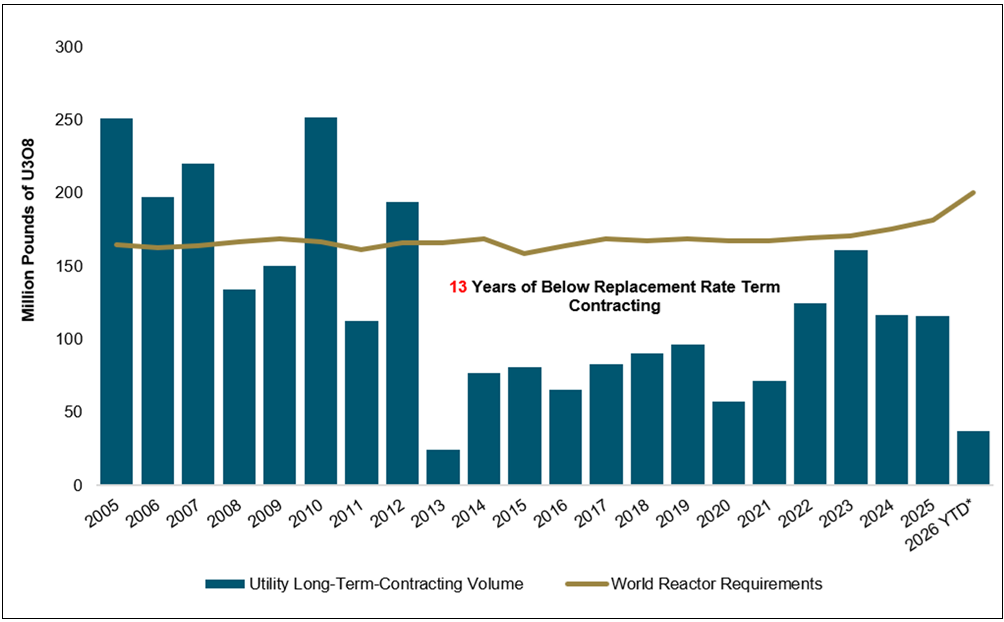
Cameco (TSX:CCO), North America’s largest producer, has similarly described the uranium market as being in the early stages of a broader contracting cycle, with utilities yet to purchase enough material to fully replace reactor consumption.
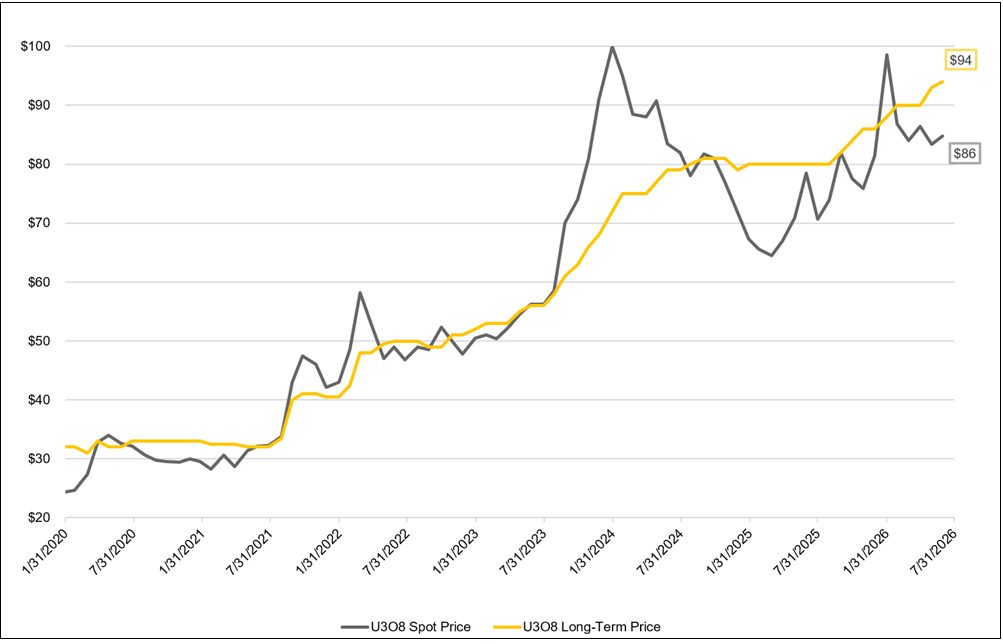
Despite subdued contracting, Sprott notes that the long-term uranium price has already reached US$94 ($131) a pound, its highest level in 18 years, suggesting the market is placing an increasing premium on dependable future supply.
Nuclear renaissance supports demand
The contracting gap is emerging amid renewed growth in nuclear power.
Reactor life extensions and restarts are preserving uranium demand that had previously been expected to disappear, while uprates are increasing requirements from existing reactors.
New reactors are also advancing, particularly in China, while India announced in July that it plans to have at least five small modular reactors ready by 2033.
The International Atomic Energy Agency has said sufficient uranium resources exist to support nuclear power growth through 2050 and beyond, but timely investment in exploration, mining, and processing will be needed to ensure that material reaches the market when required.
Athabasca Basin in focus
The outlook is putting renewed attention on established uranium jurisdictions and the companies positioned to potentially supply the next contracting cycle.
Canada’s Athabasca Basin is particularly important. Located in the northern part of Saskatchewan, the region accounts for around 13% of global uranium production and hosts some of the world’s highest-grade uranium deposits, according to Natural Resources Canada.
Skyharbour Resources (TSX-V:SYH) holds interests in 44 projects covering more than 682,000 hectares in the region. Its portfolio ranges from the more advanced Moore Lake and Russell Lake projects to earlier-stage exploration properties.
The company also operates a prospect generator model, bringing in partners to advance some of its non-core properties.
One such partner is Purecore Metals (CSE:PURE), which recently optioned the Yurchison property. The project comprises 22 claims covering approximately 35,029 hectares and sits around 75km south of Cameco’s Rabbit Lake operation.
Dark Star Minerals (CSE:BATT) is also targeting Canadian uranium opportunities. Its Bleasdell Lake Project in Saskatchewan has undergone extensive historical exploration, including the identification of uranium mineralisation, while the company also holds a project in Labrador’s Central Mineral Belt.
As utility contract coverage falls sharply into the next decade and nuclear demand grows, the uranium market’s challenge is increasingly not whether resources exist, but whether enough new supply can be contracted, financed, and delivered when utilities need it.
Write to Jackson Chen at Mining.com.au
Images: Sprott & Unsplash