The US Government has taken another step to strengthen its domestic critical mineral supply chains by pushing for greater use of domestically sourced materials in defence procurement.
President Donald Trump recently signed an Executive Order that limits when defence contractors can obtain waivers to source critical minerals and components from foreign entities of concern. It also encourages contractors to qualify new domestic and allied suppliers.
The move underscores Washington’s efforts to pivot away from overseas supply chains, particularly China, which dominates production and processing of many critical minerals.
According to the US Geological Survey (USGS), the US remains heavily reliant on minerals imported from China. These include rare earth elements such as yttrium, widely used in defence systems, and graphite, a critical material for batteries and other advanced technologies.
Supply risks in spotlight
Trump’s order in July came days after the International Energy Agency (IEA) released its annual Global Critical Minerals Outlook, which, as reported, warned that concentrated supply chains and expanding export restrictions are creating growing risks for global industries.
In the report, the IEA identified yttrium, graphite, gallium, tungsten, cobalt, and rare earths as minerals whose supply is vulnerable to disruptions because production and refining are concentrated in only a handful of countries.
The IEA stressed that many of these materials, while having relatively small markets, are becoming increasingly important for defence, AI, semiconductors, and clean energy technologies.
The same concerns extend to major commodities.
For thousands of years, copper has been a staple part of the global economy, due to its high conductivity and durability. Today, traces of copper can be found in almost every building, power grid, and consumer electronic device. The metal is also important for building military equipment, power infrastructure, and AI data centres in the modern age.
Recognising its growing strategic importance, the USGS added copper to its critical minerals list last year.
The US currently imports more than half of the copper it consumes, with roughly two-thirds of those imports coming from Chile. As the Trump administration pushes to strengthen domestic supply chains, ‘homegrown’ solutions to US copper production are becoming a key priority.
Arizona leads the way
Arizona already accounts for most of the country’s copper production and is home to several of its largest development projects.
The biggest is Resolution Copper, a joint venture of industry leaders Rio Tinto (ASX:RIO) and BHP (ASX:BHP) that could eventually supply up to 25% of US copper demand. However, its development has been stalled for over a decade amid environmental concerns and legal battles.
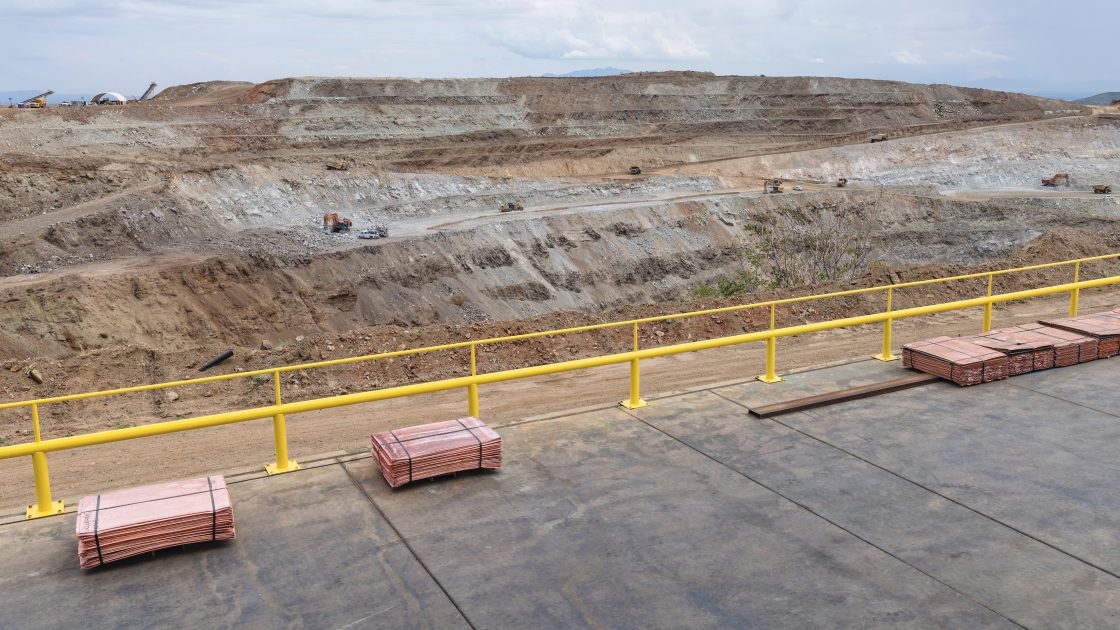
Florence Copper, owned by Trekor Metals (TSX:TKO), has already entered production. The in situ recovery project is expected to produce about 1.5 billion pounds of copper over a 22-year mine life, with all production earmarked for the domestic market.
Gunnison Copper (TSX:GCU), too, has a significant deposit near Tucson. The Gunnison Project is also expected to operate for over two decades, producing 3.2 billion pounds of copper cathodes.
When the company released its latest economic assessment earlier this year, CEO Craig Hallworth said the project is well positioned “as a significant future supplier to the American copper market and a key contributor to the domestic supply shortfall.”
The company already operates the Johnson Camp mine, which last year produced its first cathodes using a technology developed by a Rio Tinto venture, Nuton. The operation is eligible to receive up to US$13.9 million ($19.8 million) in tax credits from the Department of Energy in support of its commercial production.
Gunnison is also part of the Defense Industrial Base Consortium (DIBC), a US Department of War initiative focused on strengthening and scaling the defence industrial base.
Nevada offers another opportunity
Opportunities also lie to the northwest.
Nevada, better known for its gold and silver, has an abundance of copper porphyry deposits like Arizona. It currently has one primary producer, the Robinson mine in White Pine County, held by Poland’s KGHM Polska Miedź (WSE:KGH).
In Pershing County, Copper One Resources (CSE:CEXY) is working on a district-scale property called Majuba Hill, which historically produced 2.8 million pounds of copper. The company is currently advancing drilling to further define the mineralisation and towards a resource estimate.
“With copper demand continuing to accelerate from electrification, AI infrastructure, data centres, grid modernisation and advanced manufacturing, we believe Majuba Hill is well positioned to become an increasingly important North American copper project,” Copper One’s President and CEO David Greenway says.
The company also recently added a second US copper project in Utah, as reported by this news service.
Also in Pershing, Nevada Sunrise Metals (TSX-V:NEV) is exploring the Coronado Copper Project, a past-producing property that was mined out in the 1970s.
These are just a few examples of early-stage projects outside of Arizona that could bolster the US copper pipeline.
New mines needed
Trump’s executive order reinforces a broader trend across the Trump administration, from streamlining mine permitting to tightening defence sourcing rules, all aimed at increasing domestic production of critical minerals.
The challenge remains significant. According to the USGS, US copper mines produced about 1 million tonnes in 2025, down 5% from the previous year.

(Source: IEA)
The IEA also warns that developing new copper mines remains one of the biggest challenges facing the market. Despite higher prices, the agency estimates global primary copper supply could face a 25% deficit by 2035 under current policy settings.
For the US, closing that gap will require more than policy support. It will also require a new generation of copper mines to move from early exploration to production.
Write to Jackson Chen at Mining.com.au
Images: Gunnison Copper & International Energy Agency