



Fraudulent transactions are on the rise in the commodities market, with the latest case involving tin.
Last month, it was revealed that major trading house Gerald Group was duped out of $49 million when it turned out what it had bought was not tin.
Peak Asset Management executive director Niv Dagan tells Mining.com.au the most recent incident highlights the complexities and risks involved in the physical commodities market.
“Such discrepancies can stem from various factors, including fraudulent suppliers, inadequate verification processes, and logistical errors,” he says.
“The immediate impact on Gerald Group was substantial, resulting in financial losses and potential reputational damage.
“This case underscores the importance of rigorous verification and due diligence in commodities trading to ensure the authenticity and quality of the goods being traded.”
This followed last year’s discovery of bags filled with stones instead of nickel in JPMorgan Chase’s warehouses, which Dagan says further illustrates the challenges within the metals market.
This incident involved nine nickel contracts stored in a warehouse in Rotterdam, which were found to contain stones rather than the expected nickel briquettes.
Dagan says the situation raised questions about the security and verification processes within the London Metal Exchange (LME) warehouse network.
“The LME has since undertaken mass inspections of nickel stocks in warehouses globally to prevent further occurrences,” he says.
“Both cases have significant implications for supply and demand in the metals market.
“When fraudulent or substandard goods are discovered, it disrupts the supply chain, causing immediate shortages and potential price volatility. For instance, the Gerald Group’s tin incident could lead to a temporary decrease in available tin supplies, impacting manufacturers and other end-users who rely on this metal.”
Since the start of the year, the price of tin has spiked over 40% to a 2024 high of US$35,582 ($53,334) per tonne. That is also its highest point since June 2022. It has come off a bit since then and is currently trading just under US$33,000 per tonne.
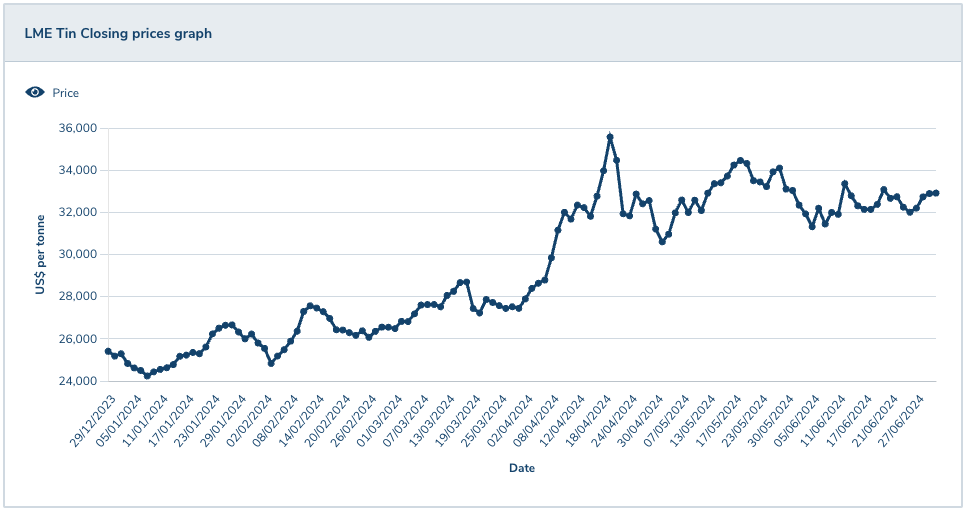
International Tin Association Chairman Mariano Pero says tin once again breached the US$35,000 mark as supply remains choked off in the Wa State of Myanmar and vital supplies from Indonesia struggle to recover into Q2.
Indonesia is the second largest tin producing country in the world, behind China, with average output of 70,000 to 84,000 tonnes annually.
“LME stocks are down to the wire, while Chinese SHFE exchange stocks are at record highs,” he says.
In June, Yunnan Tin — the world’s largest producer of refined tin — met with PT Timah, Indonesia’s largest and the world’s fifth largest producer, in Jakarta to discuss future strategic cooperation.
The International Tin Association says the companies, which are both members of the association, will implement a memorandum of understanding to cooperate on things like marketing, technology, and development.
At the same time, big technology changes are driving demand for tin.

Tin is traditionally used as a solder, and the more technologically advanced products get, the more soldering is needed due to the increase in circuits used.
This means demand is going to flow through from solar panels, semiconductors and electric vehicles.
“The huge growth in the electric vehicles market depends substantially on tin as solder connecting the electronics, the battery systems, the wiring and even the charging infrastructure,” Pero says.
“And when you consider that almost 40% of all cars made will be fully electric by 2030, that is more than double from 18% today. That alone is substantial growth. As one analyst said – ‘electric vehicles are not leaving the garage without tin’.”
Meanwhile, tin’s use in solar panels has more than tripled in five years to 35,000 tonnes and is predicted to surpass 40,000 tonnes by 2030, according to the International Energy Agency.
By 2028, solar photovoltaics and wind power are forecast to account for a record 96% of global renewable energy capacity, up from around 75% in 2023.
Write to Angela East at Mining.com.au
Images: International Tin Association


