


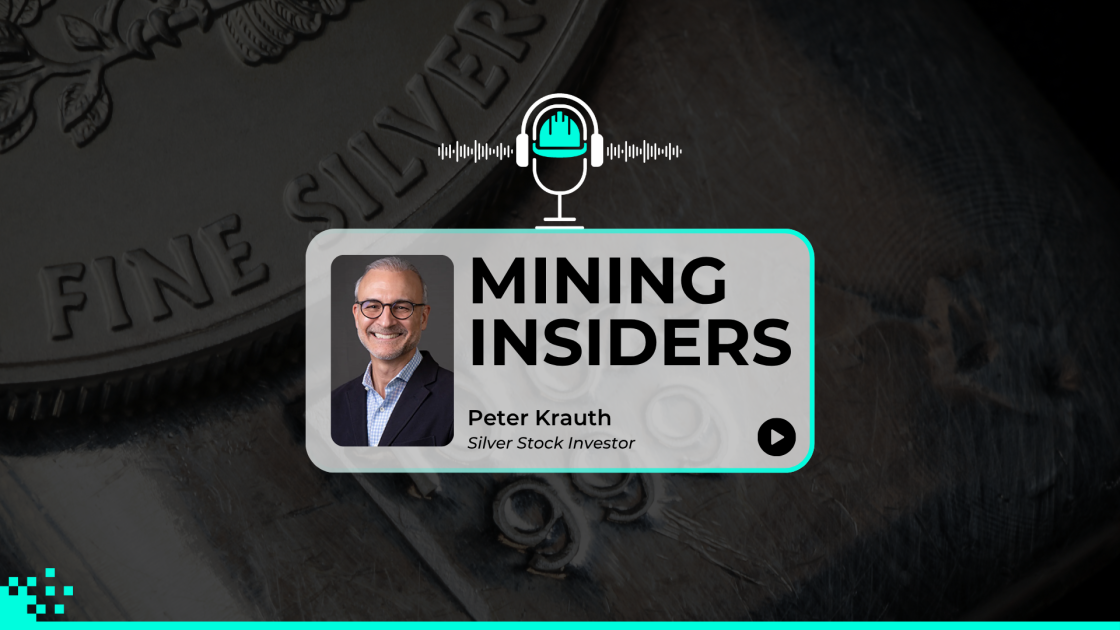
Q&A with Peter Krauth, Newsletter Editor, Silver Stock Investor
Silver-focused author and newsletter writer Peter Krauth believes the precious metal remains well positioned for further gains despite correcting from its late-2025 highs.
Speaking with Mining.com.au, Krauth says a multi-year supply deficit, strong physical and exchange-traded fund (ETF) demand, and improving macroeconomic conditions could support silver prices as the current consolidation runs its course. He expects US$50 ($71.61) per ounce to become a long-term price floor, with silver potentially returning above US$80 before challenging triple-digit levels again in 2027.
To listen to the interview, click here:
Let’s start with a quick introduction.
I’m the editor of two newsletters: Silver Stock Investor, a paid subscriber newsletter, and Silver Advisor, a free newsletter supported by companies we cover. I also wrote a book called The Great Silver Bull about four years ago and cover the silver space from all angles.
Looking at silver, what’s exciting at the moment? We saw some big price spikes earlier this year. That’s settled down to a new floor now, but what’s your take?
For decades, people have been complaining that silver was not going anywhere and that we’d never get past US$50 per ounce. Then, almost exactly a year ago, silver passed US$50. I think it was around 10 October 2025. I remember that day very well.
It took 45 years to get there, and then it took three months to go from US$50 to over US$100.
On one hand, it quieted a lot of the naysayers who thought this would never happen. To be fair, you’ve still got some haters in the silver space who think that it’s never going to return to triple digits.
In practical terms, miners are very happy because silver at US$60 is more than double the price they’ve had for the past couple of years.
Just to give some perspective, three years ago, a mining executive said to me: “Peter, if we could just get over US$30, we’d be so happy. Most of that could go right to our bottom line and we would be so profitable”.
Now we’re at double that price, so miners aren’t complaining. Some investors are, however, because they saw US$120 and the price is now about half that. But, if you look at it with some perspective, silver is still doing quite well.
Let’s look at some of the macro drivers that have brought silver to where it is now. What’s driven that boost?
It’s a combination of things. There’s a silver deficit that’s been running for the last five or six years. We’re consuming more than we’re producing.
From about 2020 to 2024, I kept wondering why silver wasn’t rising and why it had a hard time getting beyond US$30, especially considering the market had been in a deficit situation for about three consecutive years at that point.
I did some digging and saw that the futures exchanges actually held an oversupply — silver was basically sitting above ground in exchange inventories. Across the COMEX market, the London Bullion Market Association (LBMA), and the Shanghai Futures Exchange, there were several billion ounces of silver.
I realised that, although the market was in a deficit, the big silver consumers — whose demand exceeded what mining and recycling could supply — were meeting that deficit by going to places like the futures exchanges, where there were these excess above-ground supplies they could draw down on.
So, if you can draw down on these inventories at prevailing prices, you’re not putting pressure on mining or recycling to bring new supply to market. And if you’re not doing that, prices aren’t being pushed higher.
When I came to that conclusion in early 2024, based on the rate these secondary supplies were being drawn down, I figured we had about 12 to 18 months before the game was over.
And that’s essentially how it played out. From early 2024 until mid-2025, that’s when the silver price really broke out, first to about US$40–45 before eventually reaching US$50 by October 2025.
Breaking through US$50 was a multi-decade technical breakout that attracted a lot of attention. We saw a lot of buying by speculators and investors. There were lineups in places like China, Korea, and Singapore, and some bullion dealers there even had to ration silver out. I was told that in Korea, banks — where most people buy their physical silver — were basically saying that they had run out.
People were buying like crazy. Then we also saw some of the impacts of tariffs, with questions about whether they would affect silver in the US, for example. Because of this, we saw a fair bit of silver moving around, which helped fuel the frenzy around the silver price.
It sort of fed on itself. As people saw the price rise, they thought it would keep rising, and we had these latecomers who were buying at US$80 or US$100 and thought it would just keep going. But it didn’t.
In January 2026, I spoke at a conference and said that I didn’t expect those prices to last. Within about a week, silver was trading at around US$67 intraday.
So, now we’re in a consolidation phase.
Do you think the price will remain at that US$60 mark?
Technically, I think US$50 is going to be the new floor. It was the ceiling for decades, and I think it’ll now act as the floor.
We’ve already had around seven or eight months of correction and the lowest we’ve gotten is US$55. I do think a more comfortable place is around the US$60–70 range though.
If you look at the macro side, two factors have weighed on both silver and gold: a US dollar that’s rallied and rising bond yields. Metals compete with other assets, especially bonds because they pay yields. So that’s taken away some of silver’s attractiveness, at least temporarily.
But, as I told my subscribers recently, I think this rally in the dollar and bond yields might be close to peaking. There’s uncertainty as we get closer to the US midterm elections in November, and we could see a renewed interest in gold and silver.
I expect the US dollar and bond yields to peak and ease, shifting from headwinds to tailwinds for silver. That could start to help prices rise again as we make our way towards the end of 2026.
How does the supply deficit feed into this pricing narrative?
According to The Silver Institute, the deficit has been shrinking. It topped out several years ago. The market saw a shortage of 250 million ounces (Moz) back in 2022, and that was on the back of really big physical buying. This was a couple of years into COVID, when governments introduced coordinated global stimulus to support people and businesses as economies came to a standstill.
There was a lot of physical buying and we had a huge market deficit that year, but it’s been shrinking ever since. Last year, the deficit was 40Moz. This year, The Silver Institute expects it to be around 45–46Moz.
When you look at the institute’s own numbers, there are other things to consider. Two metrics stand out to me. One is that it expects coin and bar demand to rise in 2026 to around 257Moz, the third-highest level on record, which is pretty interesting.
The second is ETF flows. One important detail in how The Silver Institute calculates its figures is that it has a market balance, which is supply minus demand. This can either be positive or negative. But it also includes, as a separate line item after market balance, net investments into ETFs. When you include that number, things get pretty interesting because you get a very different perspective of the market balance, taking into account both forecast and actual flows into ETFs.
Last year, we had a near record. In 2020, the year COVID emerged, we had 330Moz flow into silver ETFs. Last year, that figure was 278Moz.
The Silver Institute thinks that number will drop this year, but even with that decline, including ETF flows produces a net deficit of 318Moz. That is the largest single deficit the silver market has ever seen when ETF flows are included.
So, between that and the amount of silver that is forecast to be flowing into physical coin and bar demand, I think this is a very robust market. As I said earlier, miners are very happy.
This might seem a bit counterintuitive, but the cost to produce an ounce of silver has fallen significantly. Silver is quite different from most other metals because only about 25% of it comes from primary silver mines, while the remaining 75% is produced as a byproduct of mining other metals, including gold, copper, zinc, and lead.
In 2025, the average all-in cost to produce an ounce of silver had fallen pretty significantly to just US$12.21. One reason the cost was so low was that revenue from gold, copper, or zinc can be credited against the overall cost of producing silver. When prices for those metals rise, the credits increase. And that’s exactly what happened over the past couple of years, with prices rising not only for gold, but also for copper, zinc, and lead.
When silver is produced alongside other metals, those credits rise and the overall cost of silver production goes down.
If you look at the overall cost average across the 10 largest primary silver miners, they can produce silver for US$12.21 an ounce and they’re selling it for around US$70. They have screaming margins of about 80%, so they become true cash machines.
Many investors don’t realise that.
If you look at the gold, silver, and other base metal miners lumped together on the S&P, they are by far the most profitable sector. The next closest sectors are financials and tech. But, if you just drill down and look at profitability, the base and precious metal miners remain well ahead.
I do see a situation where it’s a question of when, not if, the market rolls over and investors start to look for sectors that are performing well, because the balance of them are not. When this happens, I expect there’s going to be a huge rotation into mining.
A lot of generalist investors have woken up to the sector. They have been buzzing around these big conferences, sending larger teams, asking lots of questions, and realising they need to participate.
Just to close it off, what’s your outlook for the remainder of the year and into 2027?
I could see silver continuing to move sideways for a couple of months. Several things could trigger a move. It could be the midterms, or it could be the dollar or bond yields rolling over and becoming a tailwind for silver and gold.
But I expect we’ll see this consolidation phase play itself out, with precious metals starting to rise again in the last month or two of the year. Silver could move north of US$80, and I think that next year, the odds are pretty good that we’re going to see somewhere close to triple digits again.
Write to Amy Rotman at Mining.com.au
Main image: Mining.com.au

