
MDF Global MDF Global
Apple’s iPhone boom highlights critical minerals powering smartphones•Presenting a united front for Queensland’s copper sector•Thailand seeks Myanmar mine access amid arsenic pollution•Egypt to set up state-backed company to license artisanal gold miners, free detainees•Brixton closes $7.4 million raise for Thorn, Langis projects•Heliostar banks record $78.7 million for Ana Paula push•Mining giants bet billions on 2030 supply crunch•Gunnison Copper reports Q3 output, revenue surge•Triumph Gold targets $15.46 million for Yukon push•African Rainbow Minerals faces a jobs dispute at Nkomati mine•Angola seeks 10% stake in De Beers under Anglo’s proposed exit•Gold price rebounds but heads for biggest weekly loss since June•Teck copper strike reaches BC port as operator sues union•Copper benchmark rocked by miner-smelter tug-of-war•Zimbabwe mining bill targets community, environmental safeguards•Mount Isa critical minerals hub secures Feasibility Study funding•Eramet initiates $814.5 million capital raise to reduce debt•Richemont backs natural gemstones, declines De Beers comment•‘Tis the season for administration as Comlek falls a second time•OceanaGold Philippines trials wireless blasting at Didipio mine Apple’s iPhone boom highlights critical minerals powering smartphones•Presenting a united front for Queensland’s copper sector•Thailand seeks Myanmar mine access amid arsenic pollution•Egypt to set up state-backed company to license artisanal gold miners, free detainees•Brixton closes $7.4 million raise for Thorn, Langis projects•Heliostar banks record $78.7 million for Ana Paula push•Mining giants bet billions on 2030 supply crunch•Gunnison Copper reports Q3 output, revenue surge•Triumph Gold targets $15.46 million for Yukon push•African Rainbow Minerals faces a jobs dispute at Nkomati mine•Angola seeks 10% stake in De Beers under Anglo’s proposed exit•Gold price rebounds but heads for biggest weekly loss since June•Teck copper strike reaches BC port as operator sues union•Copper benchmark rocked by miner-smelter tug-of-war•Zimbabwe mining bill targets community, environmental safeguards•Mount Isa critical minerals hub secures Feasibility Study funding•Eramet initiates $814.5 million capital raise to reduce debt•Richemont backs natural gemstones, declines De Beers comment•‘Tis the season for administration as Comlek falls a second time•OceanaGold Philippines trials wireless blasting at Didipio mine
Nickel Industries

Nickel smelting falls for second consecutive month

Geospatial intelligence company Earth-i reports global nickel smelting activity in July fell for the second consecutive month, driven by continuing weakness in Indonesia, further corroborating tough market conditions.

Data from Earth-i’s SAVANT Global Smelting Monitoring Index, shows nickel pig iron (NPI) operations in the Southeast Asian archipelago recorded its highest level of inactivity since November 2022, at 15.9%.

Smelting activity in China also fell by 10.5%, contributing to the Global Inactive Capacity Index rising by 2.6% to 18.6%, its highest reading in over a year.

SAVANT provides indicators of smelter activities around the globe, in an easy-to-understand format, covering multiple metals and minerals. Data is collected and analysed using advanced algorithms derived from AI and machine learning techniques. 

Earth-i notes the jump in the country level inactivity series for China from 11.6% to 22.1% was difficult to isolate to specific plants given the increasingly fragmented nature of the domestic industry – “save for Tangshan Kaiyuan Industrial Company’s eponymous 27 kT/a NPI plant in Hebei, which we have observed as inactive since 7 July”.
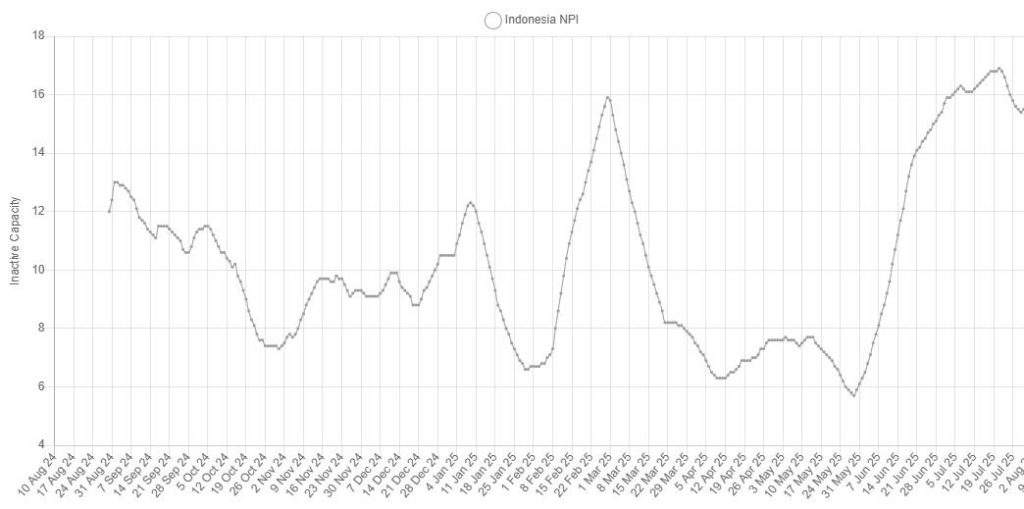
“This marks the longest period of inactivity at the site since 2018,” Earth-i reports.

Meanwhile, Africa had the greatest month-on-month change in activity, “with the Mother Continent’s inactivity capacity series falling by 19.5% to 7.2%”.

Activity also increased in Europe by 6% month-on-month although with an inactivity reading of 55.2%, Earth-i says the region remains the weakest performer globally. 

“At the other end of the spectrum, activity in Asia and Oceania also increased, by 1.5%, so that the latter remains the most active region for nickel smelting relative to capacity.”

Lastly, the regional incapacity index for the Americas rose by 1% to 45.1%, which masks a solid performance in South America, with all four of the continent’s ferronickel smelters displaying good operating profiles. 

Write to Adam Orlando at Mining.com.au

Images: Earth-i & Nickel Industries

Add to Watch List:
Author Image
Written By Adam Orlando
Mining.com.au Editor-in-Chief Adam Orlando has more than 20 years’ experience in the media having held senior roles at various publications, including as Asia-Pacific Sector Head (Mining) at global newswire Acuris (formerly Mergermarket). Orlando has worked in newsrooms around the world including Hong Kong, Singapore, London, and Sydney.