In the modern mining industry, Western Australia is well-regarded as Australia’s resources powerhouse, with the state being the single biggest contributor to the economy through mining and providing $8.1 trillion in potential resources.
However, that was a very different story in the 1800s, when Victoria was leading the country in gold discoveries.
The historic Victorian Gold Rush kicked off in 1851, after gold was first discovered in Clunes in 1850 and announced in 1851, bringing thousands to the state each week before the rush tapered off in the late 1860s.
In the 1850s, Victoria was deemed one of the greatest gold-enriched areas, producing more than one-third of the world’s gold in this decade and quickly outshining New South Wales.
For some, Victoria’s gold endowment was not news. Resources Victoria reports First Nations people to have long known about the state’s gold as small, heavy nuggets would appear in central Victoria’s creeks and rivers at times.
Right before the gold rush took off, European settlers uncovered the gold in the 1840s, though they chose to keep quiet about the discovery as mining was illegal and gold belonged to the Crown.
The Victorian Gold Rush wasn’t the end of gold mining in the state. It was only the beginning, and an impressive one at that.
The heart of gold
Since gold mining began in the 1850s, Victoria has produced 2,400 tonnes of gold, accounting for nearly 2% of gold mined worldwide, according to Resources Victoria.
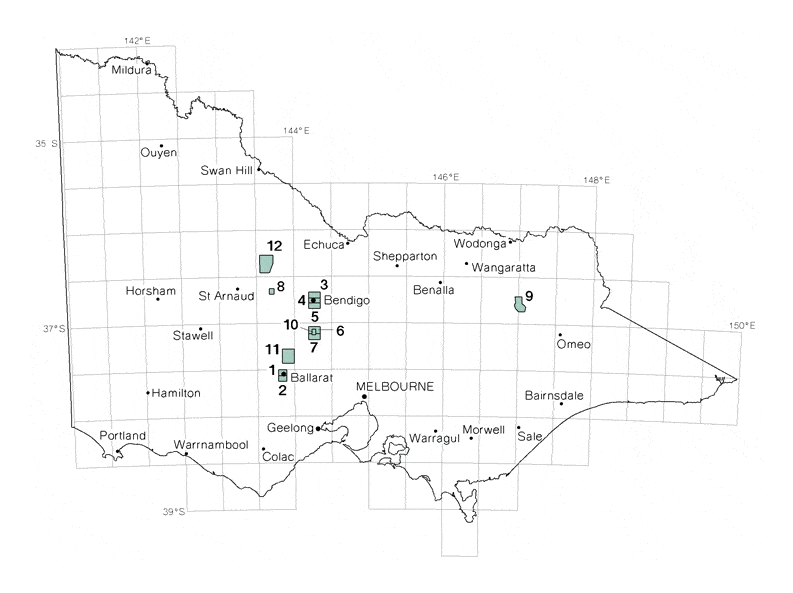
There are four major operating gold mines in the state today, spread across Ballarat, Costerfield, Fosterville, and Stawell.
Victorian gold mines are often paired with antimony production, with 3.2 million ounces (Moz) of gold (Au) produced between 2018–19 and 2022–23, and 2,144 tonnes of antimony (Sb) between 2022–23, Minerals Council of Australia reports.
Within the state, the Golden Triangle is a famous region in the central part of Victoria, known for containing high concentrations of gold.
The triangle stretches between Ararat, Ballarat, Bendigo, and Wedderburn, covering towns such as Castlemaine and the historic Clunes.
One junior explorer taking advantage of the Golden Triangle is Kalamazoo Resources (ASX:KZR), which has one of the largest tenement holdings in the Central Victorian Goldfields.
The company’s portfolio comprises the Mt Piper, South Muckleford, and Castlemaine gold projects, spanning a total area of 2,006km2 and covering the Bendigo zone and Melbourne zone.
Historically, the Bendigo zone has produced more than 60Moz of Au, while the Melbourne zone is considered prospective for ‘high-grade’ gold-antimony potential.
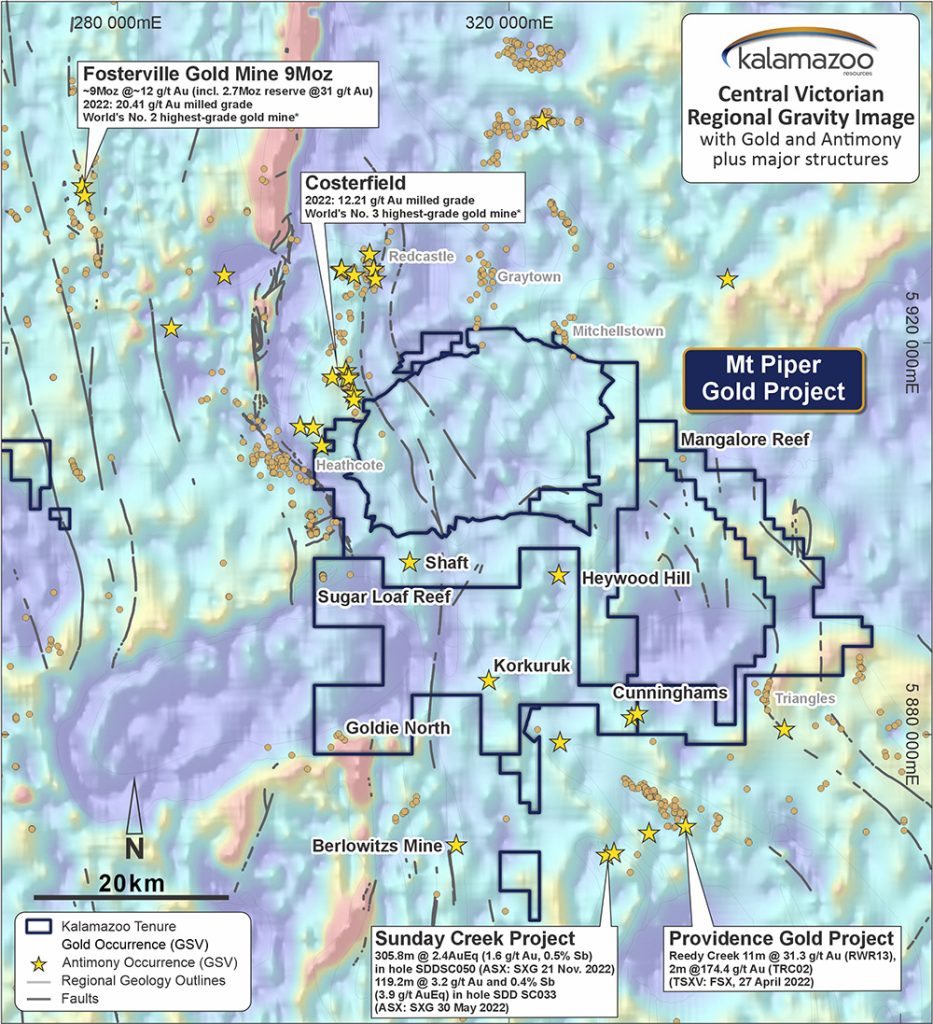
Earlier this month, Kalamazoo consolidated a land position of 1,574km2 at Mt Piper after being granted the Seymour and Hughes Creek exploration licences.
At Mt Piper, the company holds 1,179km2 of granted tenure, with another 395km2 under application.
Meanwhile at the Whiteheads Hill prospect, the company has conducted reconnaissance aircore drilling that returned up to 155 parts per million (ppm) Sb and 68 parts per billion Au from a 15-hole program totalling 328m.
While Kalamazoo’s workstreams are primarily focused on fast-tracking development at its Ashburton Gold Project in Western Australia through a Prefeasibility Study, the company’s position in the Central Victorian Goldfields has a lot to offer.
CEO Andrew McDougall previously described the Mt Piper Project in particular as a chance for the company to establish a “meaningful longer-term discovery platform” alongside the existing primary development focus at Ashburton.
“Kalamazoo has assembled a significant wholly controlled exploration position across an underexplored part of Victoria’s highly endowed gold-antimony region,” McDougall says.
“The opportunity is to convert that land position and our growing geological understanding into a disciplined pipeline of high-quality drill targets.”
But Kalamazoo isn’t the only explorer targeting gold resources in the Golden Triangle.
Eureka reimagined
Shouting ‘eureka’ is a famed way to indicate the excitement behind finding something, and is more commonly used in reference to finding gold.
That’s exactly what junior explorer Aureka (ASX:AKA) intends to do, and the company is operating in the right place to yell it.
The company’s name is a reimagined version of this expression, mixed with the chemical symbol for gold, and it is conducting exploration in the Golden Triangle.
Aureka’s flagship asset, the Irvine Project, hosts an inferred resource estimate of 398,000 ounces @ 2.59 grams per tonne Au — and the company has a pathway to production.
At the start of September, Aureka entered a binding agreement to acquire 100% of High Grade Holdings (HGH) for $8.9 million, gaining the operating Fiddlers Creek gold and silver mine and Wedderburn gold processing mill in Victoria.
The company says this acquisition is intended to transform Aureka into Victoria’s newest ASX-listed gold producer.
Managing Director James Gurry explains that Irvine continues to yield new mineralisation across multiple areas.
“The acquisition of the Wedderburn Gold Processing facility, one of only a small number of mills in Victoria, now provides all our projects with a conceptual pathway to first production,” Gurry says.
“While starting production from Fiddlers Creek followed by the previously mined Comstock, the vast scale potential of the Irvine Gold Project continues to show why it is our flagship project and ultimate value driver.”
Drilling is ongoing at Irvine as Aureka focuses on advancing its resource estimate.
Aureka’s combined project portfolio hosts approximately 455,000 ounces of inferred JORC mineral resources at 2.27g/t gold.
Irvine forms a part of Aureka’s Stawell Corridor Project, along with the Langi Logan Project.
Stawell itself is a historic gold rush town in Victoria, also falling within the Golden Triangle.
Following Stawell’s golden footprints
A major producer in the area is Stawell Gold Mines, at its namesake mine located adjacent to the township. Stawell Gold Mines has owned the mine since 1981, though it has gone through numerous acquisitions.
The mine was operated by Northgate Minerals in 2009 until 2011, producing 2Moz of Au during this period.
The Stawell mine was briefly in care and maintenance in 2016–17, before production resumed in December 2018.
Nearby explorer North Stawell Minerals (ASX:NSM) chooses to use this mine as a model for mineralisation across its tenements.
North Stawell has a broad project portfolio within the western margin of the Stawell zone, though exploration is currently centred around the Darlington prospect.
This week, the company extended a gold-bearing structure at Darlington through its ongoing diamond drilling program.
Assays returned include 0.5m @ 1.16g/t Au from 129.6m, with arsenic results of 3,849ppm. The result sits 40m down dip of 0.4m @ 17.1g/t Au from 98.6m, and 70m along strike from 2.3m @ 29.18g/t Au from 108.2m, including 0.8m @ 82g/t Au.
Executive Director Bill Reid says the broader North Stawell tenement holding provides access to 12 basalts with associated gold mineralisation — five of which the company is focusing on.
“NSM maintains its focus on Darlington because of observed similarities to the multi-million-ounce deposit at Stawell,” Reid says.
“However, it’s important to note that there are at least 20 additional basalts identified in the NSM tenement portfolio, each with potential to host mineralisation similar to Stawell.”
While Victoria is no longer the leading gold producer in the country, the state’s golden story is far from over.
Explorers and producers remain focused on the state, often only holding local assets, as Victoria has more gold to give.
Write to Maddison Elliott at Mining.com.au
Main Image: Mining.com.au