



Global smelting activity rose for the third month straight in January 2025, accelerating by 3%, according to Earth-i’s Savant’s Global Copper Monitoring Index.
The geospatial intelligence company says the acceleration in smelting comes as as inactivity averaged only 8.6%, the lowest figure since February 2023.
Following November’s 2.7% rise, copper smelting activity also registered a gain in December – this time of 1.9%. The collective 4.6% increase in smelting activity over the two months to December (as deduced by a fall in inactivity from 16.1% in October to 11.5% in December) was the largest since January 2024 and before that February 2023, reflecting the consistent seasonal pattern driven by the timing of Chinese New Year.
“Indeed, the fall of 7.5% since October 2024 is the largest three-month decline in four years,” Earth-I reports.
“The driving force behind this surge in activity came from smelters in China, where the country level inactivity index fell by 6.5% to just 6.7%, the lowest reading since March 2023.
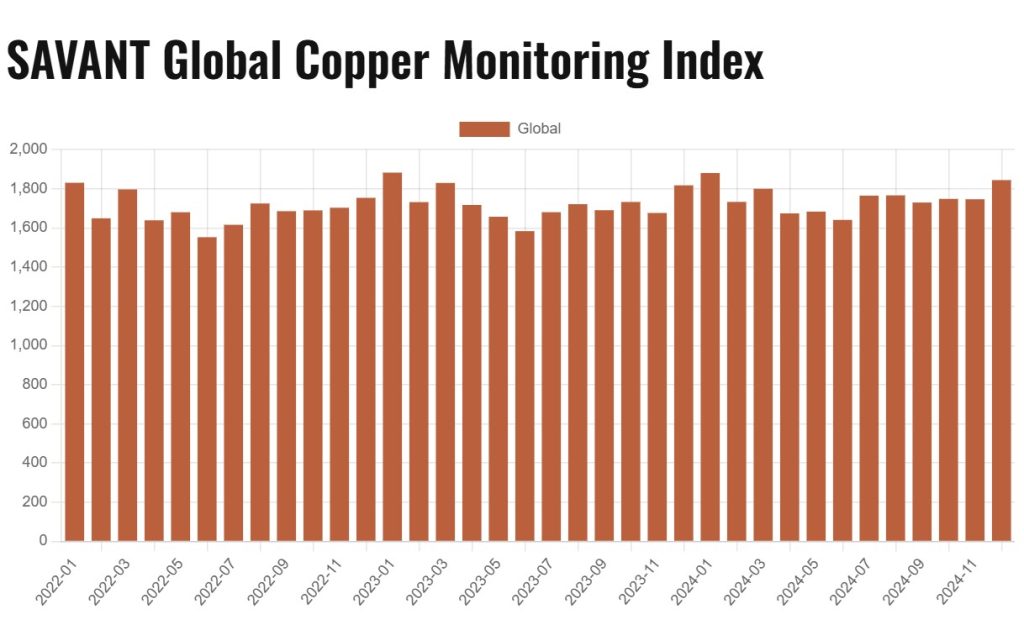
“As we pointed out last month, this is consistent with seasonal patterns driven by the timing of Chinese New Year, as well as the requirement to have product ready for semi fabricators to take advantage of the uptick in economic activity that comes with the end of winter in the northern hemisphere.”
The great copper conspiracy
Earth-i hypothesises in its latest feature article Cat Theory and The Great Copper Conspiracy it seems operators on the mainland have taken the collective position they are more able than competitors to ride out an extended period of low treatment and refining charges, which has fallen sharply again in recent weeks.
“And not only are existing smelters like Daye’s 400 kT/a Hongsheng Copper coming back online, but new facilities are ramping up, with Yunnan Copper’s 200 kT/a Kunming 2 and Jinchuan’s 300 kT/a Gansu no.2 being the most prominent, which Savant monitoring shows have started commissioning since October and November respectively,” the company says.
Smelting inactivity in the rest of world also declined by 0.5% to give an average inactivity reading of 9.9% for January – again the lowest reading in almost two years.
At a regional level, Earth-i notes activity in Asia and Oceania rose for the third consecutive month, while that in Europe rose for the fourth month in a row. Interestingly, the 3.7% rise in regional smelting activity in the latter was primarily the result of strong activity signals from the larger smelters in the region, especially Aurubis’ 360 kT/a Pirdop in Bulgaria.
“This would seem to build on the strong Q4 2024 operating result which saw the smelter produce 57 kT of copper cathodes during the period, as work progresses with the expansion of the tankhouse that will increase capacity at the site by around 50% to 340 kT/a,” the company reports.
Activity in South America also increased with the regional inactivity index falling from an average of 34% in December 2024 to 25.2% in January.
The only two regions where inactivity rose during the month were Africa and North America, by 8.7% and 12.4% respectively. However, the two regions came off a base of smelting activity at multi-year highs.
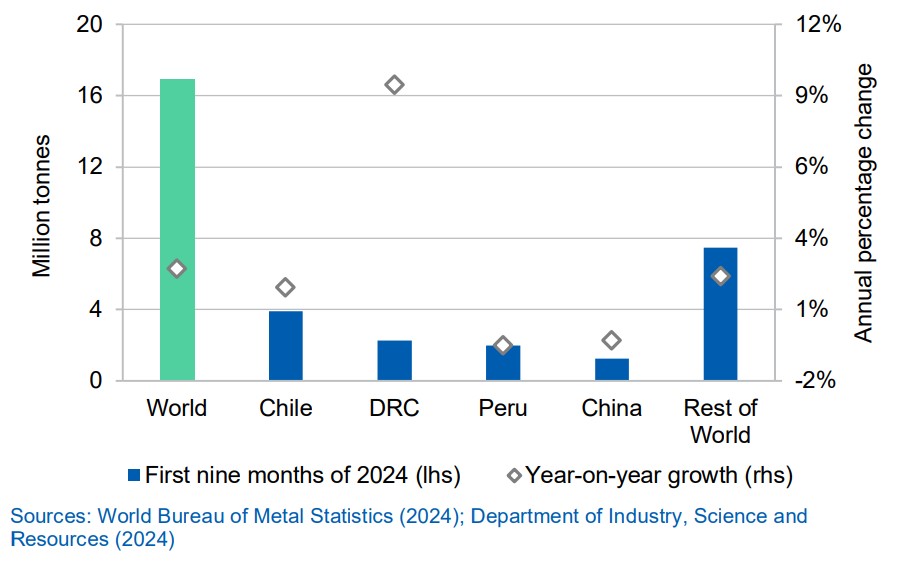
Global mine production reached 16.8 million tonnes in the first nine months of 2024 — a 2.4% increase compared to the same period in 2023 (pictured below). Mine output rose in Chile (up 2%), the Democratic Republic of Congo (DRC) (up 9.6%), and Indonesia (up 6.9%).
This growth was due to improved output at major mines in Chile, recovery of constrained output in Indonesia and better power supply in the DRC. Peru’s output fell by 0.6% in the first nine months of 2024, driven by community blockades and weather issues.
In the first nine months of 2024, global refined copper demand was 21.2 million tonnes, 4.3% higher than the same period in 2023. Demand growth was broadly based across key copper consuming markets – China (up 2.4%), the US (up 1.4%), ex-China Asia (up 7.6%), and the European Union (up 6.1%).
Demand in the rest of the world surged by 15%, although it only accounted for 900,000 tonnes of global demand over the same period.
Global demand is forecast to grow by about 3% annually, reaching 28.9 million tonnes in 2025 and 29.8 million tonnes in 2026.
Chinese copper demand, driven by manufacturing, the energy transition and construction remains resilient, according to the Department of Industry, Science and Resources.
Global mine output is expected to reach 23.2 million tonnes in 2025 – an increase of around 3% compared to 2024 – and 23.9 million tonnes in 2026.
This growth is expected to be driven by capacity expansions at operating mines and the opening of new mines in Chile, the DRC, and China. However, declining ore grades, funding scarcity, disruptions from energy access, regulatory complexity, weather events and social unrest could hinder growth over the outlook period.
Write to Adam Orlando at Mining.com.au
Images: Earth-i & Department of Industry, Science and Resources


