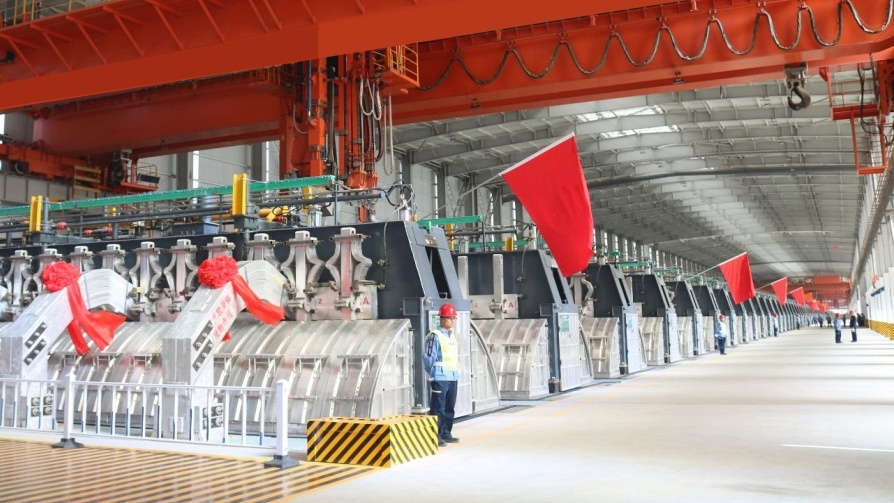
China’s aluminium production hit a monthly record in August as smelters ramped up output to help fill a global supply shortfall caused by the conflict in the Middle East.
The country produced nearly 4 million tonnes of aluminium during the month, up 4.7% from a year earlier, according to official data cited by Bloomberg.
That brought year-to-date production to more than 31 million tonnes as the industry approaches the government’s limit of around 45 million tonnes of annual capacity.
Chinese smelters have been increasing production to take advantage of higher export margins after the US-Iran war disrupted around 9% of global aluminium supply.
Disruptions across the Gulf initially pushed aluminium prices to their highest level in four years. Since then, Chinese producers have helped ease supply concerns by signalling their willingness to increase exports.
Production cap looms
However, the rapid increase in production leaves Chinese smelters with limited room to raise output over the remainder of the year as the industry nears the government-imposed capacity cap.
China introduced the roughly 45-million-tonne annual smelting capacity ceiling in 2017 as part of efforts to curb structural oversupply, carbon emissions, and electricity consumption in the power-intensive aluminium industry.
After setting a monthly record in August, output levels will be closely watched over the final four months of the year.
Steel output continues to fall
Elsewhere in China’s industrial sector, steel production fell 3.7% year on year in August as the country’s prolonged property crisis continued to weigh on demand.
Output is on track to finish the year at its lowest level since 2018.
Manufacturing and exports have provided some support, although the seasonal increase in construction activity during autumn could determine how much further steel production declines.
Mixed energy production
Meanwhile, both oil and natural gas production increased 0.8% in August.
Coal output fell 7.7% as production remained affected by disruptions following the Shanxi disaster in May.
Benchmark thermal coal prices have since climbed to their highest level since 2023, with China’s statistics bureau saying the country will step up efforts to strengthen domestic energy supplies.
Oil refinery runs also increased in August as more crude passed through the Strait of Hormuz or arrived from Russia. However, refinery activity remained 6.9% below the level recorded a year earlier.
Write to Jackson Chen at Mining.com.au
Image: CHINALCO