



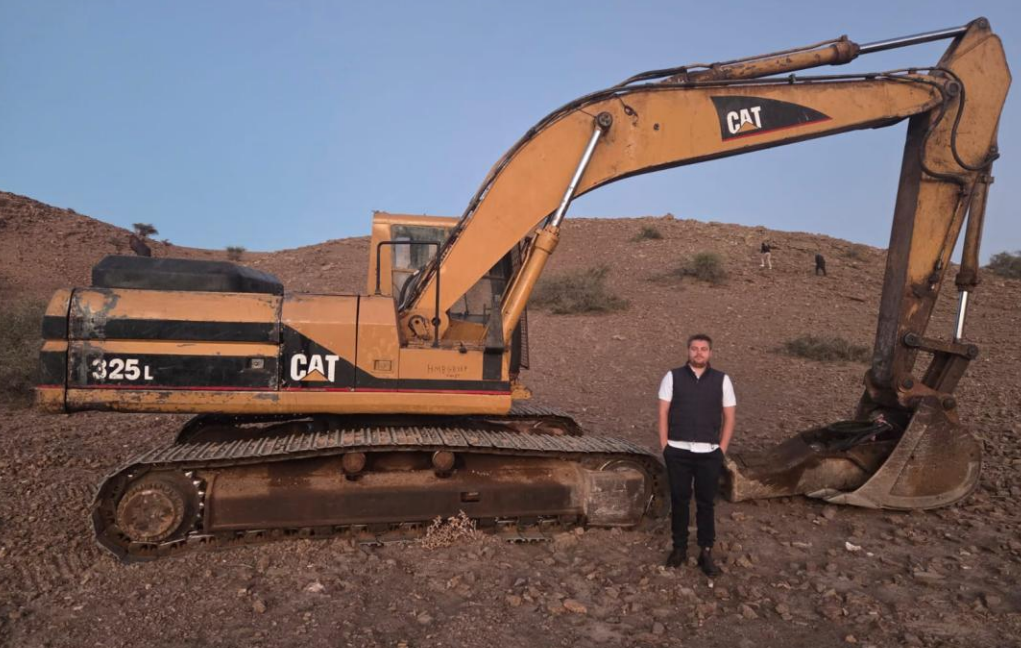
The excavator for a planned trenching program at Zeus Resources’ (ASX:ZEU) Casablanca Antimony Project in Central Morocco has now been mobilised to site.
As reported by Mining.com.au, Zeus has been streamlining a trenching program at Casablanca and was awaiting final approval from the local forestry department.
The company intends to test surface expression of chargeability anomalies across eight trenches, following findings in an August induced polarity induced polarisation survey.
The company has received confirmation that trench one (T1), which is located on privately held land, is permitted to proceed under the approvals for that area.
As private land permitting follows a separate process, T1 has advanced ahead of the remaining proposed trenching program.
Zeus continues to progress the outstanding permitting requirements for the broader trenching program, which relate to areas situated on Forestry-administered land.
These applications remain under review by the relevant authorities.
Trenching will be structurally mapped and sampled to refine geological understanding of mineralisation style aiming to design drilling targets for Stibnite anomalies observed at earlier geophysical surveys.
Each trench will be designed to expose fresh bedrock across mineralisation ahead of geological mapping and structural measurements taken to guide future exploration.
Antimony has gone from niche to indispensable in short order. Driven by China’s export ban, recent structural supply constraints, and rising critical minerals policy urgency in the US, antimony is now a red-hot commodity, as reported by this news service.
Presently, about 90% of global antimony production is controlled by China, Russia, and Tajikistan, which is creating significant supply risks for Western nations such as Australia, Canada, and the US.
Antimony is a critical metal. As independent advisory firm Blue Ocean Equities notes, it has one of the most skewed resource endowment distributions outside of Western countries, including many that are openly hostile to US economic and defence interests.
China historically dominates as the primary production of antimony including across the supply chain with advanced processing capabilities.
Blue Ocean Equities reports Chinese mine production decreased from 110kt in 2015 to 40kt in 2023. Key drivers for this decline in mine supply include depletion of higher grade resources and tighter environmental controls amid consolidation of small-scale mining.
A forecast by China Merchants Securities suggests antimony demand from the photovoltaic sector alone will increase from roughly 16,000 tonnes in 2021 to 68,000 tonnes in 2026. The industry’s share of total consumption is poised to rise from 11% to 39%.
Write to Adam Orlando at Mining.com.au
Images: Zeus


