Society is at a standstill, awaiting the ongoing Middle East crisis to potentially fledge into World War III.
News services are running around the clock to report live updates on the US and Israel’s war with Iran, as the US admits it has attacked around 11,000 targets across Iran since the first US-Israeli strikes began on 28 February 2026.
As the war heats up and uncertainties rise globally, there is one thing that remains certain: the world needs antimony.
In the defence sector, antimony is used as a hardening agent in ammunition and alloys, holding flame-retardant properties that are crucial for military purposes.
Antimony has been in hot demand over the last year or so, as supplies remain scattered and China, the world’s lead producing country, cuts off supply for many critical minerals.
Mining.com.au reports around 90% of global antimony production to be sourced from China, Russia, and Tajikistan, while the US’ domestic supply remains virtually non-existent.
Western nations are struggling to meet supply demands as the need for critical minerals continues to grow. Antimony supply in particular has become indispensable in short order due to export bans, as reported.
According to the Department of Industry, Science and Resources (DISR) December 2025 Resources and Energy Quarterly, Australia had a total of 817 tonnes of antimony ore and concentrate products in the 2024-25 financial year.
The quarterly forecasts Australia to have 1,117 tonnes over the 2025-26 period, before reaching 4,415 in 2026-27, representing a 295% growth over these upcoming periods.
Kalamazoo Resources’ (ASX:KZR) Exploration Director Ben Ackerman tells this news service that heightened geopolitical tensions will often see increasing attention on critical materials, such as antimony, as they “reinforce the importance of secure supply chains”.
“Antimony is used in a range of applications including defence technologies, flame retardants, and advanced energy systems, meaning supply disruptions can have broader strategic implications,” Ackerman tells Mining.com.au.
“While geopolitical developments can create short-term price volatility, the longer-term effect is typically increased investment into exploration and development in stable jurisdictions such as Australia.”
Reloading in Victoria
Kalamazoo Resources is an early stage explorer targeting antimony as part of the company’s broader gold-antimony exploration strategy in the Victorian goldfields.
“Our immediate objective is to identify and define economically viable gold-antimony systems,” Ackerman explains.
In February, the company identified ‘extensive’ gold-antimony anomalism from a surface geochemistry campaign conducted at the Mt Piper Gold Project, located in Central Victoria, as reported by Mining.com.au.
Rock chip sampling returned results up to 3.2 grams per tonne gold and 1,427 parts per million (ppm) antimony at the Kurkuruk prospect over 670m.
Geoscience Australia records 100% of the country’s antimony ore reserves are attainable to the Costerfield mine in Victoria, as of 31 December 2019.
The Costerfield operation is held wholly by Alkane Resources (ASX:ALK) after a merger with Mandalay Resources, and is located 10km northeast of Heathcote in central Victoria.
“Victoria is an attractive jurisdiction with excellent infrastructure, a skilled workforce, and a long history of gold mining,” Kalamazoo’s Ackerman says.
“Should exploration success continue, discoveries in this region could ultimately contribute to diversifying global antimony supply, particularly as governments and industry increasingly prioritise secure and transparent supply chains.
“At our Mt Piper Gold Project located to the immediate south of Costerfield, we are exploring multiple targets where the structural setting and geochemical signatures are consistent with this style of mineralisation within one of the more prospective emerging gold-antimony exploration areas in Victoria.
“Our exploration program combines systematic surface geochemistry, detailed structural interpretation, and targeted drilling.
“Overall, our strategy remains centred on disciplined exploration with the aim of delivering meaningful gold-antimony discoveries within the Victorian goldfields, while continuing to advance the Ashburton Gold Project in Western Australia.”
Kalamazoo Resources is an Australian explorer focused on advancing its portfolio of gold and base metals projects.
Market demands antimony
Critical minerals have been in dire need for longer than the US-Israel war with Iran.
China’s call to halt exports has created a lot of uncertainty for supply chains, which Albright Metals (ASX:ABR) CEO Greg Hill says has translated to “market volatility”, with the specific antimony market likely to follow.
“Longer term, though I think the conditions are still very supportive for antimony prices,” Hill tells Mining.com.au.
“A big part of the reason for China preventing exports is because antimony is critical for many industrial applications, and China cannot produce enough for its own needs.
“The conflict risks short to medium term damage to the global economy which could reduce some industrial demand for the mineral.
“However, China has always taken a long view on mineral supply, so they are unlikely to allow antimony exports any time soon, which will continue to support prices outside their sphere of control.”
Hill explains that throughout the second quarter of 2026, investor sentiment should remain “positive” as the commodity is perceived as a defence critical mineral, which is desired in escalating conflicts.
Albright is focused on gold production, with an exploration upside in antimony.
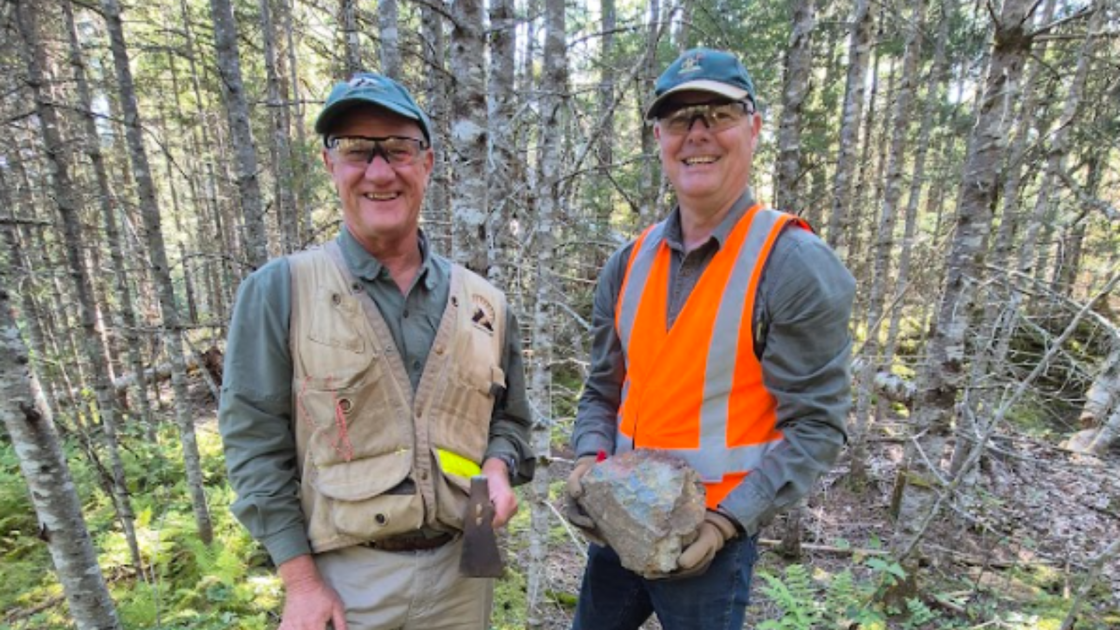
The company just headed back on site at the Golden Pike Project in New Brunswick in Canada to restart drilling in March, targeting antimony at the Bond Road and Albright Brook prospects, as reported by this news service.
“We are advancing our antimony exploration program at the Golden Pike Project by continuing our planned drilling,” Hill explains.
“We are also actively assessing additional antimony prospects for expanding our exploration efforts.”
The current drilling campaign will cover 460m of drilling for three holes, targeting ‘high-grade’ antimony veins within interpreted fault structures.
“From what we have seen, New Brunswick, Canada is very prospective for multiple high grade antimony deposits,” Hill explains to Mining.com.au.
“With high grades comes the opportunity to rapidly develop antimony mines with relatively small capital investment.
“Plus, our project site is close to excellent infrastructure and support services that would facilitate development and supplying antimony concentrate to western markets.”
The CEO says in order to navigate China’s dominance in the antimony market, Albright will target buyers in Europe, North America and Japan that have been excluded from China’s supply.
“I think the conflict could spur new demand for antimony and other strategic minerals as governments start to look at creating their own strategic stockpiles, as the US is doing,” Hill adds.
Targets set on the US
One explorer focused on creating a significant US-based antimony supply chain in times of need is Felix Gold (ASX:FXG).
Just last week, Felix exercised its option to wholly acquire the Treasure Creek Project from Goldstone Resources and Oro Grande Mining Claims, after the company confirmed that hand-sorted bulk ore exceeds the US Military Concentrate Specification.
Excavation, hand sorting, and bagging of massive stibnite vein delivered a 370kg ‘high-grade’ sample to Core Resources for characterisation and testwork, which reported that the ore samples exceed military requirements and confirms ‘exceptional’ direct-shipping quality of the ore prior to processing, as reported.
Located in the Fairbanks Mining District of Alaska, the Treasure Creek Project hosts one of the only proven sources of antimony ore in the US.
On the return of the military grade ore, Executive Director Joseph Webb says that the ore characteristics are important to note.
“This is not concentrate – this is ore: Direct Shipping Ore that meets military-grade specifications,” Webb says.
“There are no known sources to the company’s knowledge of military-grade antimony concentrate in the Western world – and this exceeds that threshold straight out of the ground.
“It can then be converted to metal – either by direct smelting of untreated ore or by leach and electrowinning – both without pre-treatment and at coarse grind.”
Felix Gold is a gold and critical minerals explorer, focused on the Tintina Gold Province in Alaska, US.
Write to Maddison Elliott at Mining.com.au
Images: Mining.com.au & Albright Metals