



Tin has been one of the best-performing commodities over the last three years.
It’s a niche metal that has come into focus because of its restricted supply and growing demand.
Even so, tin dropped 5% in one session last week. This may be nothing more than short-term volatility.
There has been very little investment in the sector for many years.
The only active tin producer listed on the Australian Securities Exchange (ASX) is Metals X (ASX:MLX), which operates a mine in Tasmania. Clearly management at Metals X still sees upside to tin.
Yesterday, Metals X announced to the ASX that it has presented a non-binding, unsolicited proposal to acquire a smaller tin developer called First Tin (LSE:1SN). First Tin is listed on the London Stock Exchange and its shares were up 20% on Friday after the company notified British investors of the proposed acquisition.
Metals X is already a shareholder of First Tin. At the last quarterly update, the company said it owned 162 million shares in First Tin, or around 29.95% of its issued capital. Metals X had invested $16.87 million in First Tin at the time of the report.
Under the terms of the deal, Metals X is offering £0.15 per share for the remaining equity of First Tin that it doesn’t already own.
The company is well funded to make the bid. It has been generating strong cash flows from the high tin price and disclosed almost $374 million in cash and cash equivalents as at 30 June.
Tin inventories drop 50%
One of the more interesting aspects of the tin sector is the low level of inventories, as reported from ASX-listed tin developer Elementos (ASX:ELT).
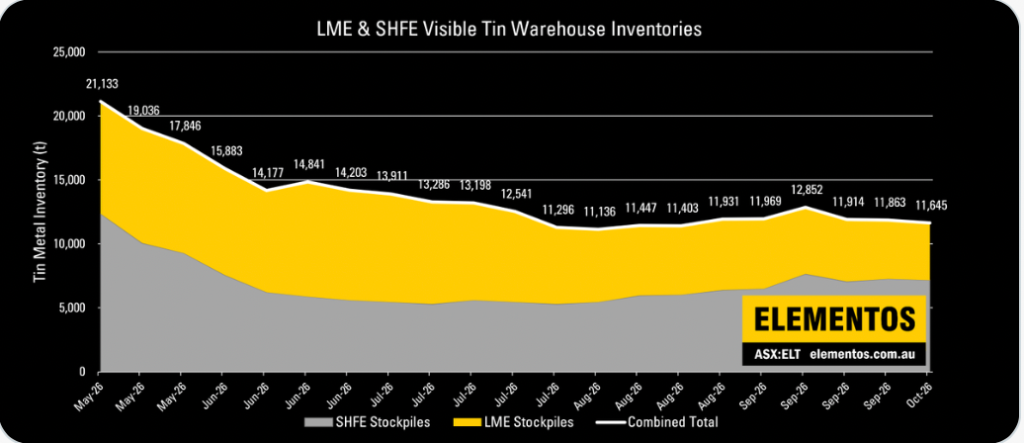
Source: Elementos
Elementos says tin inventories have dropped by around 50% over the last six months, despite significant macroeconomic uncertainty during the same period.
The team at Elementos posted on 9 October:
“There is only 11,645 tonnes of tin in global warehouses, [approximately] 10 days of demand. But did you know that 99% of this inventory is located within Asia?
- 62% China, 17% Hong Kong, 18% Malaysia, 0.9% Singapore, 0.6% Taiwan,
- only 1% sits in Europe,
- and 0% in North America
“Non-Asian economies are completely exposed to tin supply shortages, with no buffer to withstand supply shocks.
“Elementos is developing Europe’s only mine-to-metal tin supply chain to ensure the European Union can shore up tin supplies for its green transition, data, AI, and electronics industries.”
These low tin inventory levels contrast with copper, which is hitting quite a high level in the US.
That’s despite the fact that most investors would be more familiar with the copper narrative because of the AI buildout and the shift towards electrification.
No tin? No AI semiconductors
Tin’s biggest use is in soldering electronics. That includes almost all electronic devices, such as mobile phones and computers. Tin is also used in semiconductors, including the most advanced chips.
That means the AI ‘industrial revolution’ relies, in part, on this old industrial metal.
Write to Callum Newman at Mining.com.au
Main image: Unsplash


