



Thorium is not a near-term production commodity, but is increasingly relevant to Australia’s long-range defence and energy security planning. Abundant domestically and commonly hosted within rare earth mineral systems, thorium represents a strategic resource whose value lies in optionality rather than immediacy.
As digital oversight, nuclear innovation, and geopolitical uncertainty converge, thorium’s role shifts from geological curiosity to latent national asset.
Mining.com.au previously reported thorium is similar to uranium and can be used as a source of nuclear power with consensus there’s probably more energy available from thorium than from both uranium and fossil fuels.
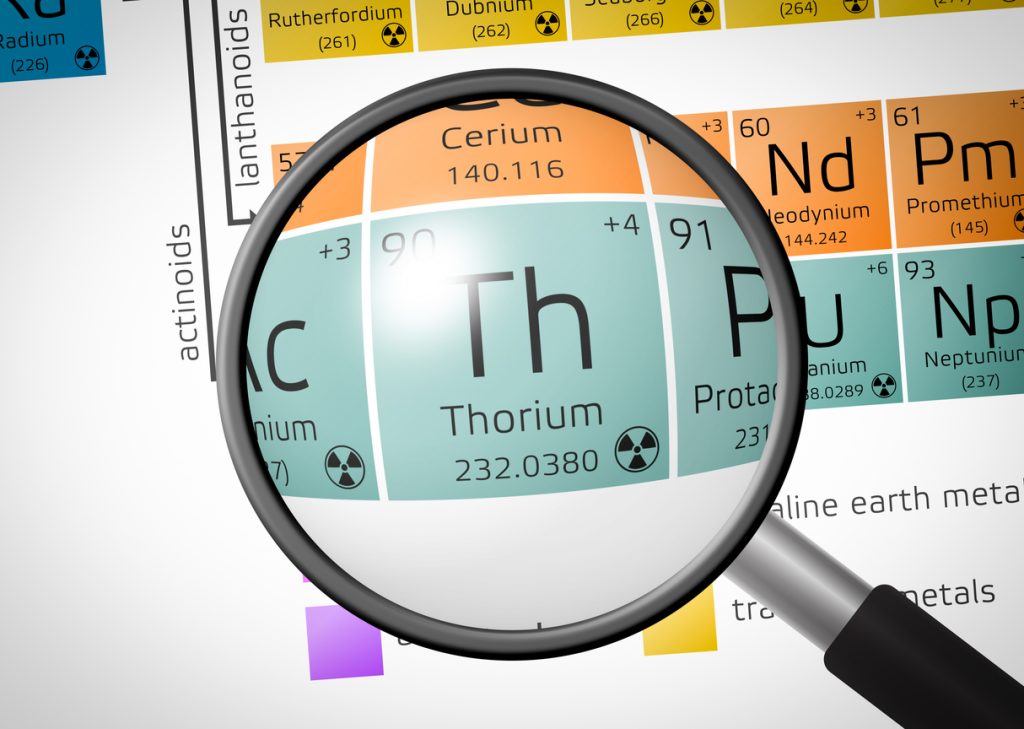
It is a weakly radioactive, silvery metal and important alloying agent in magnesium, as it imparts greater strength and creep resistance at high temperatures. Thorium oxide is used as an industrial catalyst and was formerly added to glass during manufacture to increase the refractive index, producing thoriated glass used in high-quality camera lenses.
In a strategic context, thorium is emerging in defence planning through three intersecting lenses – energy security, supply chain sovereignty, and advanced nuclear capability.
In this report, Mining.com.au outlines why thorium warrants attention within defence-adjacent mining policy, how digital technologies reshape its viability, and what strategic signals to monitor between now and 2030.

No longer flying under the radar
Military and defence spending is rising across the world, which is leading to more demand for metals and minerals crucial to the sector from antimony to rare earths to thorium and uranium.
World Population Review reports America leads the world in military and defence spending at about $970 billion, ahead of China ($320 billion), Russia ($150 billion), and Germany ($86 billion). Australia ($33 billion) and Canada ($29 billion) are way down the list.
Unlike uranium, thorium is not currently embedded in Australia’s nuclear fuel cycle. However, its abundance (three times more abundant than uranium and about the same as lead), distribution and byproduct nature within rare earths systems offer Australia a potential future advantage should alternative nuclear technologies mature and longstanding policies change.
Analysis from the Center for Strategic and International Studies (CSIS) shows that critical minerals cooperation, including nuclear fuel inputs, offers a way for the allied partners of Western nations to find common ground and bolster defence supply chains.
Although thorium itself is not singled out, the report stresses the defence sector’s growing reliance on strategic mineral security as part of broader geopolitical competition.
From a defence perspective, thorium offers strategic optionality. Advanced reactor concepts, particularly those designed for long-duration, low-maintenance power, are often discussed in the context of remote installations, hardened infrastructure and future naval or industrial systems.
While these technologies are not yet commercial-ready, thorium’s presence especially within Australia’s resource base positions the country to not be structurally excluded from future pathways.
In October 2025, the Government of Canada announced the launch of the Critical Minerals Production Alliance with allied partners – a C$6.4 billion initiative to accelerate critical minerals supply chains crucial for defence, clean energy, and advanced manufacturing.
Minister Tim Hodgson says the measures will “accelerate and unlock” projects vital to strengthening national and allied security interests. While not solely about thorium, this reflects how critical minerals policy – including uranium and potentially byproduct thorium – is being integrated into defence industrial strategies.
Organisations from the International Atomic Energy Agency (IAEA) to the Nuclear Energy Agency (NEA) to the World Nuclear Association point out in terms of defence, there’s no readiness to mine thorium tomorrow, but there should be readiness to respond if demand emerges and technology advances.
Collaboration under the microscope
Thorium in Australia does not typically occur as a primary target. It is most often found in monazite-bearing rare earth deposits, alongside zircon and titanium minerals.
As global tensions rise and a potentially irreversible fracturing of the North Atlantic Treaty Organization (NATO) emerges, this aspect could become important for defence strategy as it reduces standalone project risk, enables thorium to be extracted within existing or future critical-minerals supply chains, and avoids the need for a dedicated thorium mining industry.
A November 2022 report by law firm Herbert Smith Freehills Kramer notes that Australia has leveraged existing trade relationships with America, India, and Japan (formalised under the recently signed Critical Minerals Partnership), establishing commitments towards building secure critical minerals supply chains between Australia and each relevant economy.
The firm reports that using these partnerships, Australia can garner investment in collaborative ventures in the critical minerals industry, from research and development and pilot studies through to commercial projects.
“These international agreements help Australia to solidify trade pathways for critical minerals demand and its reputation as a reliable supplier of resources to the world,” the firm says.
“The growing global demand for critical minerals, coupled with Australia’s significant demonstrated reserves and commitment from the Australian Government places Australian mining companies in a position to benefit from investing in critical mineral exploration.”
There are commercial opportunities available to repurpose existing exploration and mining operations to take advantage of existing infrastructure and supply chains, including co-production of critical minerals occurring at existing sites; establishing new processing and extraction facilities on existing sites; post-production extraction of metals, such as deriving metals from mine waste (tailings extraction); and mine closure and rehabilitation planning, Herbert Smith Freehills Kramer continues.
To ensure that any benefits earned from critical minerals exploration and processing activities are not offset by the material geological, political, trade, and investment risks associated with critical minerals, sharing of risk allocation can be achieved by utilising collaborative contracting structures.
From a strategic resilience standpoint, co-production would allow thorium to “ride along” with commodities already recognised as defence-critical, particularly rare earths used in electronics, guidance systems and advanced manufacturing.
As Herbert Smith Freehills Krame notes, this structure lowers barriers to future access while keeping regulatory and environmental controls intact.
Data, defence, and digital oversight
Digital transformation in mining and land governance is emerging as one of the most significant changes affecting thorium’s future relevance. Modern mining operations increasingly rely on satellite-based monitoring, AI-driven predictive analytics, and secure digital traceability systems.
AI uptake in particular is set to soar in 2026 as demand rises, testing grid limits, revenue models, and sustainability goals. In S&P Global Energy’s latest Horizons Top Trends report for 2026, AI growth and geoeconomic shifts in clean technology markets confirm that energy expansion and sustainability are linked imperatives, as reported by Mining.com.au.
S&P Global Energy’s high-growth view reveals that global data centre power demand will rise 17% to 2026 and 14% per year through 2030. As a result, potential demand is forecast to reach more than 2,200 terawatts per hour, roughly equivalent to India’s current total electricity consumption, which accounts for 2,054 terawatts per hour as of 2023-24.
Data centre sustainability commitments vary significantly, according to S&P Global Energy, and net zero ambitions are not a given. Data from a 2024 S&P Global corporate sustainability assessment shows that 38% of assessed companies with data centre operations lack a net zero commitment.
For miners, these aforementioned technologies deliver real-time visibility over extraction, environmental impact, and compliance, which are essential when dealing with materials that intersect with nuclear policy and international scrutiny.
From a defence perspective, this capability matters as it enables secure oversight of sensitive materials, assurance of regulatory compliance, and transparent reporting to domestic and international stakeholders
Platforms developed by groups such as Farmout demonstrate how satellite intelligence and digital monitoring systems now support resource oversight at scale, including for regulated or strategically sensitive commodities.

Regulatory and security considerations
Thorium mining is constrained less by geology than by regulation and market structure. The market is far from mature and amid strict environmental and radiological controls, there must be alignment with global nuclear frameworks.
From a defence planning perspective, these constraints could become magnified given the current fracturing of long-held international relations of what have been allied global partners.
As such, analyses show that thorium-based nuclear systems, if proven viable, could theoretically support long-duration, low-carbon power generation without the refuelling frequency associated with conventional fuels.
While this remains forward-looking, the strategic logic aligns with broader defence objectives around reduced fuel logistics exposure, enhanced infrastructure autonomy, and long-term emissions management.
As previously reported by this news service, thorium’s relevance therefore sits not in current energy policy, but in future contingency planning. Capital markets are not yet pricing thorium as a commodity.
Thorium’s integration within rare earth value chains also means defence investment does not require standalone funding mechanisms – it can leverage existing critical minerals strategies.
This silvery metal is not an urgent defence commodity but it is a strategic one. In an era where defence resilience increasingly depends on energy security and supply chain sovereignty, thorium is emerging as a resource investors are watching.
Write to Adam Orlando at Mining.com.au
Images: iStock


