



Thorium, much like uranium survives on Earth because it has isotopes with long half-lives but is about three times more abundant in nature than uranium. It’s fertile rather than fissile and can only be used as a fuel in conjunction with a fissile material such as recycled plutonium.
About 200 years ago, Jöns Jakob Berzelius of the Royal Karolinska Institute, Stockholm extracted thorium from a rock specimen sent to him by an amateur mineralogist who had discovered it near Brevig. The mineral turned out to be thorium silicate, and it is now known as thorite, with Berzelius realising that it had not previously been reported.
Berzelius even produced a sample of metallic thorium by heating thorium fluoride with potassium, and confirmed it as a new metal.
Thorium’s radioactivity was first demonstrated in 1898 by renowned German scientist Gerhard Schmidt and confirmed by Marie Curie. Thorium’s predominant isotope thorium-232 has a half life of 14 billion years.
It is a weakly radioactive, silvery metal and important alloying agent in magnesium, as it imparts greater strength and creep resistance at high temperatures. Thorium oxide is used as an industrial catalyst and was formerly added to glass during manufacture to increase the refractive index, producing thoriated glass used in high-quality camera lenses.
Similar to uranium, thorium can be used as a source of nuclear power and there is consensus there is probably more energy available from thorium than from both uranium and fossil fuels.

Slow path to power
India and China are in the process of developing nuclear power plants with thorium reactors, but this technology is still in its early days.
In November 2025, the Shanghai Institute of Applied Physics of the Chinese Academy of Sciences announced that the experimental TMSR-LF1 thorium-powered molten salt reactor in Wuwei, Gansu Province achieved the first successful conversion of thorium-uranium nuclear fuel.
The International Atomic Energy Agency (IAEA) and the OECD Nuclear Energy Agency (NEA) joint publication Uranium 2016: Resources, Production and Demand (often referred to as the Red Book) gives a figure of 6.2 million tonnes of total known and estimated resources (the 2018 edition of the same publication did not provide estimates of thorium resources).
World Nuclear Association data for reasonably assured and inferred resources recoverable at a cost of $80/kg Th or less, excluding some less-certain Asian figures, shows India topping the list of estimated world thorium resources at 846,000 tonnes, followed by Brazil (632,000t), Australia (595,000t), US (595,000t), and Egypt (380,000t). China sits 11th on the list with 100,000t.
There is no international or standard classification for thorium resources and such identified resources do not have the same meaning in terms of classification as identified uranium resources. Thorium is not a primary exploration target and resources are estimated in relation to uranium and rare earths resources, as per the World Nuclear Association.
The most common source of thorium is monazite, a rare earth phosphate mineral and minor constituent of heavy mineral sand (HMS) deposits. On average, monazite contains about 6% thorium and 60% rare earth elements, according to Geoscience Australia.
Monazite is found in igneous and other rocks with its richest concentrations in placer deposits, associated with other heavy minerals. Global resources are estimated to be roughly 16 million tonnes – 12Mt of which are in heavy mineral sands deposits on the south and east coasts of India.

More abundant than uranium, still overlooked
While this naturally occurring metal does not dominate the headlines much in the same way as uranium, thorium’s use and applications as a new primary energy source has been a prospect for some time.
It’s being touted as potentially more cost-effective in extracting its latent energy value but this remains a challenge and requires considerable R&D investment.
As mentioned, thorium rarely dominates mining headlines the way lithium, copper or uranium do, but as interest in advanced nuclear technologies grows, investors are quietly eyeing public markets that offer exposure to this often-overlooked element.

Australia has a major share of the world’s thorium resources. Unlike uranium, which is well represented by a broad suite of listed miners in Australia and Canada, pure thorium explorers are scarce – in part because thorium is usually a byproduct of rare earth and heavy mineral sands production and not yet a standalone commercial commodity, as per Geoscience Australia.
Yet several listed companies on the ASX, TSX, TSX-V, and CSE exchanges have indirect or emerging exposure to thorium, either through rare earth projects, monazite-rich heavy mineral sands or diversified mineral portfolios that include thorium-bearing minerals.
Mining.com.au breaks down the key players and how they fit into the evolving picture looking ahead to 2030. (This is by no means an exhaustive list.)
Thorium’s hidden resource base
In Australia, thorium resources are typically found in heavy mineral sands (HMS) and monazite-rich rare earth deposits, but are seldom reported separately in company disclosures because there is currently no significant commercial market for thorium itself.
AustralianUranium reports several ASX-listed explorers and developers contain thorium within broader resource inventories, including Arafura Resources (ASX:ARU), which is best known for its Nolans Rare Earths Project, where thorium occurs in monazite alongside rare earth elements.
The Nolans Project will encompass a mine, process plant (comprising beneficiation, extraction and separation plants) and related infrastructure to be constructed and located at the Nolans site, 135km north of Alice Springs in Australia’s Northern Territory.
Arafura says the project is underpinned by low-risk mineral resources that have the potential to supply a significant proportion of the world’s neodymium and praseodymium (NdPr) demand.
“It is a globally significant and strategic NdPr project which, once developed, will become a major supplier of these critical minerals to the high-performance NdFeB permanent magnet market,” the company says.
The Nolans project is moving toward first production of neodymium and NdPr products, with byproducts potentially including thorium in the future balance sheets as markets evolve.
As a global critical minerals and major heavy mineral sands producer, Iluka Resources (ASX:ILU) handles monazite-rich materials that contain thorium, although thorium is not currently sold independently.
Thorium is found in mineral sands deposits, specifically within minerals like monazite and xenotime, which are often processed for rare earth elements.
The Wimmera Project, a key development for Iluka, for example contains low concentrations of naturally occurring radionuclides, including thorium, in the ore.
Iluka is developing a rare earth refinery at Eneabba, Western Australia, which will process materials containing thorium and uranium. The project has associated radiation management and waste management plans to handle these materials.
The company also operates specialised disposal facilities for mineral sands byproducts that may contain thorium, such as the Pit 23 facility at the Douglas Mine.

X marks the spot
RareX (ASX:REE) is an Australia-based company focused on exploring and developing rare earth elements, primarily through its 100% owned
Cummins Range Rare Earths Project in the Kimberley region of Western Australia. While RareX’s main focus is NdPr, the project is a carbonatite-hosted deposit, which typically contains thorium as a byproduct.
Cummins Range is a carbonatite pipe, the centre of which has been the focus of exploration and where the current deposit is defined. Particularly to the North-East, the company says there exists geophysical anomalies consistent with further intrusions and with minimal and poorly placed past drilling.
RareX’s Cummins Range Project in Western Australia is a near-permitted multi-critical mineral deposit containing rare earths, gallium, scandium, and phosphate. The project holds a resource estimate of 1.6 million tonnes of total rare earth oxides and 24 million tonnes of phosphate, as reported by this news service.
Technical studies at the Cummins Range project have identified the presence of thorium. A 2022 Scoping Study notes a thorium-uranium content of 159ppm.
While RareX is heavily focused on the development of its rare earth resources on 20 January 2026 it appointed Glen Edwards as the General Manager for business development, effective immediately. In his role with RareX, Edwards will assist the company in its East African business development activities, playing a key role in advancing its broader growth portfolio, as reported by Mining.com.au.
Other ASX-listed company with potential exposure to thorium include Lynas (ASX:LYC), VHM (ASX:VHM), and FYI Resources (ASX:FYI).
These ASX companies do not purport to be thorium miners, but their projects contain thorium-bearing minerals that could become strategic if the metal’s role in future nuclear fuel cycles expands.
There are many more companies that may have thorium listed under rare earths, monazite, and heavy mineral sands related projects.
Canada’s case for nuclear metal
Canada’s stock exchanges are globally notable for hosting mining equities, particularly through the Toronto Stock Exchange (TSX) and TSX Venture Exchange (TSX-V), which together list around 40% of the world’s public mining companies.
Most initiatives with potential thorium exposure on Canadian markets come via uranium or rare earth exploration companies.
One such company is Skyharbour Resources (TSX-V:SYH) and its partners hold projects in the Athabasca Basin, a premier uranium district where thorium can be found associated with uranium and other radioactive minerals.
In May 2023, Skyharbour entered into an option agreement with North Shore Energy Metals for the latter to execute an earn-in option to acquire an initial 80% and up to a 100% interest in the South Falcon Property located in Saskatchewan, Canada.
As far back as 2015, Skyharbour’s Falcon Point Uranium and Thorium Property located 55km east of the Key Lake Mill contained a uranium and thorium resource at the JNR Fraser Lakes target.
Elsewhere, Skyharbour plans to conduct a ‘major’ 2026 exploration campaign spanning several of the newly-formed Russell Lake joint venture properties in Canada together with Denison Mines (TSX:DML), as reported by Mining.com.au.
More than 15,000m of diamond drilling is planned across the Wheeler North, RL, and Getty East properties – each of which were formed following completion of the strategic transaction with Denison Mines.
Drilling will be conducted where previous drilling identified extension faulting and intense illite- and dravite-dominated alteration, together with elevated uranium and boron geochemistry, which confirms the presence of strong uranium-mineralising hydrothermal systems.

Relegated to byproduct status
As mentioned, pure thorium mining companies remain effectively nonexistent on major exchanges today as currently there is no robust global market or pricing reference for thorium as a mined commodity.
It often stays in concentrate streams or is stockpiled because it lacks a regular offtake, according to Geoscience Australia.
The reality is, thorium is most commonly found as a component of rare earth and heavy mineral sands deposits – industries that currently prioritise rare earths, titanium, zircon or other higher-value elements.
While it has long been touted as a safer and more abundant alternative to uranium for nuclear fuel, commercial thorium reactor technology remains developmental and not yet material on a global scale.
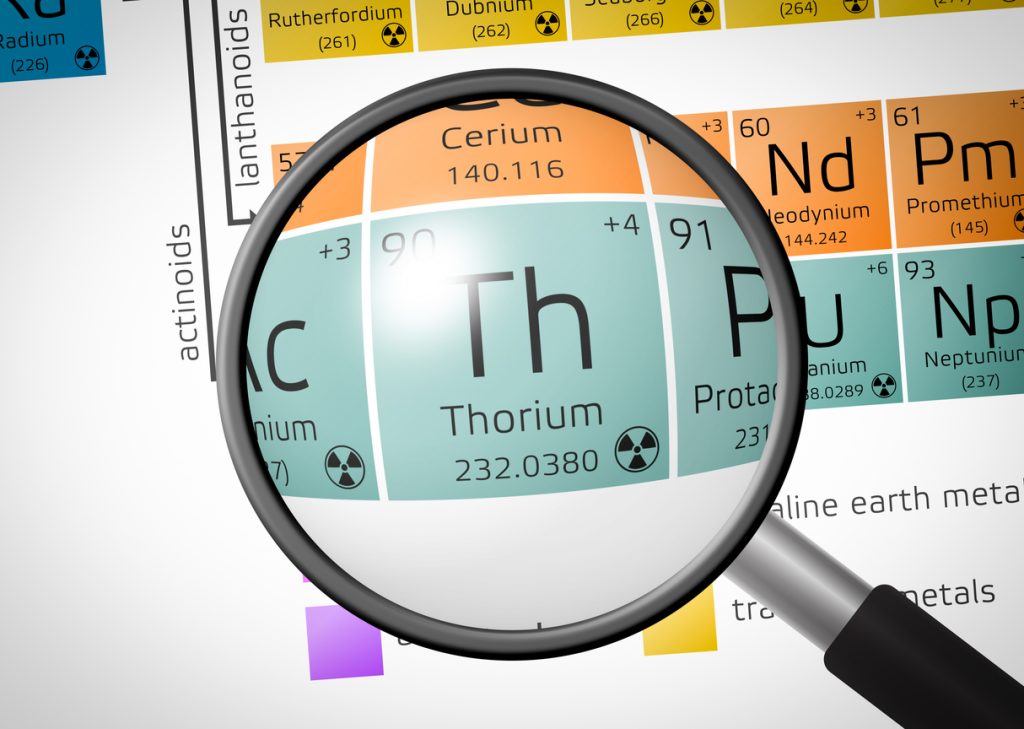
Geoscience Australia says commercial use of thorium as a nuclear reactor fuel is still some decades away, with only small scale and intermittent research into associated technologies.
However, thorium-fuelled reactors have previously operated to generate electricity in Germany and the US, while as mentioned earlier, India has an operational test facility in operation with plans for a network of larger commercial facilities.
If monazite processing becomes a bigger focus to feed electric mobility and clean tech demand, analyses show thorium could become a meaningful byproduct revenue stream for rare earth producers.
Should thorium-based fuel designs gain commercial traction – possibly driven by climate policy or advanced reactor technology – listed companies with thorium in their resource base could see a value re-rating.
For now, exposure to thorium in public markets remains indirect and niche, but as commodity markets evolve in response to energy transitions, that may change, opening new strategic plays for explorers and producers with thorium-bearing assets in their portfolios.
Write to Adam Orlando at Mining.com.au
Images: iStock & Unsplash


