


For all his bluster and bravado, it’s hard to escape the conclusion that Donald Trump’s presidency isn’t going to plan — at least when measured against his original policy goals.
There were supposed to be no more foreign wars. We got Iran.
Trump was going to bring down US national debt. It’s now at a record high.
The biggest bugaboo was the trade deficit with China. How’s that going? It’s heading for a record high, too!
The Financial Times reports that China’s trade surplus with other countries has already exceeded US$1 trillion ($1.46 trillion) this year, rising 35% year-on-year in October.
What about tariffs and reindustrialising the US?
There’s just one problem.
The AI investment boom is happening now. Nobody is sitting around waiting for Americans to staff the factories producing integrated circuits and transformers.
Between 2021 and 2025, US imports of AI-related goods increased by around 73%.
That means US companies are sending a tidal wave of US dollars to China.
It also means the US and China are more codependent than ever. Chinese exports are the only thing propping up growth for Beijing. The domestic Chinese economy stinks.
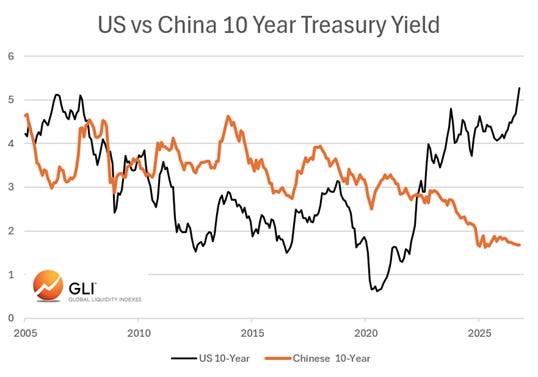
That’s why bond yields are much, much lower in China than in the US.
Now Trump and the US have an extra problem. That’s because of Jensen Huang’s affair with an alleged Chinese spy.
Huang was the CEO of NVIDIA (NASDAQ:NVDA), the AI juggernaut. He may have breached US national security laws — no small matter, even if unintentionally.
I have no idea how this will play out, but a movie couldn’t script it better.
Overarching all this is that the world economy needs the AI buildout to keep going because there’s precious little else to turn to. Governments the world over also have huge debt and deficits to finance. They need growth to keep the maths under control.
That leads me to think Presidents Xi and Trump will reach some form of conciliation.
As it happens, they’re due to meet this month in Shenzhen, China, at the Asia-Pacific Economic Cooperation (APEC) Economic Leaders’ Meeting on 18–19 November.
Now, what might an arrangement look like?
Truth be told, I’m not certain. I’m just speculating. But it could involve China resuming its accumulation of US Treasury securities (debt).
If there is one good thing about China’s trade surplus, at least from Trump’s perspective, it’s that China has to do something with the money.
China has avoided US Treasuries for a long time.
If Trump can induce China to buy US debt, fears around debts and deficits could begin to fade. China, in turn, would support the US in keeping the AI boom going — which would also benefit China.
That’s one idea.
Another might relate to metals and export controls
Benchmark Mineral Intelligence reported this week that China had extended the suspension of certain export controls on rare earths, lithium-ion batteries, and graphite anode materials until 10 January 2027.
Benchmark adds that the original suspension was part of the US-China trade truce agreed in late 2025.
January is not far away. It appears China is keeping an ace up its sleeve but is also prepared to put it on the table.
We also heard this week that physical copper is in short supply in China. No wonder. Much of the world’s copper is sitting in US warehouses!
Clearly, both economies could benefit from de-escalating the stand-off, easing restrictions, and stepping back from the hardball tactics.
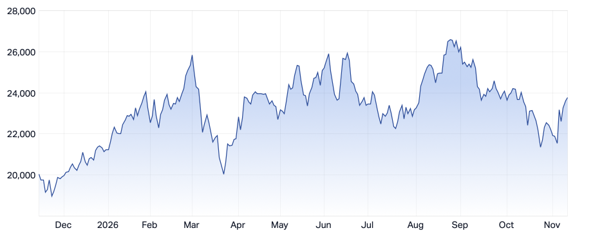
If I’m right, that would be a very positive pivot for markets. It could help reverse the correction we’ve seen in the Materials sector since August.
It might already be turning:
Another tailwind is a falling oil price.
The pressure is easing. One thing we know is that China cut its oil imports during the height of the disruption.
China also appears to have held back from stimulating its economy, despite the obvious need to do so. Perhaps Beijing was concerned that doing so would send oil prices soaring again.
Ready to stay ahead of the market?
Get stories like this, delivered direct to your inbox.
If the Iran war does not escalate and oil prices continue to drift lower, Beijing may be prepared to go harder on efforts to turn around the sliding Chinese stock market and boost weak domestic spending.
That should be good for the broader resources sector, too.
All in all, 2026 has been tough going, especially for the smaller end of the ASX. It’s been clobbered.
We could use some good news.
As outlined above, I believe there could be some on the way.
The two most powerful men in the world both face pressing issues. Both have plenty to gain from working together.
Let’s hope so.
Images: iStock, Capital Wars, Market Index


