


Uranium investors have faced a sharp sell-off recently, with related ASX shares falling heavily. Developer Deep Yellow (ASX:DYL), for example, peaked at $2.91 in January before closing at $0.88 yesterday — down around 70%.
The sell-off reflects heavy selling at the smaller end of the ASX, pushing the entire sector into a bear market in 2026. The ASX Small Ordinaries Accumulation Index was down nearly 15% for the year at the end of October.
Australian small caps are now lagging the large cap sector by a margin rarely seen in the last 20 years:
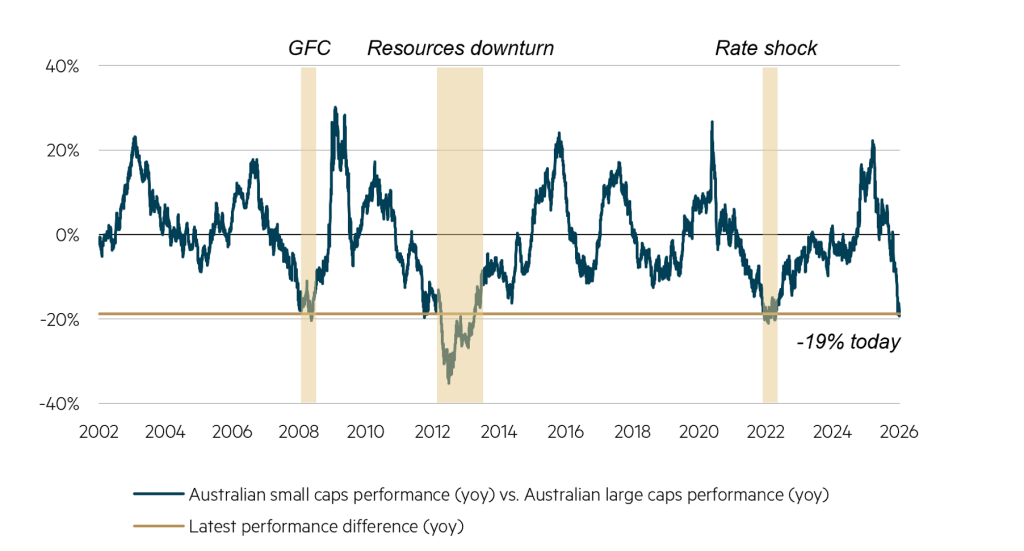
Source: Maple-Brown Abbott
More recently, the material sector has sold off sharply, and questions around the AI buildout have become more urgent. That sent a wave of selling through associated trades like semiconductors, the US Mag 7, and resources like uranium.
Longer-term investors may consider this an opportunity
Matt Griffin is the Co-Portfolio Manager for the Australian Small Companies Fund at investment firm Maple-Brown Abbott. He spoke to Mining.com.au about the current state of the uranium market.
Griffin says that uranium has “always been a longer-dated bull case” and that the market looks tight over the next few years as supply continues to be constrained.
“We’ve seen underwhelming updates from producers such as Cameco, restarted mines continue to under-deliver on production plans, and large new mines keep getting pushed to the right,” he adds.
Part of the rationale for uranium is the huge need for power from AI data centres, plus traditional energy demand from the regular grid.
Even with the recent concerns around the pace and expense of the AI buildout, there is a broad agreement that electricity demand growth is still going higher.
Earlier this year, the International Energy Agency projected global electricity demand will grow about 50% faster over the next five years than in the previous decade.
Compounding the supply constraints are the lingering effects of the Iran war.
“Industry cost inflation and acid shortages are pushing incentive prices higher and constraining expansion opportunities at existing mines,” Griffin explains.
This is not unique to uranium. The wider resource sector is grappling with the same issues.
Paladin Energy: Down 40% since April
One stock that the Maple-Brown Abbott Small Companies Fund is invested in is Paladin Energy (ASX:PDN).
The recent trading of the shares is shown in the chart below:
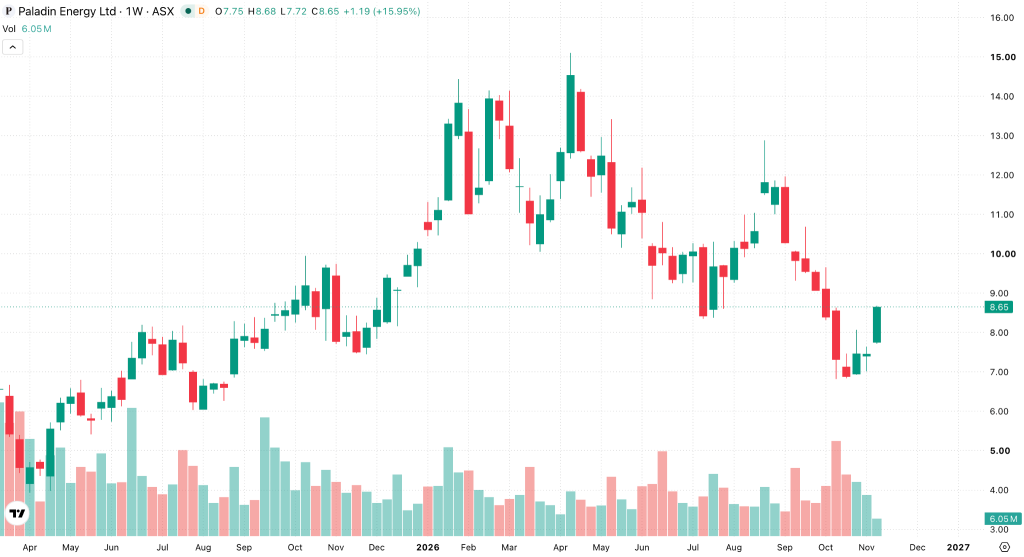
Source: Trading View
Paladin has a market capitalisation of $3.9 billion and is down approximately 40% since peaking in April.
PDN has a 75% interest in the Langer Heinrich mine in Namibia. It also has a development project in Canada called Patterson Lake South (PLS), and a basket of exploration projects.
PDN reaffirmed its production guidance on November 5, which seems to have reassured the market, with the stock lifting since.
Why Maple-Brown Abbott likes Paladin Energy
Griffin says that it’s hard to find many quality stocks in the uranium sector.
He points to Langer Heinrich’s operational stability as a key differentiator in a sector where peers are missing production targets.
Griffin says the mine is “becoming more consistent and guidance looks realistic”, contrasting with other emerging producers that have downgraded nameplate capacity.
The team at Maple-Brown Abbot are also excited about the potential for the PLS development project.
“The PLS project in Canada looks exciting to us and we expect ongoing exploration to lead to a significantly larger resource base and longer mine life,” Griffin notes.
“While this project is long dated and likely still 5-plus years away from production, we view it as a tier-one uranium development asset in a tier-one location (Athabasca Basin, Canada), and should underpin a significant long-term cashflow profile for the company.”
Write to Callum Newman at Mining.com.au
Main image: Unsplash


