

This article is a sponsored feature from Mining.com.au partner Scandium Canada. It is not financial advice. Talk to a registered financial expert before making investment decisions.
Following numerous positive meetings last year, 2025 will be all about follow up and cementing partnerships for Scandium Canada (TSX-V:SCD).
CEO Guy Bourassa tells Mining.com.au that in 2024 Scandium Canada underwent a major strategic transformation that reinforced the company’s commitment to innovation, sustainable development and its position as a leader in the critical minerals sector.
Among the notable moves last year was Bourassa’s appointment as CEO, which brought a new strategic vision to the critical minerals sector.
This was reinforced by the change of name from Imperial Mining Group to Scandium Canada, symbolising a new era for the company.
In October 2024, Bourassa embarked on a major mission in Hong Kong and Singapore meeting with a number of investors and potential scandium users interested in developing Scandium Canada’s Crater Lake project in Québec, Canada.
Bourassa, who also spent a few days in South Korea to meet with players interested in the aluminium-scandium alloys markets, says it was a productive period for the company.
“Not only did we talk about interests in participating in Scandium Canada’s business growth, but also about business opportunities in the aluminium-scandium alloys markets,” he says.
“These initial contacts will require a lot of follow-up, but we’re convinced of the interest generated by our projects, both in terms of the mining project and our advances in alloys for 3D printing and extrusion.”
Crater Lake is one of the world’s largest primary scandium projects, hosting an existing resource within the TG Zone of 11.8 million tonnes @ 275.9 grams per tonne in the indicated category and 15.9 million tonnes @ 268.4g/t in the inferred category.
Scandium Canada holds exclusive mineral rights to Crown lands in Québec. The project spans 96 contiguous claims over 47 km², including the TG zone, which extends 4.5km with an estimated 27 million tonnes. Bourassa says the untapped potential for new discoveries remains immense.
A Preliminary Economic Assessment completed in June 2022 estimated the operation would deliver revenue of C$15.2 billion ($16.9 billion) over the life of the mine and would have a net present value and internal rate of return after tax of C$1.72 billion and 32.8%, respectively.
Growing Crater Lake
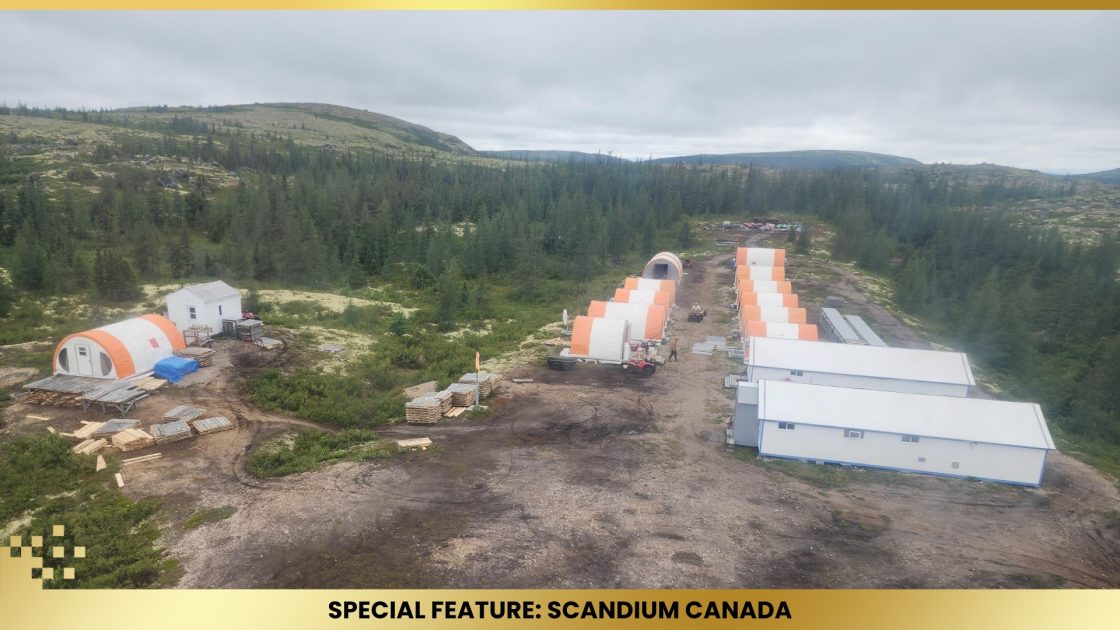
Scandium Canada spent the Canadian summer of 2024 completing a two-part drilling program, with one of the main goals being to confirm the potential extension of the TG Zone over an additional 250m.
Scandium and rare earths mineralisation was identified in the seven holes drilled after the program intersected the target scandium-bearing ferrosyenite host rock.
Results released just prior to the end of last year showed the company had achieved its goal of extending the TG Zone, with the deposit remaining open in all directions and at depth.
With all of the results in, Scandium Canada is working on an updated 43-101 mineral resource estimate to reflect the extension to the south of the already known deposit that is due for completion in the first quarter of 2025.
“Drilling campaigns in 2024 confirmed the TG Zone’s significant scandium and rare earth potential, paving the way for a mineral resource update and Prefeasibility Study for this strategic project,” Bourassa says.

Another milestone achieved in 2024 was the filing of a patent application in the US for the company’s two aluminium-scandium alloys and their powders designed specifically for additive manufacturing (3D printing) applications.
Scandium Canada developed the two alloys in partnership with McMaster University in Ontario.
Using aluminium-scandium alloys and their powders in 3D printing opens up the opportunity for manufacturing lightweight, high-strength components, particularly in aerospace, automotive, and maritime industries.
Adding just 0.4% scandium to aluminium alloys shows as much as an eightfold increase in strength.
Utilising aluminium-scandium alloys for the welding of aircraft structures rather than rivets for assembly is tipped to reduce weight and generate C$10 to C$15 million in fuel savings over an aircraft’s lifetime.
Major aircraft manufacturer Boeing estimates that the use of aluminium-scandium alloys would contribute to lightweighting and reduce manufacturing costs by up to $US3 million ($4.8 million) per aircraft.
Following the filing of the patent application, Scandium Canada began to approach potential users wishing to independently test the properties of parts to be manufactured by 3D printing.
Bourassa tells this news service that the filing of the patent reflects the company’s ambition to establish itself as a key player in the field of critical materials, while adhering to responsible and sustainable practices.
In the final quarter of 2024, Scandium Canada was on the hunt for a prime location to build its proposed hydrometallurgical plant designed to convert scandium concentrate into scandium oxide.
The company looked at sites in Wabush, Labrador City, and Fermont.
Bourassa says the repositioning of Scandium Canada was accompanied by the optimisation of ore treatment processes for the Crater Lake Project, made possible by technological innovations.
Work on optimising the ore concentration process flow sheet and the process flow sheet for hydrometallurgical production of scandium oxide began at SGS Canada’s Lakefield, Ontario laboratory, using a 500kg sample.
The ore concentration steps have been validated and the hydrometallurgical process to transform the concentrate into scandium oxide is now Scandium Canada’s main focus.
Full testing is slated for completion in February, with a final report due in March.
Also on the agenda for 2025 is the completion of a Prefeasibility Study, including a resource update, and the start of a 15-ton metallurgical pilot program, which is slated for completion by mid-2026.
Meanwhile, environmental assessment and permitting is ongoing.
“With these achievements, Scandium Canada enters 2025 with a clear vision to pursue its development with its aluminium-scandium alloys value chain,” Bourassa says.
Write to Angela East at Mining.com.au
Images: Scandium Canada