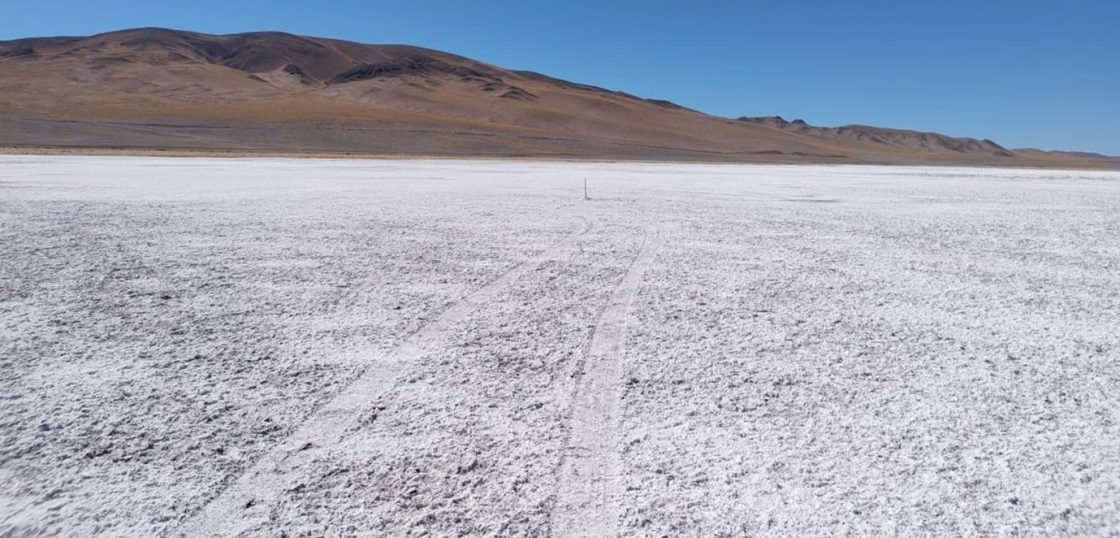
Patagonia Lithium (ASX:PL3) is looking to define the basement depth of the Cilon Lithium Brine Project in the Jujuy Province of Argentina after returning reprocessed magnetotelluric data from Southernrock Geophysics’ 2023 surveys.
Results indicate that the increasing lithium and salinity numbers could be related to the deep conductor.
The original 2D inversion model indicated a resistivity below 0.5 ohm-metre signatures, which Southernrock Geophysics South Australia Senior Geophysicist Jeremy Barrett says correlates with the brine assays results of 580 parts per million (ppm).
“The absence of a drilled ‘basement’ leaves the interpretation of precisely where to interpret the basement on the geophysical sections to be determined,” Barrett says.
“At least, the absence of a drilled basement confirms where it isn’t. so estimating it somewhere close to where the resistivity begins to increase with depth beneath the conductors remains a reasonable proposition until disproved.
“Likewise, the best conductors continue to present themselves as being the best targets.”
Executive Director Phil Thomas says Patagonia is considering a 2km seismic survey prior to drilling, determining if the basement is volcanics or a consolidated set of lithologies.
“Our 600m well planned for Cilon as JAM 25-05 will assist in the determination of the depth of basement that will permit us to recalculate the volume of brine and hence lithium contained in the project,” Thomas says.
“The issue is the absence of a well-defined contact that is due to the underlying physics of electromagnetic propagation which incorporates a large degree of non-uniqueness in real-world datasets for this scenario of a resistive basement beneath a (highly) conductive overlying lithium filled layer.”
Patagonia Lithium holds exploration licences over three properties within the lithium triangle in Argentina, including one in the Salta Province and two in the Jujuy Province.
Write to Maddison Elliott at Mining.com.au
Images: Patagonia Lithium