


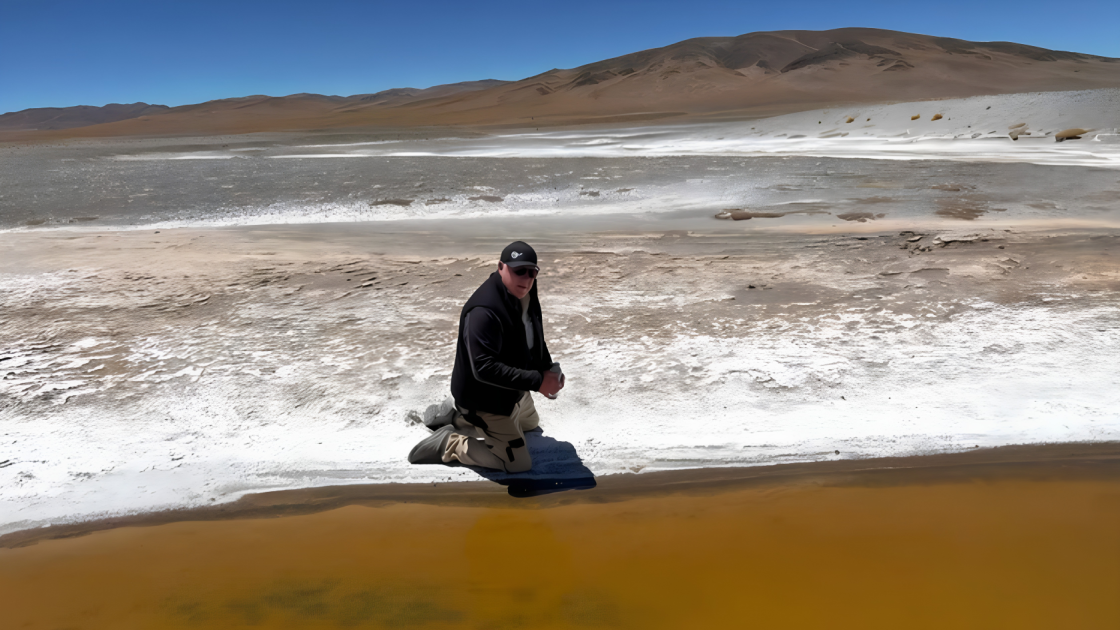
Patagonia Lithium (ASX:PL3) has completed Well 9 at its Formentera Lithium Project in Argentina, recording brine flow of 66 litres per hour at 95m depth.
Drilling stopped at 230m after the company obtained only one brine assay from the well. A packer test at 95m achieved the 66L/hr flow at a specific gravity of 1.016g/cm3.
Drilling intercepted 50m of clays with gypsum veins, testing the extent of the large aquifer previously intersected by Well 2.
The clays represent a basement layer above gravels with very low porosity, though core samples from other wells have recorded high porosity in laboratory tests.
Executive Chairman Phillip Thomas says the flow at 95m was ‘positive’.
“While we would have preferred results consistent with other wells, the information sourced from the well is very valuable in modelling the layers and aquifers across the salar,” Thomas notes.
The packer test recorded electrical conductivity of 28.59 microsiemens per centimetre, pH of 10.72, total dissolved solids of 14.47 parts per thousand, and temperature of 15.89°C over a 90–104m interval with a 14m chamber length.
Core analysis from the 86.8–96.3m interval showed 80% metaquartzite and lithic fragments, 18% quartz, 2% montmorillonite and smectite, and 0.5% opaque minerals including trace gypsum.
Patagonia has decided not to continue drilling at the infill location and has shipped 2,000L of brine to a laboratory for Ekosolve pilot plant testing.
“This completes our drilling program and all available data has been passed to Atacama Water Consultants to complete the Mineral Resource Estimate upgrade,” Thomas adds.
The company’s current mineral resource estimate stands at 551,400 tonnes lithium carbonate equivalent (LCE) at 294 milligrams per litre, comprising 14,800 tonnes at 393mg/L indicated and 536,600 tonnes at 292mg/L inferred.
Patagonia Lithium is an Australian explorer advancing lithium brine, rare earth, and niobium projects across Argentina and Brazil.
Write to JC Villarba at Mining.com.au
Images: Patagonia Lithium


