Patagonia Lithium (ASX:PL3) Executive Chairman Phillip Thomas tells Mining.com.au the lithium market was characterised by a dynamic and “rapidly evolving” landscape in 2025.
“Demand will increase in 2026-2030, assisted by a recent rally in the price,” Thomas reiterates in reference to comments from chairman at Ganfeng Lithium (HKG:1772).
“This resurgence is primarily driven by the accelerating global shift toward electrification, especially in the electric vehicle (EV) sector, which remains the dominant force behind lithium demand – for the moment.
“Energy storage systems and government policies supporting clean energy technologies further underpin this demand.
Lithium has seen a 49.10% increase in its price for this year to date – with a 19.94% rise in December alone – according to Trading Economics at time of writing. The commodity was marketed at ¥111,900 ($23,737) per tonne on 29 December 2025.
“After a period of oversupply that led to significant price volatility and a steep decline from the highs of 2022, the market has begun to stabilise with renewed demand growth,” Thomas tells this news service.
Argus Media predicts solar power installations, artificial intelligence (AI) data centres, autonomous machines, and humanoid robots to all contribute to the growing demand for lithium in 2026, following a market driven by the EV sector in 2025.
Currently, Australia is the leading country for lithium production, returning 88,000 tonnes of lithium in 2024, followed by Chile and China producing 49,000 and 41,000 tonnes respectively in this same period. Australia is expected to remain the leading lithium supplier to 2027.
China plans to boost its energy storage capacity to 180 gigawatts by 2027, almost doubling its current capacity of 95 gigawatts as of June 2025 through its industry plan announced in September. This will stimulate a ¥250 billion investment in the lithium sector.
The Department of Industry Science and Resources’ December 2025 edition of the Resources and Energy Quarterly highlights that 95% of Australia’s lithium ores and concentrate produced in 2024 was shipped to China.
Australia’s lithium exports have increased by $700 million to a total of $6.3 billion in 2025-26, with the sector expected to increase by another $900 million in 2026-27.
Aspirations to produce
Patagonia intends to jump in on the global demand for batteries with its streamlined focus on lithium exploration.
“We have aspirations to be a producer within two years,” Thomas explains to this news service.
The company is currently updating its environmental report to be submitted shortly, including a 1,000 tonne pilot plant.
“Global demand is currently about 1.6-1.7 million tonnes of lithium carbonate,” Thomas adds.
“Various major producers are indicating there is a looming shortage when demand hits 2.4-2.6 million tonnes in 2026-27. Demand in 20230 is projected to be even higher.
“If we can expand the 1,000 tonne plant to 10-15,000 tonnes then we will be in a great position to earn $120 million plus a year and probably just sub $100m in earnings.”
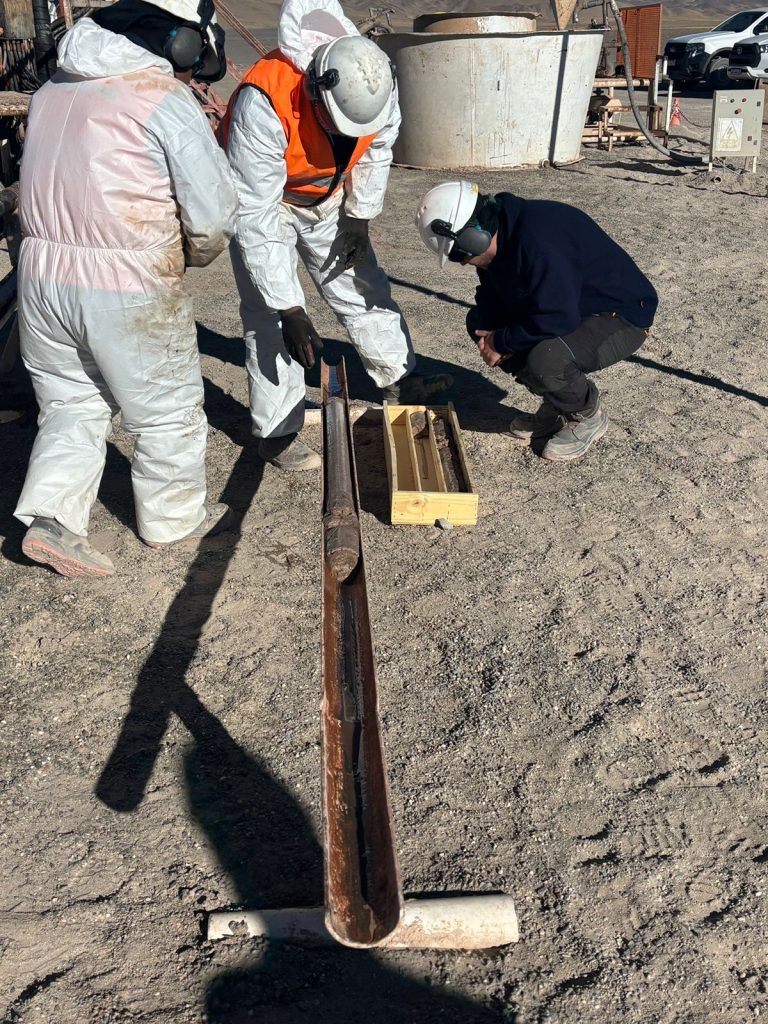
Patagonia has been focused on drilling at its Formentera Lithium Project in Argentina, with three bottles of lithium brine collected at the start of December 2025. Two were sent for analysis at differing laboratories, while the other remains in retention by the company, as reported by Mining.com.au.
“As the seismic collects data and we build a cross section, because we have the data on the lithology we can correlate the seismic with the actual lithology,” Thomas adds.
“The main game is to extend the domain in the block model so we get a much larger mineral resource estimate and a higher average lithium value.
“We have an assumption (but it doesn’t always apply) that the deeper you go the higher the lithium concentration and the higher the specific gravity of the brines.”
The project’s resource estimate was increased by 319% in both the inferred and indicated categories in July 2025, totalling 551,400 tonnes of lithium carbonate equivalent @ 294 milligrams per litre (mg/L) of lithium and 894 mg/L of magnesium for 103,700 tonnes of lithium metal, as reported.
Patagonia Lithium has two major lithium brine projects, Formentera and Cilon, which are located in the Salar de Jama, Jujuy province, as well as the Tomas III at Inchahuasi Salar in Salta Province of northern Argentina.
Write to Maddison Elliott at Mining.com.au
Images: Patagonia Lithium