


Advanced remote sensing completed at Litchfield Minerals’ (ASX:LMS) Lucy Creek Project has identified target areas considered prospective for manganese, rare earths, and base metals.
Located in the Northern Territory, Lucy Creek has demonstrated stratabound and hydrothermal manganese deposits, with occurrences mapped across large areas. One key area is the Lucy Creek 2 prospect, which has highlighted a thick manganese mineralised horizon over a 1km area.
The company reports several historical rock chip samples have returned 50.5% manganese, 0.44% iron, and 0.06% phosphorous.
CEO Matthew Pustahya says identifying the target areas with a high-potential for manganese, rare earths, and base metals underscores the immense geological promise of the project.
“With over 100 new exploration targets identified, we are confident that Lucy Creek has the potential to deliver substantial value,” Pustahya says.
“This is a pivotal step in advancing our exploration efforts and we look forward to further unlocking the region’s mineral wealth in the coming months.
“The latest exploration work, with our drive to find a Bootu Creek-style of manganese mineralisation across Lucy Creek, will play a pivotal role in confirming its potential.
“This project offers the potential to transition from exploration to a resource definitive phase, ultimately becoming a key player in Australia’s critical mineral supply chain.”
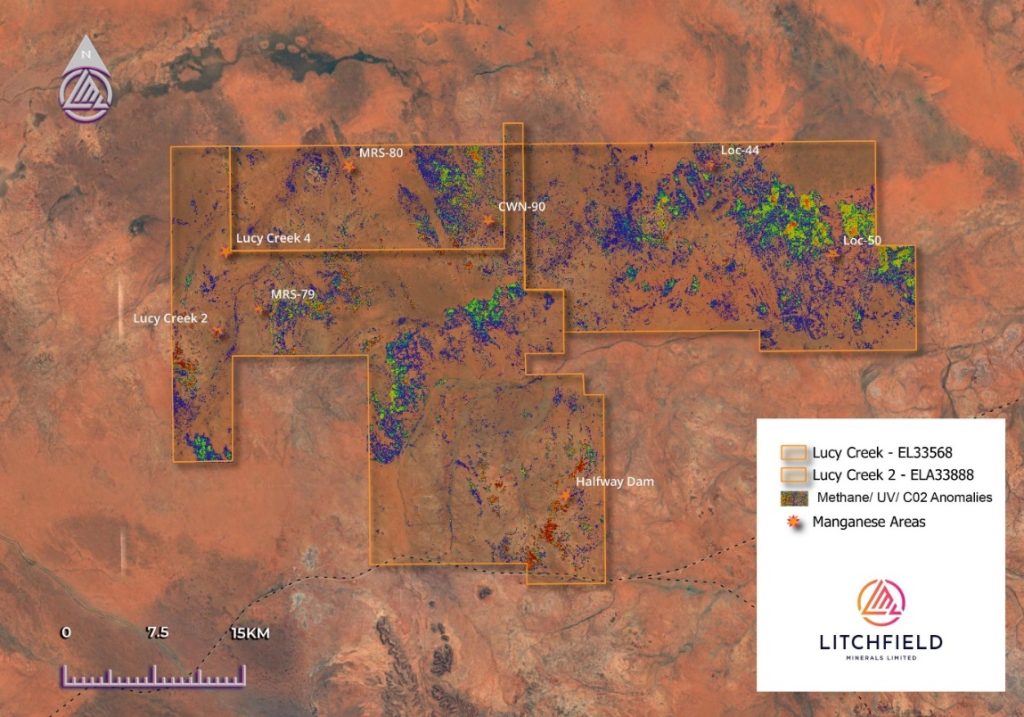
Litchfield Minerals adds that methane, CO2, and helium anomalies help define potential manganese areas.
Methane is produced through the breakdown of organic matter within sedimentary rocks, particularly in carbonate-rich environments like those containing a manganese carbonate mineral, rhodochrosite.
The company says the presence of methane can indicate the weathering or breakdown of rhodochrosite, suggesting the proximity of manganese mineralisation.
CO2 is another gas commonly released during the weathering of carbonate mineralisation. As such, elevated CO2 levels detected through remote sensing are considered a strong indicator of manganese carbonate deposits.
Meanwhile, helium and radon are associated with uranium-bearing dolomites. Dolomitic rocks in the Tomahawk Formation contain trace amounts of uranium, which decays to produce radon and helium.
Litchfield Minerals says the correlation between helium and manganese suggests that the dolomitic rocks in Lucy Creek host manganese as the presence of helium anomalies can be a reliable market for these manganese-rich horizons.
Litchfield Minerals intends to collect rock chip samples from targeted areas based on the data provided.
The company aims to uncover manganese and associated elements including iron, cobalt, barium, lead, and zinc to indicate a Mississippi Valley-type mineralisation.
A surface geochemical sampling program will also be undertaken to detect anomalous concentrations of manganese, base metals, and pathfinder elements.
Litchfield Minerals is a critical minerals-focused explorer. The company is primarily focused on discovering base metals and uranium out of the Northern Territory.
Write to Aaliyah Rogan at Mining.com.au
Images: Litchfield Minerals