

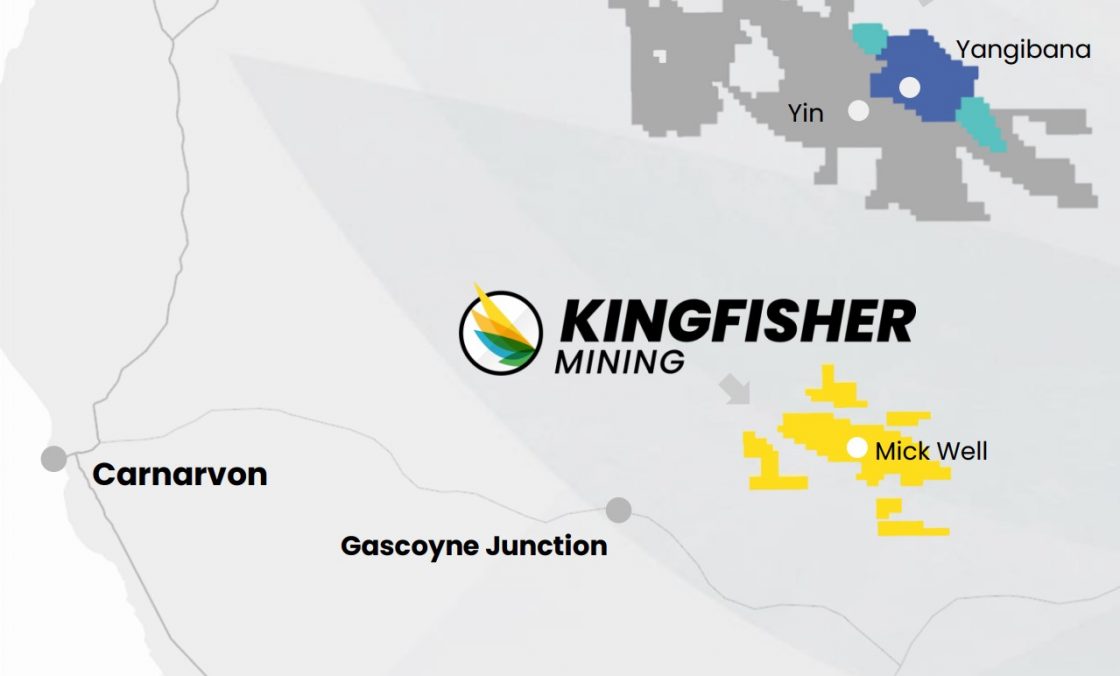
ASX-listed mineral exploration company Kingfisher Mining (ASX:KFM) reports it has identified new carbonatite rare earth element (REE) targets at its Kingfisher and Mick Well projects in the Gascoyne region of Western Australia.
The company states this trend was identified along the 54km-long Chalba target corridor through tenement-scale magnetics and radiometrics airborne geophysics surveys.
Furthermore, Kingfisher reports 10 ‘high-priority’ target areas have been identified from the interpretation of the geophysics survey, with each target selected from a combination of magnetic, potassium and thorium features.
Moving forward, the company reports it is planning its exploration activities for 2023 at its projects in the Gascoyne region. Kingfisher anticipates the 2023 exploration program will include drilling at MW2, MW7, MW8, as well as ‘substantial’ project generation work across the Chalba target corridor.

This will include the CH1 to CH10 targets, as well as the Arthur River and Mooloo projects. Kingfisher also notes the 2023 exploration program is likely to include an airborne geophysics survey across the Mooloo project and states the details of this year’s program will be announced shortly.
Commenting on the REE find, Kingfisher Mining Chief Executive Officer (CEO) and Executive Director James Farrell says: “The results from the airborne geophysics at our Gascoyne REE projects continue to highlight the ‘significant’ potential of our belt-scale tenement holding in this globally important REE region.
“The survey adds another leg in our discovery journey which has led to the identification of numerous additional potential carbonatite intrusions along the 54km Chalba mineralised corridor”
The survey adds another leg in our discovery journey which has led to the identification of numerous additional potential carbonatite intrusions along the 54km Chalba mineralised corridor.
This is an enormously encouraging early development in the project generation, expanding our footprint beyond the Mick Well area, where we made our first breakthrough high-grade REE discovery only 12 months ago.
All of the selected targets have geophysical responses similar to the Mick Well, where we have so far identified more than 5km of outcropping high-grade REE mineralisation strike, delineated by surface samples and drill results which includes 5m @ 3.45% TREO (total rare earth oxides).
We are extremely excited and are looking forward to following up these dominant targets which will hopefully confirm that our Chalba mineralised corridor is world class.”
Kingfisher reports a ‘significant’ new large-scale target has been delineated at Kingfisher South, where geological mapping has already confirmed the presence of ferrocarbonatite intrusions. This target includes a central area defined by a ‘distinct’ circular magnetic feature with a diameter of about 2km which is surrounded by an area of high thorium and potassium, which extends over a length of more than 6km along the Chalba corridor.
Furthermore, the company has selected high-priority targets CH2, CH5, CH6, and, CH8 for immediate surface mapping and sampling due to the presence of interpreted carbonatites and circular or oval-shaped features which are indicative of intrusion pipes.
Kingfisher states the identification of the targets from geophysics is an important early part of the discovery process, with all of the targets to be ranked and included in the company’s project generation activities in 2023 and beyond.
Kingfisher Mining is a mineral exploration company with a land holding of 1,676km-square in the Ashburton and Gascoyne Mineral Fields. The company’s projects include the Kingfisher, Mick Well and Arthur River projects in the Gascoyne Mineral Field, as well as the Boolaloo Project in the Ashburton Basin.
Images: Kingfisher Mining Ltd