

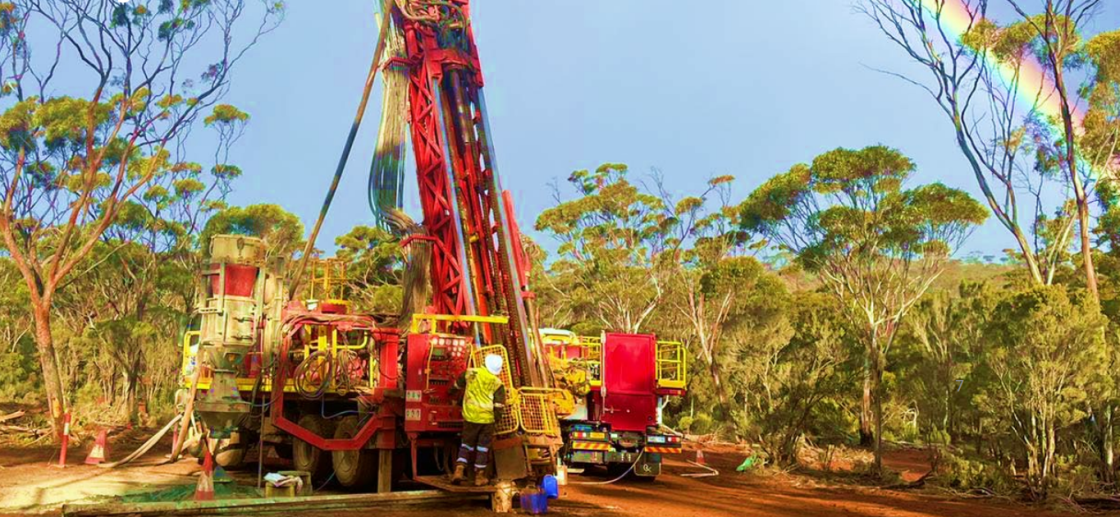
Galileo Mining (ASX:GAL) has encountered a ‘thick’ sulphide zone following a step-out reverse circulation (RC) drilling at the Callisto palladium-nickel discovery within its wholly owned Norseman Project in Western Australia.
The company says results, which include the widest drill intersection recorded to date with 72m of mineralisation, support Galileo’s geological interpretation that the 5km of untested strike length to the north of Castillo is ‘highly prospective’ for further discoveries.
Galileo Mining notes results also indicate the source of mineralisation, originally discovered to the west, is related to the much larger mafic-ultramafic sill complex that dominates the geology of the area.
Key results include drillhole NRCD394 with 72m @ 1.16g/t 3E (0.95g/t palladium (Pd), 0.16g/t platinum (Pt), 0.05g/t gold (Au), 0.20% copper (Cu) and 0.24% nickel (Ni) from 498m including a ‘higher-grade’ interval of 39m @ 1.46g/t 3E (1.19g/t Pd, 0.20g/t Pt, 0.06g/t Au), 0.26% Cu and 0.28% Ni from 503m.
Follow-up drilling is currently underway with the current step-out drillhole NRDD420 to be followed by drilling immediately adjacent to NRCD394. Drilling at Castillo is focused on determining the size and grade of the sulphide zones, understanding the relationship with the much larger host sill, and looking for a possible source of the discovery to the east and north along strike.
Commenting on the discovery, Galileo Mining Managing Director Brad Underwood says: “Today’s results are firm confirmation of our view that we have only just started to comprehend the full extent and potential of our Castillo discovery.
To intercept 72 metres of sulphides from our northernmost drill line targeting the centre of the host intrusion is an extraordinary result and a highly encouraging sign for the potential discovery of more mineralisation along strike to the north. We have five kilometres of prospective rocks to the north of Castillo and, with $20 million in cash (as of 31 December 2022), we have the funding to thoroughly explore the area without needing to raise money in a difficult market.
“To intercept 72 metres of sulphides from our northernmost drill line targeting the centre of the host intrusion is an extraordinary result and a highly encouraging sign for the potential discovery of more mineralisation…”
Our geological interpretation indicates that there are multiple mineralised rock units in the area and that the source of these rocks may exist further to the north and east. We will be testing this concept over the coming months and are very excited to be exploring a newly discovered palladium-nickel district.”
The company also notes the priority target zone located to the north and east of drillhole NRCD394 matches the interpreted core of the host intrusive sill complex, which can be traced in the magnetic data for 5km to the north.
In addition, current drillhole NRDD420 is drilling due west and is planned to finish on the same section as drillhole NRCD394. This drillhole is expected to provide a basis for interpretation of the geometry of mineralisation from geochemical and geological data.
With drilling still ongoing, Galileo Mining announces having completed the initial drilling post discovery at a 50m spacing, it will move forward with undertaking step-out drilling up to 200m from existing drilling with the intention of rapidly defining the footprint of mineralisation at Callisto over the coming months.
As of 2.50pm AEST Galileo Mining’s share price had increased by 33.26%.
Galileo Mining is an ASX-listed company focused on the exploration and development of palladium, nickel, copper and cobalt resources in Western Australia. The company’s 100% owned Norseman project is located about 10km from the township of Norseman with excellent infrastructure, including gas, water, and electricity facilities, as well as access to road and rail.
Images: Galileo Mining Ltd