

Galileo Mining (ASX: GAL) reports that electromagnetic surveying at its Norseman Project in Western Australia has defined ‘strong’ electromagnetic conductors beneath massive sulphides identified in recent aircore drilling.
These massive sulphides occur above the confluence of two modelled conductors which are up to 800m long, and start at a depth of 70m below surface.
A new conductive target was also identified on the southern margin of the project’s Jimberlana Dyke, with strike length of up to 400m and starting at between 20 to 40m below surface.
The company notes that all conductors have ‘very high’ modelled conductivities, which it interprets as indicating ‘significant’ source thickness.
Speaking on the results, Galileo’s Managing Director Brad Underwood said: “The results of our EM surveying at Norseman are exceptional and, combined with the identification of sulphide in aircore drilling, we now have well developed targets ready for drill testing. The sulphide in aircore drilling is just 52 metres below surface (60 metres downhole) and is immediately above the modelled conductors which start at 70 metres below surface. The location of the sulphide on the margin of a large ultramafic dyke is an excellent setting for the development of mineralisation and the EM models provide substantial weight to the target.
“All of the new EM targets can be readily tested with RC drilling due to their shallow depths”
Further to the main sulphide target we have identified another strong conductor on the southern margin of the Jimberlana Dyke at a similarly prospective location. The modelled conductor at this location is accompanied by a magnetic anomaly and starts between 20 and 40 metres below surface.
All of the new EM targets can be readily tested with RC drilling due to their shallow depths. RC drilling is planned to commence after heritage surveying and statutory approvals have been received.”
The EM survey was designed to target prospective areas on the margin of the large scale Jimberlana Dyke where recent aircore drilling had intercepted massive sulphide mineralisation at 60m downhole. The interpretation of data showed that the sulphides occurred above the confluence of two ‘large and highly conductive’ bodies.
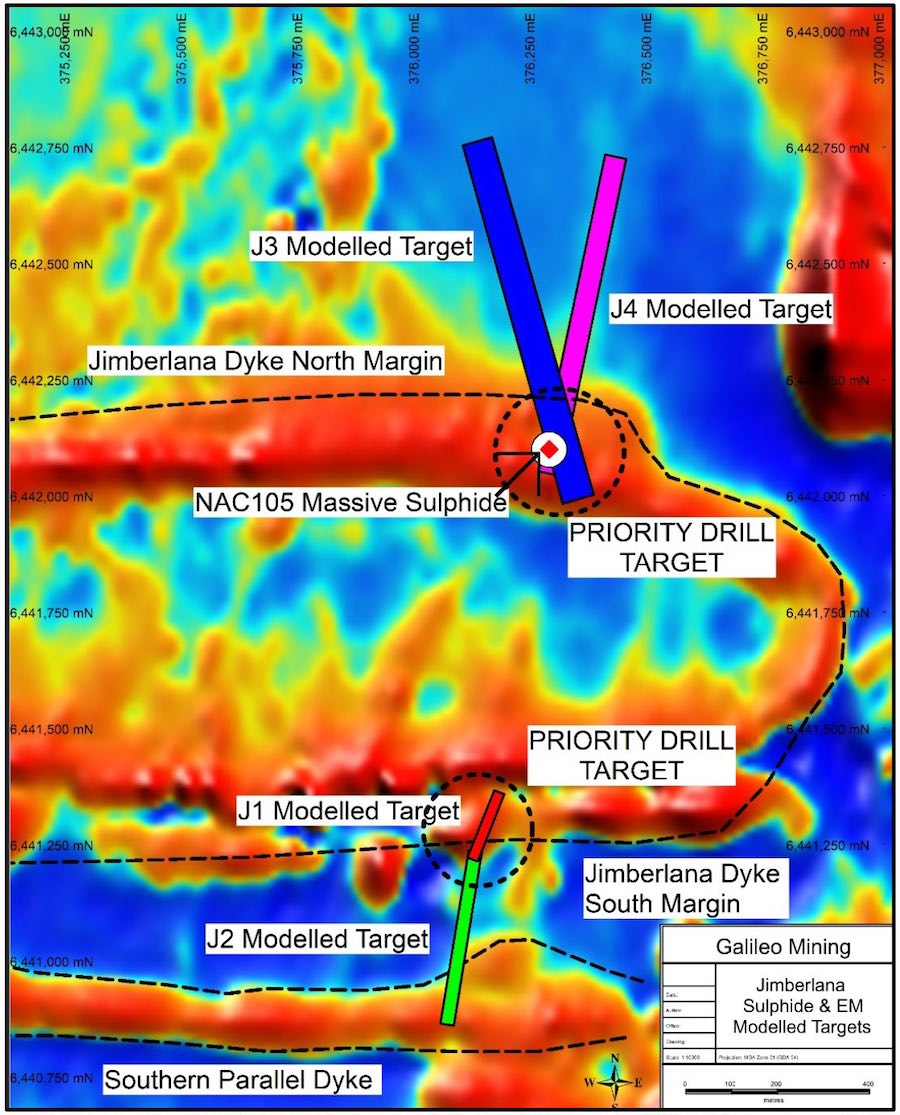 EM conductors with the NAC105 sulphide intercept along with priority drill targets
The company said that the ‘exceptional results’, paired with the identification of sulphide in aircore drilling, have now provided well-developed targets ready for drill testing.
Moving forward, Galileo reports that it plans to commence RC drilling post the completion of heritage surveys and receipt of statutory approvals.
Images: Galileo Mining Ltd