



A new report by Saxo’s Head of Commodity Strategy Ole Hansen highlights copper’s rising importance across the energy transition and new technologies. He also raises critical questions about the industry’s ability to meet future supply needs.
Hansen writes that this is particularly relevant at the moment, with copper trading at record highs this week at US$6.92 ($9.83) per pound, marking a 20% year-to-date increase.
Supercycle forces driving demand
Key structural forces such as population growth and urbanisation, rising power consumption, energy storage, decarbonisation, defence, and de-globalisation indicate the potential for a new commodity supercycle. Notably, most of these forces are either directly or indirectly dependent on copper.
Citing Robert Friedland, Hansen outlines the main barriers to meeting growing demand: geology, declining grades, energy, water, permitting, capital intensity, infrastructure, geopolitics, and time, among others.
“One number in particular stands out,” Hansen says.
“Friedland says humanity has mined roughly 700 million tonnes of copper throughout history. Based on eight billion people and around 3% annual global economic growth, he argues the world may need to produce another 700 million tonnes during the next 18 years.
“Importantly, his calculation excludes the additional requirements from electrification, electric vehicles, and data centres.”
According to Hansen, this indicates a challenge of scale.
Barriers to supply: Declining grades and rising costs
The biggest challenge at the moment for the industry is declining ore grades, with most of today’s major copper mines having been discovered decades ago.
BHP (ASX:BHP) has flagged a decline in total copper production due to ore grade decline, with total production falling 3% to 1.953 million tonnes (Mt) in FY26. Q4 output of 491,900 tonnes is also down 5% from the same period last year. BHP has set guidance for FY27 at 1.65–1.80Mt.
At Escondida, BHP’s flagship asset in Chile, 1.261Mt was produced this year — down 3%, with concentrator feed grades falling 0.90% from 1.02% last year. BHP has highlighted that it expects further grade declines to around 0.70% in FY27.
Considering the current grades, Hansen notes that according to Friedland, five times as much material must be processed in order to obtain the same amount of contained copper.
“That means more rock movement, more crushing and grinding, more energy and water, and ultimately, higher capital and operating costs,” he says.
Water and power signify additional risks, as many of the major copper deposits around the world are in dry regions like Chile and Peru and often depend on desalinated seawater.
“But desalination does not eliminate the constraint; it transforms it into an infrastructure and energy challenge,” Hansen points out.
Friedland has noted the need for US$4 billion in desalination infrastructure for Escondida, with the cost of electricity needed to pump water from the Pacific coast at US$1 million per day.
Time is also named as a key factor in the copper supply story.
“Higher prices can encourage exploration and improve project economics, but they cannot compress geology, engineering, permitting, and construction into a couple of years,” Hansen says.
Because of this, copper has a weaker short-term supply response to price than other metals.
Demand driven by electrification and AI
Demand for copper is growing, spurred by the energy transition and growth in technology such as AI.
Apollo Global Management’s Chief Economist Torsten Slok has noted that the copper discovery pipeline is drying up. He says discoveries of deposits with at least 500,000 tonnes of contained copper are falling — from double digits annually in the 1990s and 2000s, to one or two in recent years, and with none in 2025.
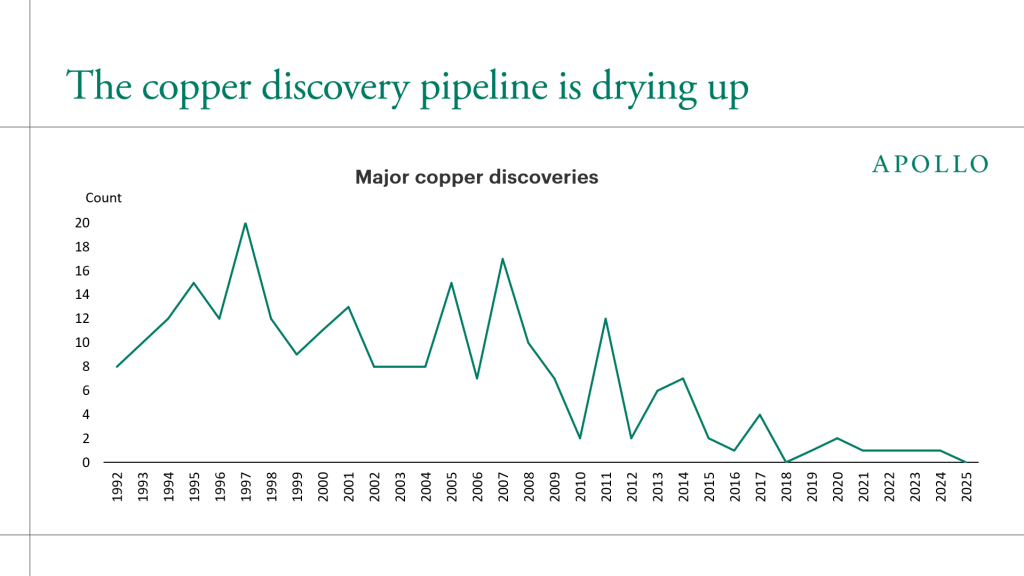
Demand for copper from the energy transition and AI infrastructure need copper now; but any new discovery made today will likely not start producing until the 2040s or later, based on typical project timelines.
BHP has reported on the amounts of copper needed for data centres, including those needed in construction, power networks, circuit boards, and cooling systems, as well as in their overall power generation.
Microsoft’s US$500 million data centre in Chicago has reportedly used 2,177 tonnes of copper, equivalent to 27 tonnes of copper for every megawatt of applied power.
BHP estimates that copper used in data centres will grow six-fold by 2050, from around 0.5Mt a year of copper today to around 3Mt a year by 2050.
Although copper projects can take decades to move from discovery to production, exploration and investment today are critical to unlocking tomorrow’s supply. Every drill program, feasibility study, and capital commitment made now lays the groundwork for the mines that will be needed in the 2030s and 2040s.
Without this early pipeline of discoveries and development, the industry risks falling further behind the surging demand from electrification and AI infrastructure.
Advancing the Briggs Copper Project in Queensland
Alma Metals (ASX:ALM) understands the global need for more copper to support electrification and technology growth. The company is advancing the Briggs Copper Project in Queensland to support that future supply gap.
Briggs is a joint venture project, with Alma holding 51% and earning up to a 70% interest. The project contains 2Mt of copper metal at a 0.15% cut-off and is Queensland’s largest undeveloped copper project.
Infill drilling on an 80-hole program at Briggs has recently reported ‘high-grade’ copper zones, returning 383.8m @ 0.25% copper (Cu) from 10.2m.
Importantly, Alma highlights that the results support the conversion of inferred resources to indicated, a key objective for the company as it works toward an upgraded mineral resource estimate (MRE) for a Prefeasibility Study (PFS).
Copper-gold at Mt Cannindah
Cannindah Resources (ASX:CAE) is also working across Queensland, advancing a copper-gold growth story through the Mt Cannindah copper-gold-silver-molybdenum project.
Its Cannindah breccia deposit has an MRE of 14.5Mt @ 1.09% copper equivalent (CuEq), with 160,000 tonnes CuEq in contained metal.
Reconnaissance drilling has reported a high-priority target at the Appletree prospect, with reverse circulation returning 72m @ 0.18% CuEq from surface. This comprises 0.12% Cu, 0.06 grams per tonne gold, and 1.21g/t silver.
Cannindah notes that the higher grade results sit within a larger mineralised footprint and are associated with intrusive dykes and skarn, which provides additional support for the potential of a buried pencil porphyry centre at Appletree.
Drilling the Llahuin Project in Chile
Southern Hemisphere Mining (ASX:SUH) continues drilling at the flagship Llahuin Copper-Gold-Molybdenum Project in Chile. The company released an updated JORC resource for Llahuin in July 2025 and has since completed an expanded diamond drilling program across a number of targets.
It reported ‘significant’ copper sulphide mineralisation in early August 2026, from diamond drilling over nine holes totalling 2,251m. Key results include 241m @ 0.42% CuEq from 18m, incorporating 143m @ 0.51% CuEq from 36m.
Southern Hemisphere notes that mineralisation remains open at depth, supporting the view that the Cerro-Ferro trend hosts a substantial copper porphyry system with significant expansion potential.
The company now has a resource upgrade in progress, with results to be released upon the receipt of final assays.
Exploring copper targets in South Australia’s Gawler Craton
Lincoln Minerals (ASX:LML) is focused on copper and other base metals projects in the Gawler Craton region of South Australia, with a key focus on the Minbrie Project.
The company has recently completed 25 aircore holes for 1,632m, with three holes drilled at the Eagle Ridge discovery, where the company confirmed mineralisation continuity up dip.
Lincoln has also identified historic ‘high-grade’ copper targets at the Southern Eyre Project. It notes that the project shares a similar geological setting to Minbrie but is relatively underexplored, especially over the last 30 years.
Lincoln continues to review all historic core across Minbrie as it plans for further drilling, while also identifying additional copper targets across the Eyre Peninsula.
As copper demand accelerates across electrification, AI, and data centres, the focus on early exploration and investment are essential to ensure that the supply chain can meet the scale of tomorrow’s demand.
While declining grades and long development timelines mean that new discoveries will only deliver from the 2030s and beyond, more exploration today will mean less supply pressure in the future.
Write to Amy Rotman at Mining.com.au
Main image: BHP


