



For the better part of the last decade, the key narrative driving the critical minerals sector was almost exclusively green. The core focus had been on the energy transition, electric vehicle supply chains and batteries, and decarbonisation.
However, a rapid shift in global security dynamics has pushed a new, highly strategic category at the top of most government priority lists — defence metals.
With elevated global geopolitical tensions, governments around the world are looking to build their strategic stockpiles. That has put key defence metals in the spotlight, including antimony, tungsten, gallium, germanium, titanium alloys, and heavy rare earths.
China’s dominant control over key defence metals supply and processing chains has triggered a strategic geopolitical reset. In response, national governments are actively funding domestic and allied supply networks to guarantee these critical inputs when needed.
The minerals underpinning military power
This new category of critical and strategic minerals encompasses the metals and materials needed across surveillance, targeting, navigation, and weapons systems.
SFA Oxford notes that access to key minerals is increasingly weaponised as a form of geopolitical competition. In that environment, securing a stable and resilient supply chain is essential for defence, technological superiority, and long-term military readiness.
In December 2024, NATO released a list of 12 key defence-critical raw materials. The list sets out the principal supply risks across military applications.
These applications span fighter aircraft, main battle tanks (MBTs), missiles, submarines, corvettes, artillery, ammunition, torpedoes, and assault rifles. The main supply risks for these applications include aluminium, beryllium, cobalt, gallium, germanium, graphite, lithium, manganese, platinum, rare earth elements, titanium, and tungsten.
“The availability and secure supply of these materials are vital to maintaining NATO’s technological edge and operational readiness,” the NATO report says.
“Disruptions in their supply could impact the production of essential defence equipment. Identifying these key materials is NATO’s first step towards building stronger, better protected supply chains, crucial for Allied defence and security.”
Aluminium and graphite carry the highest supply risk.
Aluminium is essential for the production of lightweight yet robust military aircraft and missiles. Graphite, on the other hand, is critical in the production of MBTs and corvettes due to its high strength and thermal stability.
Graphite is also used in submarine hulls and other structural components, reducing their acoustic signature and, therefore, enhancing stealth capabilities.
Why defence supply chains are under pressure
A US Naval Institute report from 2019 warned that the US naval industrial base was in “worse shape than you think”.
A more recent follow-up analysis, Fragile Supply Chains Threaten US Submarine Production, co-written by Lieutenant Colonel Jahara Matisek of the US Air Force, described the current bottleneck as a “slow-motion train wreck”.
“Despite repeated warnings, the submarine-construction enterprise still relies on a handful of sole-source suppliers for critical materials and components, with little margin for error when demand spikes,” the report says.
The report highlights two sources of operational risk: reliance on relatively few suppliers, and the scarcity of domestic sources for critical minerals, including heavy rare earths, specialised alloys, samarium, and titanium. The scarcity reflects limited domestic production and refining capacity.
The Payne Institute for Public Policy — part of the Colorado School of Mines — has issued its own report on the state of critical minerals. The institute notes that governments need to address their own supply chain needs. It sets out six steps covering geopolitics and resource and economic efficiency.
The State of Critical Minerals Report 2026 includes pre-logistics planning to connect operational requirements with industrial and mineral dependencies, and investing across the supply points, not just on individual projects.
It also calls for supporting growth in the mining workforce and for multilateral, bilateral, and regional approaches to critical minerals and infrastructure development.
Further recommendations include developing transparent critical minerals marketplaces and augmenting the industry with secondary sources from waste and recycling.
The Payne Institute report outlines the billions of dollars that have already been committed to US defence planning, with spending flowing into mining, midstream processing, and downstream manufacturing.
The report stresses the importance of ‘pre-logistics’ planning, examining the impact of material bottlenecks on wartime endurance.
“Recent supply chain disruptions show that apparently minor upstream chokepoints can slow or halt production even during peacetime,” the report states.
“For example, when China restricted antimony exports in late 2024, it immediately threatened the upstream supply of military-grade primers for US ammunition.
“Similarly, the 2026 Iran War disrupted commercial shipping through the Strait of Hormuz, which significantly reduced the global supply of sulphur, the foundational chemical required to extract and refine nearly every critical mineral used in modern weapon systems.”
Sulphur is predominantly used to produce sulphuric acid, a cornerstone of the fertiliser industry.
Within the metals and defence sector, sulphuric acid is also used to manufacture pigments, pharmaceuticals, and explosives, as well as for leaching and separation of metals. Sulphur compounds are also required to process copper, nickel, and uranium.
Governments and defence agencies are mapping supply chain vulnerabilities and directing billions of dollars towards securing strategic raw materials. In response, resource companies are positioning themselves as future suppliers of these critical inputs.
From graphite and tungsten to antimony, a growing number of North American-focused developers are advancing projects aimed at reducing reliance on foreign supply chains. These projects target domestic production of minerals considered essential to national security and military readiness.

Graphite One targets US graphite independence
Graphite One’s (TSX-V:GPH) Graphite Creek Project is the largest known graphite deposit in the US, according to the US Geological Survey.
Alaska Governor Mike Dunleavy has highlighted the project as key to securing US supplies of minerals essential to technology and national security.
The project has been nominated as a federal high-priority infrastructure project and accepted into the federal FAST-41 permitting process. Both designations allow for faster, more transparent, and more comprehensive permitting.
Graphite One has recently established its G1 Advanced Systems Division, as reported, focused on developing next-generation graphite for energy, defence, and space applications.
Beyond Graphite Creek, Graphite One is focused on developing a vertically integrated domestic graphite strategy to reduce foreign dependencies.
This includes mining and processing natural graphite from Graphite Creek, transporting graphite materials through the Port of Nome, manufacturing advanced graphite and anode materials in Ohio, and potentially co-locating graphite and battery material recycling.

American Tungsten seeks a domestic tungsten revival
American Tungsten (TSX-V:TUNG) is similarly focused on building the US domestic supply of another critical mineral, through the past-producing IMA Mine Project in Idaho.
The company notes that there are currently no domestic sources of tungsten, with about 80% of the world’s mine supply and processing capacity coming out of China.
American Tungsten points out that the tungsten market today is defined by a state of supply scarcity, with prices up more than 540% since June 2025. Governments are now drawing up stockpiling plans in response to the metal’s strategic importance.
American Tungsten is positioning IMA to be the first US tungsten producer, having recently filed a new NI 43-101 technical report for the project, outlining a new resource of 1,747 tonnes of tungsten oxide (WO3) in the indicated category and 11,933 tonnes of WO3 inferred.
The report also outlines a surface tailings resource of 413 tonnes of WO3 in the indicated category.
This resource update supports the next phase of work at IMA, beginning with a preliminary economic assessment. The company will also continue to advance exploration, drilling, engineering, and technical studies while assessing a potential restart of underground mining.
Felix Gold targets integrated US antimony solution
Felix Gold (ASX:FXG) is positioning as the US’ antimony solution, through the development of a fully integrated domestic antimony supply chain.
In March 2026, the company announced that metallurgical testwork and processing developments had confirmed the ore samples from its Treasure Creek Antimony Project in Alaska exceed US Military Concentrate Specification (MIL-A-22131), which establishes the direct-shipping quality of its ore prior to processing.
The company notes that this confirmation provides validation for the project, which Felix says is the only ‘military-grade antimony’ concentrate in the Western world.
China, Russia, and Tajikistan account for more than 85% of global mine production, leaving the US heavily dependent on antimony imports.
Felix Gold notes that there is no substitute for antimony, particularly in military applications, where ammunition primers, hardened ammunition, night vision, infrared, flares, and flame retardants all rely on the critical mineral.
The US Government has committed substantial funding to its defence stockpile through Defense Production Act Title III awards and additional Department of Energy funding. Felix Gold has been selected to receive up to US$18 million ($25.8 million) for its processing facility, the Frontier Antimony Refinery in Delaware that is purpose-built for US Government programs and capital markets.
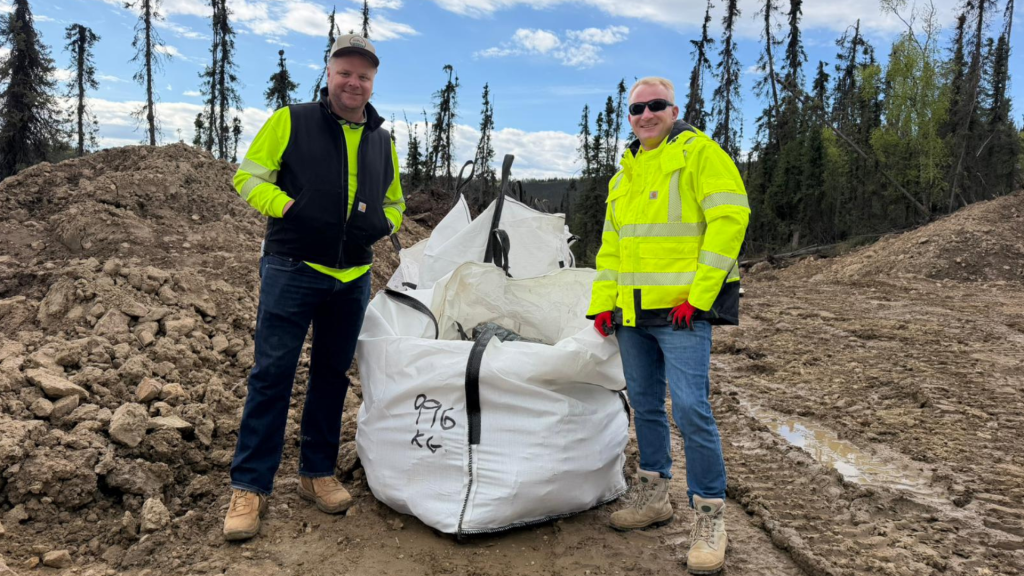
Felix began extracting and stockpiling its ‘high-grade’ antimony from Treasure Creek in June 2026, with about 30 tonnes of massive stibnite vein material extracted to date.
Write to Amy Rotman at Mining.com.au
Main image: Mining.com.au


