


Barton Gold (ASX: BGD) reports that it has identified a series of ‘large-scale’ gold and copper targets across South Australia’s Central Gawler Craton as part of its R&D partnership with tech-driven explorer SensOre (ASX:S3N) announced in March 2022.
The results, which were generated via a combination of artificial intelligence and machine learning technology, have provided targets across Barton’s own tenements, along with a broader 60,000km² area.
Speaking on the Phase 1 update, Barton Gold Managing Director Alexander Scanlon said: “These are exciting preliminary results given that Phase 1 modelling has correctly predicted targets we already know to host gold mineralisation. We will be looking forward to advancing the development of SensOre’s DPT module so that we can further refine these targets for drill testing and model validation.
“These are exciting preliminary results given that Phase 1 modelling has correctly predicted targets we already know to host gold mineralisation”
Our key focus is identifying and developing large-scale gold resources, but naturally we are very interested to see multiple potential large-scale copper targets identified proximal to, and sometimes coincident with, our gold targets. The regional geology certainly supports this potential and we will review it carefully.”
Barton notes that Phase 1 prospectivity mapping has identified areas with ‘significant’ gold and copper mineralisation potential. SensOre’s modelling system was trained on over 3,000 gold and copper occurrences, with analysis on over 200 geophysical factors in the target area.
Importantly, the ‘datacube’ used does not yet include specific project data or geochemical data layers.
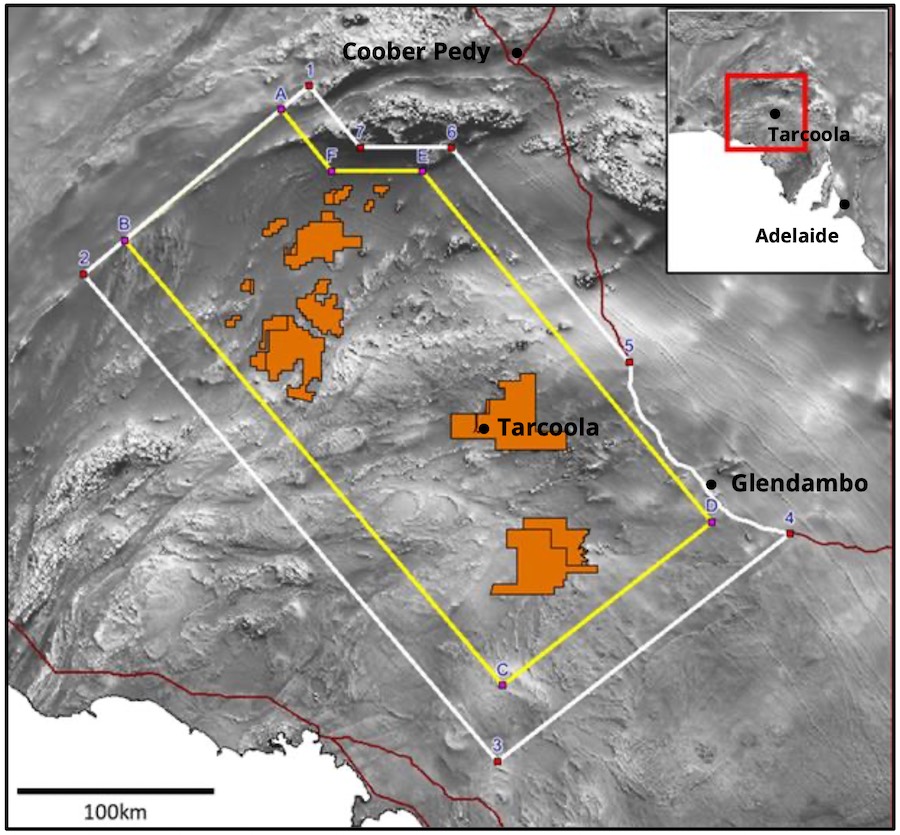 Map displaying Barton Gold tenements in orange along with Phase 1 (yellow) and Phase 2 (white) areas of exclusivity. Image: Barton Gold Holdings Ltd
Results from the analysis have returned several targets in the vicinity of known gold deposits, many of which may not have not yet been drill tested. The company believes that this may provide potential for a new ‘large scale’ testing opportunity.
Moving forward, Barton reports that together with SensOre it will work to refine models leading up to Phase 2 work, which will include the use of a ‘Discriminant Predictive Targeting’ module. Results from this will be compared with Phase 1 work to verify drill targets for a planned upcoming field program.