Zeotech (ASX:ZEO) has reported that field trials at the North Burnett Regional Council (NBRC) landfill in Queensland have been completed, as a part of Zeotech’s Methane Control Program.
The zeoteCH₄® field trial recorded average methane emissions 92% lower than untreated control cells under real-world landfill conditions.
The final report by Griffith University confirms the completion of a six-month field trial conducted at the NBRC Waste Management Facility.
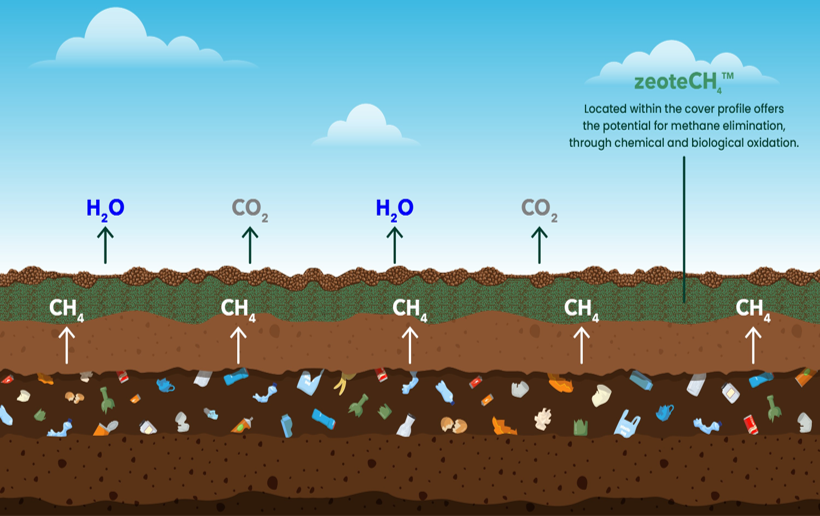
Gas analysis indicates that methane is being eliminated within the treated cover layer, rather than being delayed or trapped.
Zeotech says the field trials generated “important practical learnings” that will support future deployment, including erosion protection, treatment-layer stability, and moisture management.
The company’s biofilter product, zeoteCH₄®, remains installed at the NBRC facility. Zeotech is considering extending monitoring of zeoteCH₄® to assess longer-term durability and seasonal performance, supporting further optimisation.
Griffith University School of Environment and Science’s Australian Rivers Institute Research Fellow Chris Pratt says the field trial delivered ‘encouraging’ outcomes with “methane emissions from the zeolite-amended cells consistently and materially lower than the untreated controls across the monitoring period”.
“Importantly, the supporting gas analysis is consistent with methane elimination occurring within the treated cover layer, providing further evidence that the technology is reducing methane before it reaches the landfill surface,” Pratt says.
“As expected in a real-world landfill environment, longer-term monitoring across different seasonal and weather conditions would provide further insight into performance over time.”
Zeotech CEO James Marsh says the completion of this trial is an “important milestone” for the company and further validates the potential of its zeoteCH₄® technology.
“Achieving average methane emissions 92% lower than untreated controls, with multiple readings exceeding 97% methane elimination, is an exciting and highly encouraging result, particularly under real-world landfill operating conditions,” Marsh says.
“The trial has also generated valuable practical insights to inform further monitoring, optimisation, and progression toward larger-scale deployment.
“Many landfills are not suitable for conventional engineered gas-capture systems, creating a significant opportunity for alternative methane mitigation technologies.
“Our objective is to develop zeoteCH₄® as a practical, passive, and cost-effective solution that can be deployed at scale to help landfill operators materially reduce fugitive methane emissions.
“The successful trial results provide a strong platform to engage with industry and pursue further field applications as we advance the technology toward commercial deployment.”
The field trial was undertaken at the Mundubbera Waste Management Facility in the North Burnett Region of Queensland.
Griffith University established eight 2m by 2m test cells, which comprised four zeolite-amended cells and four untreated control cells. The test cells allow a direct comparison between treated and untreated landfill cover areas under the same site conditions.
Zeotech is also progressing its international patent application, ‘Zeolites for Methane Control’, covering the use of ion-exchanged zeolites for methane control and emissions mitigation. The application has received a positive International Search Report, with all claims considered novel and inventive over the identified prior art, while the successful landfill trial further supports the technology’s potential applications and commercial opportunity.
The company is now preparing to enter the national phase in selected jurisdictions to strengthen intellectual property protection for its zeoteCH₄® technology.
zeoteCH₄® is a key ‘Horizon 2’ product within Zeotech’s development pipeline and uses advanced zeolite materials that are manufactured from the company’s high-purity Toondoon kaolin.
Write to Maddison Elliott at Mining.com.au
Images: Zeotech