


Last week, major gold mining company Evolution Mining (ASX:EVN) released its full-year results.
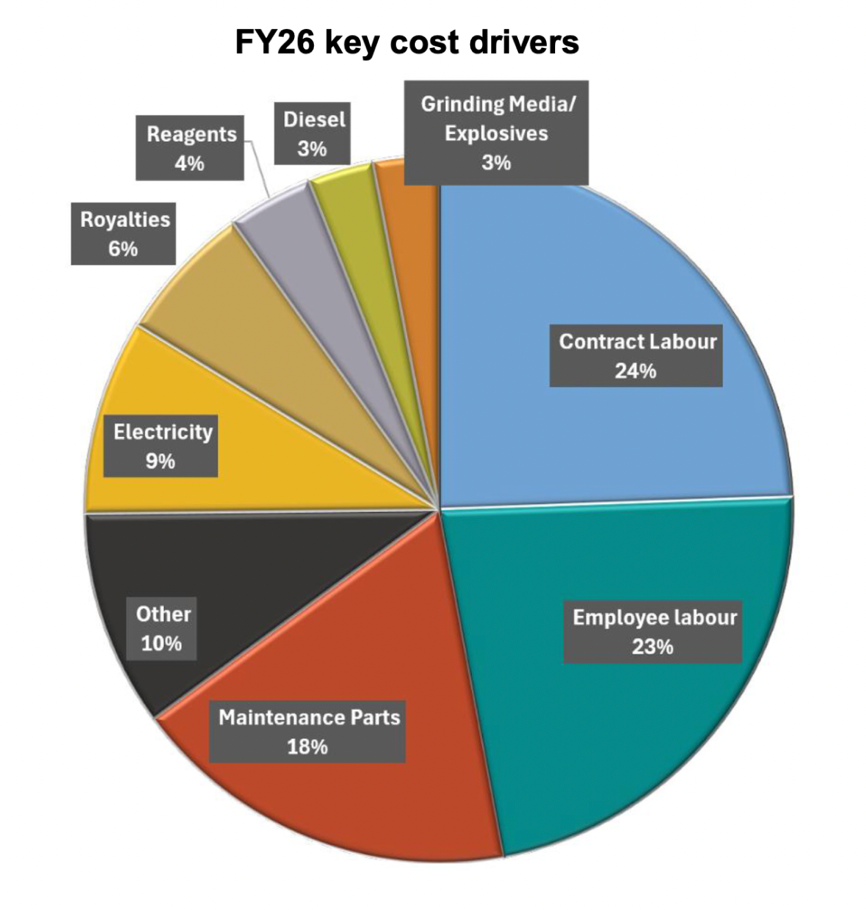
As part of its presentation, the company included a chart that showed the breakdown of its recent cost drivers.
It looked like this:
This is a very handy chart.
Here’s why. Back in March, when the Iran conflict broke out, oil prices rose substantially, as did diesel costs.
In fact, there were genuine concerns in Australia about diesel supply, given the country has only two refineries remaining.
This dynamic contributed to the sell down in gold miners over the quarter, although the main driver was the gold price’s worst three-month performance in 13 years.
Those shares are generally recovering now that the gold price is rising again and concerns about diesel and fuel supply have eased somewhat.
Diesel costs are still elevated. But the chart above shows that diesel is only 3% of Evolution’s cost base.
Much more important by far is the cost of labour
That accounts for nearly 50% of the cost base if you add contract and employee labour together.
This issue could prove far more acute for the mining industry than the diesel scare earlier this year.
Why?
Data centres.
Australia is seeing a huge buildout happening. Westpac Banking (ASX:WBC) released a report in May showing that the data centre investment pipeline is set to exceed $155 billion. That’s on top of similar numbers from the energy transition buildout.
Westpac wrote at the time:
“Australia is seeing an investment boom, with the total pipeline approaching 13% of GDP, rivalling the size of the mining investment boom.”
The Australian reports today:
“In its submission to the Senate Inquiry into Artificial Intelligence and Data Centres, HIA says constructing large-scale data centres will draw heavily from the same pool of electricians and specialist trades needed for home building and delivering other big-ticket projects.”
The HIA is warning about the impact on house construction, but its concerns could easily apply to other industries that rely on skilled labour and ‘tradies’.
That’s applicable to mining.
The Minerals Council of Australia (MCA) warned back in February that a reduction in skilled migration into Australia would make it difficult for the industry to source workers:
“MCA CEO Tania Constable said Australian mining was facing a severe skills shortage which threatens our ability to take advantage of growing global demand for critical minerals essential to daily life, the energy transition, and defence, and bulk commodities such as iron ore and coal.”
In other words, there’s a major risk of miners being forced to pay higher wages to attract the skills and talent they need.
Anything that raises costs will hurt margins unless miners receive higher prices or can cut costs elsewhere.
This may also cause the RBA to keep interest rates at the current level, or even higher, for an extended period of time.
Australia has also seen labour unrest recently, with industrial action at BHP Group (ASX:BHP) and now among coal workers in New South Wales.
Write to Callum Newman at Mining.com.au
Images: Unsplash


