


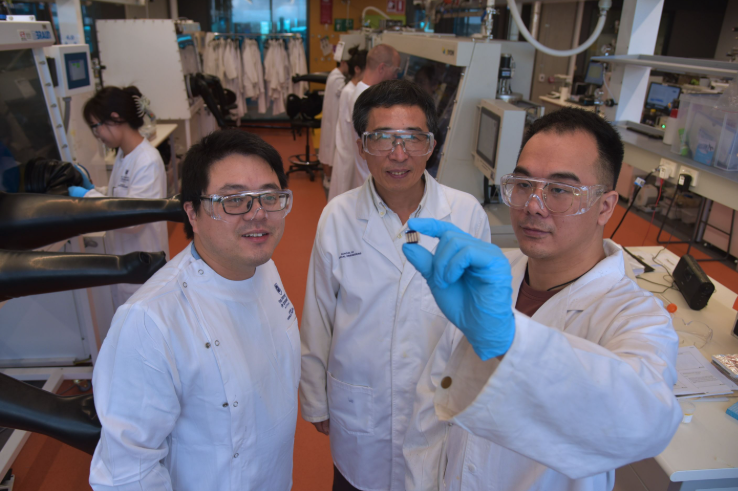
University of Queensland (UQ) researchers have set a new global benchmark for solar cell efficiency with eco-friendly perovskite technology further improving electricity generation from solar panels.
A team led by UQ Professor Lianzhou Wang has revealed a tin halide perovskite (THP) solar cell capable of converting sunlight to electricity at a certified record efficiency of 16.65%.
Wang says the certified reading achieved was nearly 1% point higher than the previous best for THP solar cells.
“It might not seem like much, but this is a giant leap in a field that is renowned for delicate and incremental progress,” Wang says.
“The reading is in line with many silicon-based solar cells currently on the market but with the potential to be cheaper and quicker to make.
“We are thrilled with the record and also to be contributing to the progress of cost-effective renewable energy technology.”
According to the US Department of Energy, perovskites are a family of materials that show potential for high performance and low production costs in solar cells. Perovskites are commonly used in photovoltaic solar cells and are made of a combination of organic ions, metals, and halogens.
Solar panels, otherwise known as photovoltaic panels, are made up of various metals including silver, aluminium, copper, indium and gallium, as well as cadmium and tellurium.
Solar panels are considered important due to the fact they provide a renewable, clean energy source that reduces the reliance on fossil fuels.
As Mining.com.au previously reported on Earth Day (22 April), global investment in the energy transition has increased up to $1.8 trillion as of 2023. This figure far exceeds investments made in the fossil fuel field, which totalled $1.1 trillion in 2023, according to the International Energy Agency.
The US Department of Energy says there are several potential benefits of perovskite solar technology including low-cost potential, use in tandem photovoltaic cells, defect tolerance, and high efficiency.
The Commonwealth Scientific and Industrial Research Organisation (CSIRO) adds that thin perovskite solar cells have emerged as an inexpensive and revolutionary photoactive semiconductor in thin-film solar photovoltaics, with a 16.7% power conversion efficiency rate.
UQ’s new solar cell record comes five years after Wang’s lab set a benchmark for power conversion efficiency in solar cells using another type of technology, quantum dots.
Research group member Dr Dongxu He says many of the methods, processes and materials used to set the quantum dot record in 2020 inspired efforts to improve the performance of the THP thin-film solar cells.
“There is great commercial potential in THP solar cells because perovskite devices are more sustainable to produce than silicon-based solar cells,” He says.
“The benefit of THP’s is that we’re dealing with more eco-friendly tin and not the toxic lead that is widely used in most of the perovskite solar cells, meaning they can be safely installed around the home.”
Wang says that lead-based perovskites deliver high efficiencies, while lead is considered highly toxic and can potentially cause severe environmental pollution.
“Beyond solar panels, the approach we’ve used in this paper could also be used for other devices that require high-quality perovskite films like lasers, photodetectors, and transistors,” Wang says.
“We could eventually see THPs used for engineering challenges, including as a lightweight solution to power electric aircraft – the sky really is the limit.”
The University of Queensland’s latest research in solar cell efficiency was worked alongside the UQ’s Australian Institute for Bioengineering and Nanotechnology and the School of Chemical Engineering.
Write to Aaliyah Rogan at Mining.com.au
Images: University of Queensland


