



Brent crude is currently trading at approximately US$97 a barrel ($134.50). It’s up 20% over the past month.
The rise is attributed to ongoing hostilities between Iran and the US, plus restricted supply coming from the Middle East.
ANZ (ASX:ANZ) noted this morning:
“The ongoing constraints on supply come amid signs of rising demand from China, the world’s largest importer.”
The outlook for crude is tempered by news that US President Donald Trump plans further involvement in Venezuela’s oil industry.
The White House released a statement on 31 August saying that the US now has “powerful governance rights, economic ownership, and guaranteed low-cost off-take from a new private Venezuelan oil champion, which will be the second-largest private oil company by reserves in the world”.
A private company, North American Blue Energy Partners (NABEP), will hold 17 oil concessions in Venezuela, equating to 65 billion barrels of reserves.
Trump calls it the ‘biggest oil deal in history’.
Furthermore, the US Department of War will be granted a 35% equity stake in the corporate parent of NABEP. The US Department of State will have the right to purchase 20% of production at cost.
The US Department of State will also have the right to purchase the remaining 80%, a reserve power in case of “emergency situations”. The projected capital expenditure to bring this oil to market is said to be US$100 billion.
The White House statement adds that this policy is consistent with the Monroe Doctrine, which considers the Western Hemisphere a sphere of US control.
Last week, US oil firm Chevron (NYSE:CVX) also announced that it now has additional acreage in Venezuela’s prime oil region. The company will invest more than US$7 billion over the next five years to raise its production in the country to around 600,000 barrels a day.
Chevron says it can produce oil at less than US$20 a barrel and has had a presence in the country since 1923.
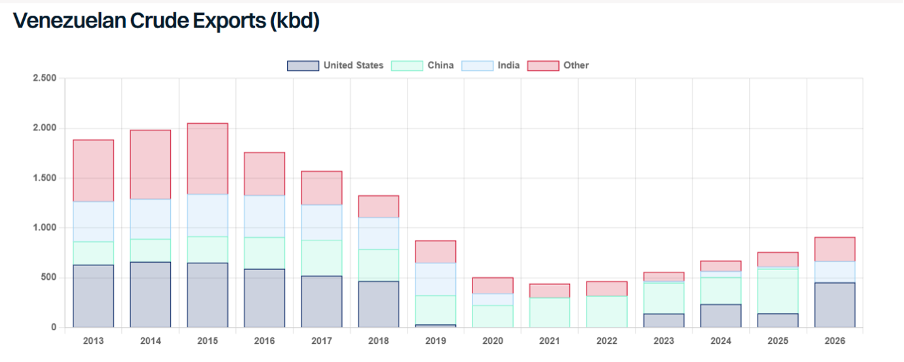
Research firm Breakwave Advisors says there is clear upside to Venezuelan production as soon as 2027, with a modest initial uplift of about 500,000 barrels a day.
What’s less clear is how quickly Venezuelan output can rise after that, given the scale of investment required.
Breakwave also shared the following chart, showing that Venezuelan production was previously higher but has fallen in recent years due to mismanagement and lack of investment.
Any additional barrels from Venezuela help offset the loss of Middle East crude that the market is currently wrestling with.
Bloomberg energy columnist Javier Blas says that the oil industry’s ‘centre of gravity’ is moving away from the Middle East toward the Americas.
Canada, the US, Brazil, and now Guyana are all producing abundant amounts. Argentina recently hit a record high too. At one point in 2026, the Americas were producing half the world’s oil output.
To put that in context, Blas says the Americas accounted for about 26% of the world’s production in 2000.
Blas wrote back in August:
“By the end of 2027, Brazil and Canada will together pump more oil than Saudi Arabia. Guyana will produce as much crude as Libya.
“Research from JP Morgan highlights a key reason why the boom will continue: the new offshore developments in Brazil and Guyana will pay off over many years and are thus relatively agnostic about swings in oil prices.”
The world can now add more Venezuelan oil to the mix following Trump’s latest deal.
The pressure in the energy market is being felt most acutely in the ‘products’ category, especially diesel.
There may be better news here, too. China might increase exports to capitalise on the high prices available on the world market.
Reuters reported on 2 September:
“To capture higher profits, Chinese refiners are expected to export slightly more than 4 million tonnes of gasoline, diesel, and jet fuel in September, according to the sources and two Chinese consultancies that track the sector.
“China’s exports of the three fuels combined averaged around 3 million tonnes a month last year. Rising exports of refined products from China are expected to add to Asian supplies and could help cap regional price gains, sources said.”
Both increasing Western Hemisphere crude production and higher Chinese product exports could cause oil prices to halt their advance, unless another wildcard shock hits market supply.
It would be good news for consumers if prices do stay put.
Write to Callum Newman at Mining.com.au
Images: Unsplash


