


In the remote outback of south-central Queensland, a geological formation older than the dinosaurs could hold the key to one of Australia’s most persistent clean-energy challenges – how to store large volumes of renewable energy on demand.
The almost $31 million Data Driven Discoveries Program, led by the government’s geoscientific research agency Geoscience Australia in collaboration with the Geological Survey of Queensland, has reprocessed decades old seismic data and collected new data to support the acceleration of discoveries in the underexplored 142,000km2 Adavale Basin region.
Geoscience Australia has been turning its attention to this region, which is a deep and largely under-explored sedimentary basin buried beneath younger rock sequences, to assess its capacity to act as a giant underground hydrogen ‘battery’.
Of particular interest is the basin’s rock salt. The Royal Geographical Society of Queensland notes rock salt plays an essential role in many plans for a net zero future, as salt caverns are the only commercially proven option for large-scale underground storage of hydrogen.
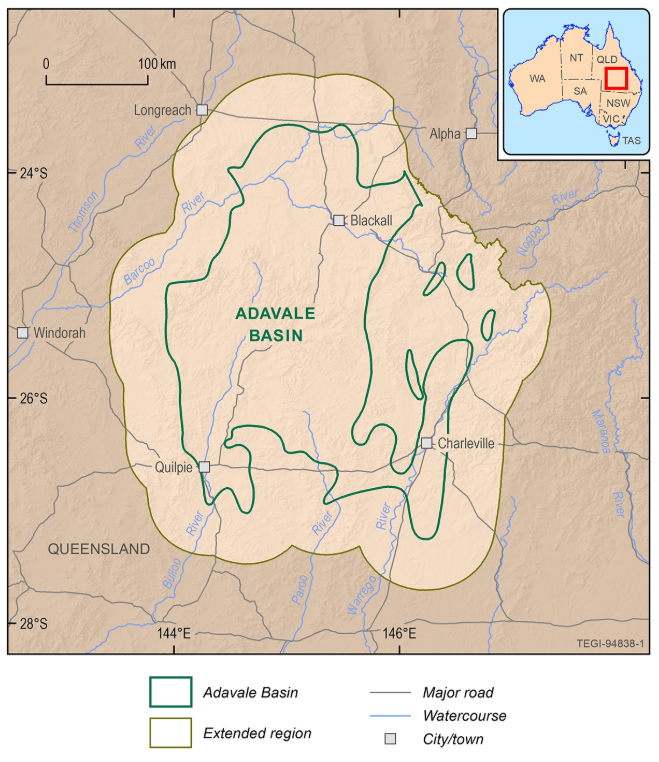
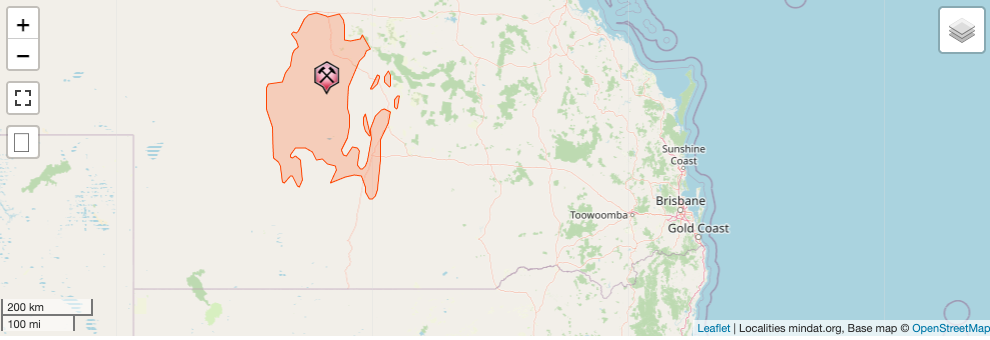
In November 2025, the Data Driven Discoveries Program completed the Adavale Basin stratigraphic drilling project as part of its final phase of delivery, reaching a total depth of 3,023m – the deepest in Geoscience Australia’s modern history. This early drilling and seismic work suggests the basin’s thick salt deposits, especially the Boree Salt, could be ideal for constructing vast caverns capable of storing hydrogen gas at scale, offering an innovative solution to the intermittency of renewables.
The campaign recovered nearly 1,000m of continuous core, rock chips, groundwater samples and detailed geophysical logs that will feed into improved geological models of the basin.
The Adavale Basin does not outcrop at surface. Until recently, much of its geology was hidden under the younger sedimentary layers of the Eromanga and Galilee basins, making it difficult to study. Geoscience Australia’s $30.9 million Data Driven Discoveries Program is seeking to change that by reprocessing historical seismic data and collecting new geoscientific information to unlock the basin’s secrets.
Head of Geoscience Australia’s Advice, Investment, Attraction and Analysis Branch, Mitchell Bouma, says that while the stratigraphic drilling will help characterise mineral and groundwater potential, the project’s unique focus is on understanding the only known thick salt accumulation in eastern Australia – the Boree Salt deposit – and its suitability for underground hydrogen storage.
Salt caverns as giant batteries
Storing hydrogen underground in salt caverns is a well-established technique overseas. In the UK, for example, the Teesside facility has stored hydrogen gas in salt caverns since the early 1970s, demonstrating both safety and longevity in long-term energy storage.
Geoscience Australia’s interest in the Adavale Basin’s Boree Salt – predominantly made up of halite – stems from its potential to host similar caverns. When sections of salt are selectively dissolved through solution mining, the resulting voids can act as secure, high-pressure containment spaces for hydrogen gas. Unlike surface batteries or tanks, these underground reservoirs can be much larger, cheaper to build, and capable of storing energy for months rather than hours.
According to reports, a single cavern developed within the basin could hold about 6,000 tonnes of hydrogen, equivalent to roughly 100 gigawatt hours of stored energy – roughly 50 times the capacity of Australia’s largest battery installations. Under this model, even a handful of such caverns could theoretically supply millions of homes on demand.
Independent energy geoscientists point out that underground hydrogen storage is a proven technology in jurisdictions such as the UK and US, where salt caverns are used to store not just hydrogen but natural gas and compressed air for grid services.
The Advanced Clean Energy Storage hub being developed in Utah in the US will use two salt caverns to store 5,500 tonnes of working capacity each. The joint venture between oil behemoth Chevron (NYSE:CVX) and Japanese power solutions company Mitsubishi Power estimate it would take more than 40,000 shipping containers’ worth of lithium-ion batteries to produce the equivalent megawatt-hours of one cavern.
There are estimates that just a handful of artificial caverns within the Adavale Basin could be enough to power 20 million homes a day, based on the average household demand in Brisbane.
According to GeoScienceWorld (GSW), rock salt caverns are recognised as a promising option for underground hydrogen storage, however industry understanding of evaporite sequences is frequently limited by poorly constrained depositional ages. The geoscience research publication notes the Adavale Basin formed as a result of widespread rifting across the Thomson Orogen in the Early Devonian (circa 408–403 Ma).
The basin stratigraphy consists of seven major formations, including the rift-related volcanic Gumbardo Formation, the fluvial lacustrine to continental marine Eastwood Formation, Log Creek Formation, Lissoy Sandstone and Cooladdi Dolomite, and the marginal marine to continental red bed Etonvale and Buckabie formations. The shallow-marine and evaporitic Bury Limestone and Boree Salt were deposited primarily in the eastern Adavale Basin.
Addressing the intermittency challenge
Brian McIntosh, VP, Research at Wood Mackenzie notes the intermittency of renewable energy – the fact that solar and wind generation ramp up and down with weather and daylight – remains one of the biggest barriers to a fully decarbonised grid. Large-scale storage solutions like pumped hydro and lithium-ion batteries have made progress, but they are costly, geographically constrained and limited in duration.
Underground hydrogen storage, by contrast, offers duration and scale. In regions like the Adavale Basin, where renewable generation from Queensland’s sun and wind resources is abundant, storing excess power as hydrogen underground could provide a dispatchable energy reserve that can be tapped when generation is weak or demand is high.
Australia’s national hydrogen mapping has identified other thick salt accumulations across the country including the Canning Basin in Western Australia, and the Polda Basin offshore South Australia. Yet the Boree Salt in the Adavale Basin remains unique as the only thick salt accumulation in eastern Australia suitable for large-scale storage.
Beyond hydrogen: Seismic insights and critical minerals
While hydrogen storage is the headline potential, the Adavale Basin investigation is yielding broader geological insights. The Data Driven Discoveries Program’s deep crustal seismic surveys and reprocessed legacy data are helping to map underground architecture not only for salt bodies but also for minerals, hydrocarbons and groundwater resources.
Basin systems such as this can host a variety of critical minerals, including cobalt, copper, and zinc, which are essential to renewable energy technologies and battery supply chains, says Geoscience Australia’s Bouma.
“Through our sampling we will also be able to gain an understanding of the composition and connectivity of the deep groundwater resources …”
“So, we’re excited to see what we can discover through improving our geological models,” Bouma adds.
“Through our sampling we will also be able to gain an understanding of the composition and connectivity of the deep groundwater resources, as well as the subsurface geology of the Adavale Basin to help characterise future resource potential.”
Enhancing the understanding of deep groundwater systems is a key consideration where energy infrastructure overlaps with fragile water resources. As borehole data are analysed, new models of aquifer connectivity and rock properties are emerging that will inform sustainable resource management.
Local concerns and environmental risk
Despite the technical optimism, not all stakeholders are unconstrained by possibility. Towns such as Blackall, Quilpie and Charleville sit above the Adavale Basin and also overlie the Great Artesian Basin – the largest underground freshwater reservoir in the world. Some residents and local leaders express concerns about any activity that might jeopardise their only reliable water source.
There are calls for discussions about underground storage to balance geological potential with community-scale impacts, including groundwater pressure changes and ecosystem sensitivities, even as experts argue that the properties of salt make such risks manageable with proper design and monitoring.
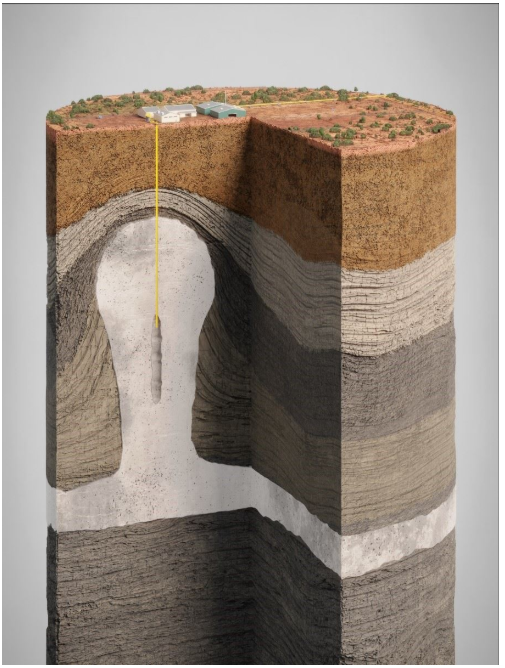
As Geoscience Australia prepares to publish its Adavale Basin findings within 2026s, the program’s broader implications are already clear. Salt cavern hydrogen storage could play a major role in Australia’s energy transition, expanding the toolkit beyond surface batteries and pumped hydro and anchoring a new class of infrastructure that stores clean energy at grid scale.
The data produced from this campaign – and the program more broadly – will help to identify ways of locating and mapping the extent of salt bodies within the Adavale Basin, as well as their geological controls, to underpin further storage assessments and exploration.
By delivering vital information about the basin and surrounding area, Geoscience Australia says it is “providing government and industry with critical precompetitive data to help secure the region’s prosperity and drive investment as Australia works towards a sustainable low emissions future”.
If successful, the Adavale Basin project could position Australia at the forefront of underground energy storage innovation, leveraging ancient geology for modern energy challenges, and turning a buried basin into a massive underworld “battery” capable of supporting renewable power resilience across eastern Australia.
The stratigraphic research borehole has been plugged and will be rehabilitated as required by Queensland law.
Write to Adam Orlando at Mining.com.au
Images: iStock, Geoscience Australia, Mindat & The Royal Geographical Society of Queensland


