



This article is a sponsored feature from Mining.com.au partner Trek Metals. It is not financial advice. Talk to a registered financial expert before making investment decisions.
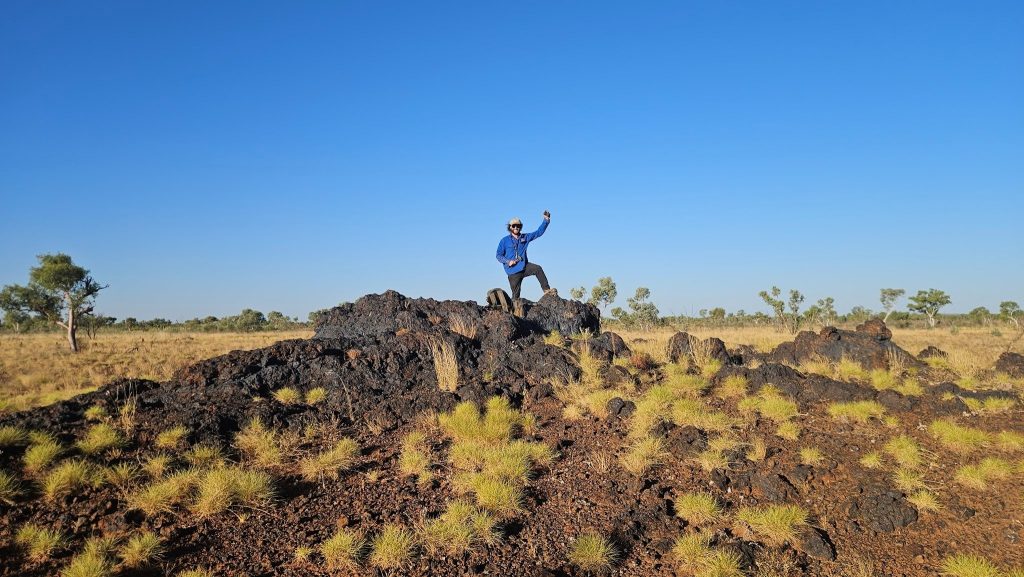
Trek Metals (ASX:TKM) was originally on the hunt for rare earths and gold at its Christmas Creek Project in Western Australia last year, when it uncovered ‘high-grade’ manganese in huge black rock outcrops spanning 750m across the surface of the desert.
Dubbed the ‘Kuro’ prospect, the find spurred the company into action, taking initial rock-chip samples which returned ‘high-grade’ manganese averaging 50%.
CEO Derek Marshall then went out to site himself, cracking open rock after rock, finding heavy manganese mineralisation in each one.
“It’s quite unusual to have such high-grade manganese sticking out of the ground,” Marshall says.
“The rock chips showed that the average was 50% manganese, which is incredibly high.”
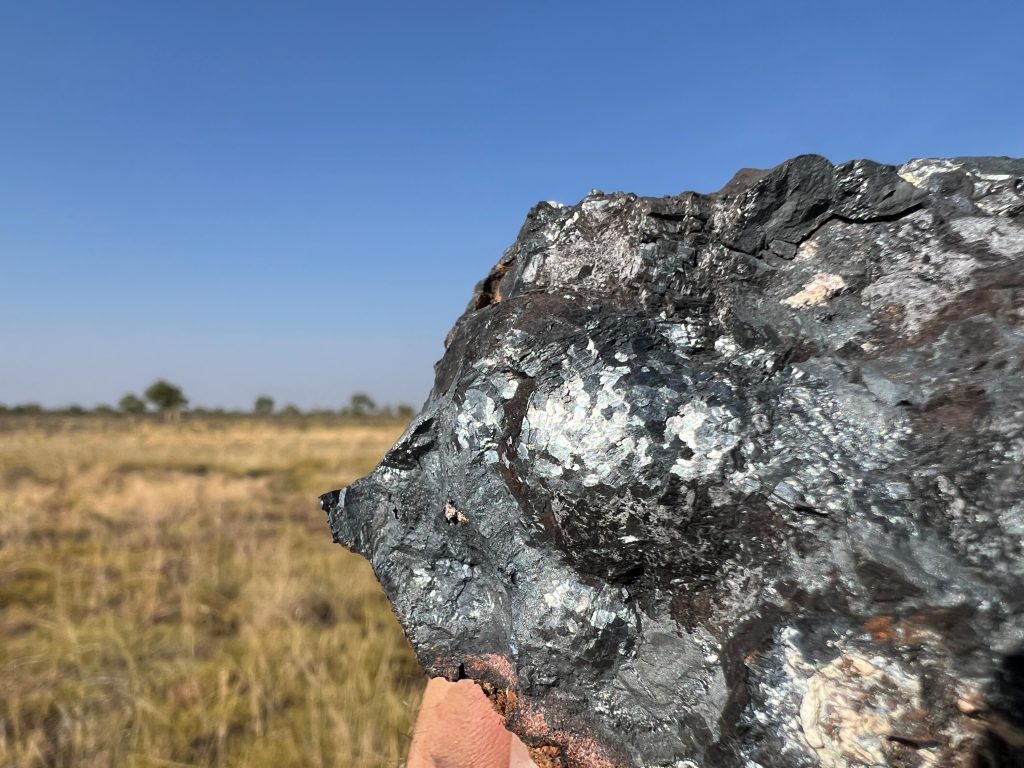
This is particularly notable because the benchmark for premium high-grade product is 44%, and Trek’s prospect boasts grades of up to 60.1%.
“63% is the theoretical maximum content for manganese, so it’s basically pure manganese oxide sticking out of the ground,” Marshall says.
“That’s really what sets us apart from other manganese players — we appear to have consistent high-grade mineralisation.
“Obviously now it comes down to thickness and whether that grade continues at depth but certainly from surface it looks really good.”
The company interprets gravity high trends in the vicinity of the outcrops as more manganese at depth and believes upcoming drilling could show a large and continuous system host to incredibly ‘high-grade’ rocks.
If it’s right, it could mark the start of Australia’s third ‘high-grade’ manganese operation.
Currently there are only two ‘high-grade’ operations in the country, Chinese-owned ConsMin’s Woodie Woodie mine, also in Western Australia, and South32’s (ASX:S32) Groote Eylandt mine in the Northern Territory.
“High-grade manganese discoveries are pretty rare, and there’s only two operations in Australia, so I think the market doesn’t know too much about manganese,” Marshall says.
“Kuro appears to be a high-grade mineral occurrence, and at Trek we have an experienced team that has brought a project online before and has a proven track record from discovery to delivery.”
Board bolstered by Pilbara Metals expertise
Marshall is referring to the company’s board which includes non-executive directors Neil Biddle and John Young who were key members of Pilbara Metals (ASX:PLS) back in the early days.
Biddle was a founding director of PLS and served as executive director from 2013 to 2016, before becoming a non-executive director from 2016 to 2017.
Young was exploration manager from 2014 to 2015, technical director from 2015 to 2017, and served as a non-executive director from 2017 to 2018.
This adds up to considerable experience in finding and mining Pilgangoora, one of the world’s largest hard-rock lithium deposits which became a bulk commodity mining operation — driving the company from a penny stock before the discovery to its current market cap of around $15 billion.
That’s some serious value creation. The question now is can Trek follow in these footsteps, discovering, scaling, and executing a high-grade project in a prime jurisdiction?
It certainly helps that Biddle and Young have deep global connections in the lithium-ion battery market, a prime market for high-grade manganese product.
“They’ve got a lot of really great contacts that they’ve put me in touch with, including metal traders and metallurgists,” Marshall says.
“A lot of battery makers are moving to higher manganese chemistries in their lithium-ion batteries because it increases energy density which means a faster charge and longer discharge cycles.
“For instance, BYD just announced that they are putting manganese into their new blade battery which goes into all of their lithium-ion phosphate batteries and around 90% of their BYD vehicles, so that’s really good for the manganese industry.”
Another market for the product is in alkaline batteries, which needs pulverised natural manganese dioxide and can command a 200–400% premium on what the steel mills will pay for the product, Marshall says.
Steel still a key market
“With manganese, 90% of it goes into the steel industry currently, with a price around double that of iron ore at around US$200–250 ($282–353) per tonne,” Marshall says.
To put that into context, the current price is sitting at around US$5.58 per dry metric tonne unit, which for around 38% of low-grade material equates to US$212 per tonne.
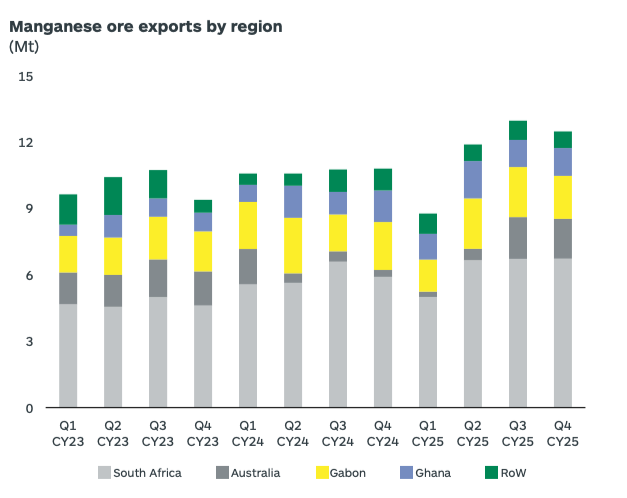
But it’s high-grade ore that really commands a premium price, especially if there’s any supply disruptions like when S32’s Groote Eylandt port infrastructure was damaged during Tropical Cyclone Megan in 2024.
That natural disaster took around 15% of high-grade manganese out of the market and sent the price soaring from around US$3.50 to US$7.50 per dry metric tonne unit.
“If there’s any sort of disruption, the steel mills that need that high-grade feed will pay a significant premium to the normal price,” Marshall says.
Marshall notes that it’s a common theme, with issues around railway strikes in South Africa previously causing the price to triple.
“If you’ve got a high-grade product then you know it’ll command a premium,” he says.
Boots on the ground next week
The company has recently expanded its tenure by around 5,608km², picking up two belt-scale manganese exploration projects around Kuro.
Notably, despite favourable geological architecture and confirmed manganese occurrences, the region has seen limited modern exploration.
Now it’s crunch time for Trek Metals, with drilling commencing this week aiming to determine the potential scale of the discovery.
Marshall says the goal is an initial 70 reverse circulation holes planned for just under 10,000m.
The company will also expand the geophysical surveys beyond the area of outcropping manganese thanks to a co-funded Exploration Incentive Scheme (EIS) grant from the Western Australian Government.
“That outcrop dives undercover, and it’s very shallow sand typically around 2–10m thick that covers around 70% of our project area,” he says.
“There’s this big northern trend of gravity high and 90% of that’s undercover and it’s not really constrained. It’s only constrained by the size of the ground gravity survey that we did late last year.
“We’ve got guys out on site expanding the gravity survey, we’ve also got induced polarisation surveying underway as well, and all of that will feed directly into the drill targeting.
“We’re keeping it flexible and all of this data will inform and feed into the drilling as we go.”
Write to Emma Davies at Mining.com.au
Images: Trek Metals & South32


