


ASX-listed mineral exploration company Strickland Metals (ASX:STK) reports it has found further ‘excellent’ gold results at the Millrose Gold Project, located in Western Australia.
The company says these results are from 2 reverse circulation (RC) drillholes completed to follow-up historic shallow aircore anomalism around 200m west of the main Millrose structure.
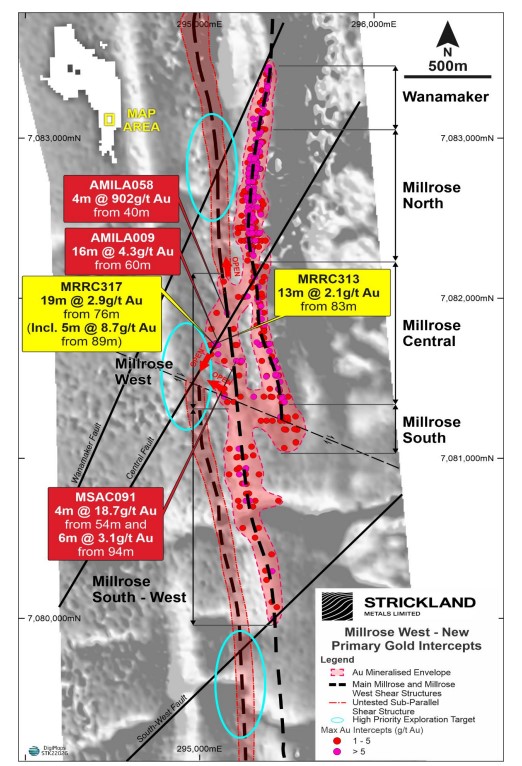
Intersections recorded include hole MRRC317 with 5m @ 8.7g/t Au from 89m, within a broader 19m @ 2.9g/t Au from 76m; and MRRC313 with 13m @ 2.1g/t Au from 83m.
Commenting on the results, Strickland Metals Chief Executive Officer (CEO) Andrew Bray says: “Our 2022 drilling campaign at Millrose has been enormously successful in delineating new zones of mineralisation, discovering ‘significantly’ more oxide gold closer to surface, and achieving major extensions to the existing primary mineralised envelopes.
“Strickland drilled further to the west of the main Millrose structure and intersected a secondary shear structure”
Of particular excitement towards the end of the drilling campaign, Strickland drilled further to the west of the main Millrose structure and intersected a secondary shear structure, hosted within an entirely separate stratigraphic package. Historically this area has only been subject to shallow aircore drilling, with little understanding of the structural controls on mineralisation, and drilling having been too shallow to have intersected the structure.
The 2 results (MRRC317 and MRRC313) are associated with metasediments and granitoid intrusives, with mineralisation open along strike in multiple directions. These results confirm the structure is mineralised, with strong potential for a secondary, high-grade system at Millrose West. This structure remains entirely untested.
From the work completed by Strickland, northeast-trending fault structures are critical to the localisation of high-grade gold mineralisation along the Millrose Shear. Given the recent discovery of this fertile sub-parallel Millrose West Structure, there are many locations along strike where northeast trending fault structures transect it, which to date have not been drill tested.
Overall, this new western shear structure represents a highly compelling exploration target. Most significantly, it demonstrates the potential for a secondary look-a-like Millrose analogue to the West.
Outside of the new western shear structure, the latest assays continue to demonstrate the ongoing excellent potential at Millrose, delivering both width and grade over a very large strike area These assays will feed into the updated mineral resource due to be released during the first half of 2023.”
Strickland reports further strong results have been recorded in other parts of the project. The company says assays from Millrose North, Millrose Central and the Wanamaker lodes are all interpreted to be north-plunging, associated with the northeast-striking cross-cutting shear structures. It also notes primary gold mineralisation across all 3 domains remains open at depth.
Assays from Millrose Central include MRRC393D with 14m @ 3g/t Au from 79m, within a broader 32m @ 1.8g/t Au from 66m; and MRRC389D with 12m @ 3.3g/t Au from 158m.
Results from Millrose North include hole MRRC417 with 5m @ 8g/t Au from 101m; and MRRC420 with 6m @ 6.4g/t Au from 56m. Assays from Wanamaker include drillhole MRRC129W with 6.7m @ 4.6g/t Au from 130.3m; and MRRC343 with 4m @ 2.9g/t Au from 88m.
Strickland Metals is an ASX-listed mineral exploration company focused on discovering gold and copper at its projects in Western Australia. The company’s portfolio of projects include the Horse Well Gold Joint Venture (JV) Project which the company holds a 60% interest, and the Millrose Gold Project in the Yandal Greenstone Belt region.
The company also holds an 80% interest in the Iroquois Project in the Earaheedy Basin, the Bryah Basin Project near Meekatharra, and the Paterson Project near Port Hedland.
Images: Strickland Metals Ltd & iStock