


Solis Minerals (ASX:SLM) says drone magnetometry survey and geochemistry work have advanced its portfolio of copper-gold targets and uncovered a high-priority exploration area within the Guaneros Project in Peru.
Interpretation of the magnetic survey results is underway, and the company expects to conduct evaluations of which areas are suitable for induced polarisation (IP) surveys in due course.
Drill permitting of these targets is anticipated to begin in the first quarter of 2025, with the associated drilling program anticipated to run throughout 2025.
Solis, which has a market capitalisation of $8.6 million, says the drone magnetometry survey uncovered magnetic anomalies in areas close to an intrusive batholith contact, with similar magnetic responses to those seen at the Ilo Este Project.
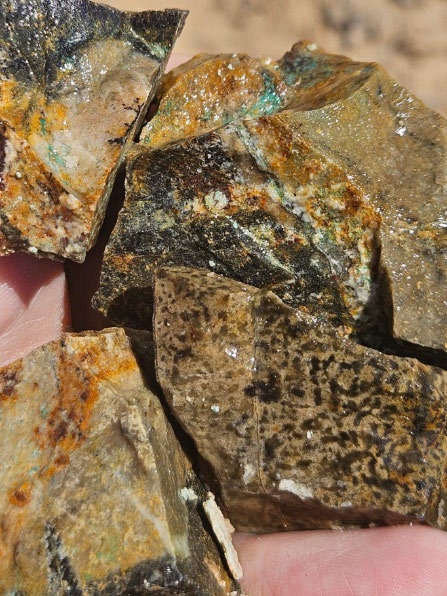
Several rock samples were also collected 1km north-west of the Gunaeros southern anomaly, which highlighted visible copper oxide mineralisation and alteration. The sample areas lie in an area of low magnetic responses, which Solis says indicates potential alteration.
Two rock samples from outcrops north of the Guaneros southern magnetic anomaly returned up to 0.37% copper and 0.14% copper, as well as 0.17 grams per tonne (g/t) gold and 0.11g/t gold.
Executive Director Mike Parker says the results have contributed to the company’s understanding of settings for potential mineralisation in the prospective Coastal Belt.
“Rock samples in the area have returned highly anomalous copper and gold values associated with alteration akin to porphyry style mineralisation,” Parker says.
“We will continue to complement our knowledge, with ground investigations and further geophysics where appropriate, as we develop a clear roadmap to permitting and drilling.
“The Guaneros Project, along with the neighbouring Ilo Este and Chancho al Palo projects, have developed into a major focus for our copper exploration in South Peru. We look forward to progressing our permitting and drilling.”
Other rock samples collected on structures 2km north-northeast of the southern anomaly returned background values of copper and gold.
The company says this shows the potential influence of the proximity of the southern anomaly to mineralisation and the pathfinder value of rock geochemistry in the area.
The magnetic data from Guaneros will be further processed in due course, using magnetic vector inversion techniques to assist interpretation work and any follow-up programs.
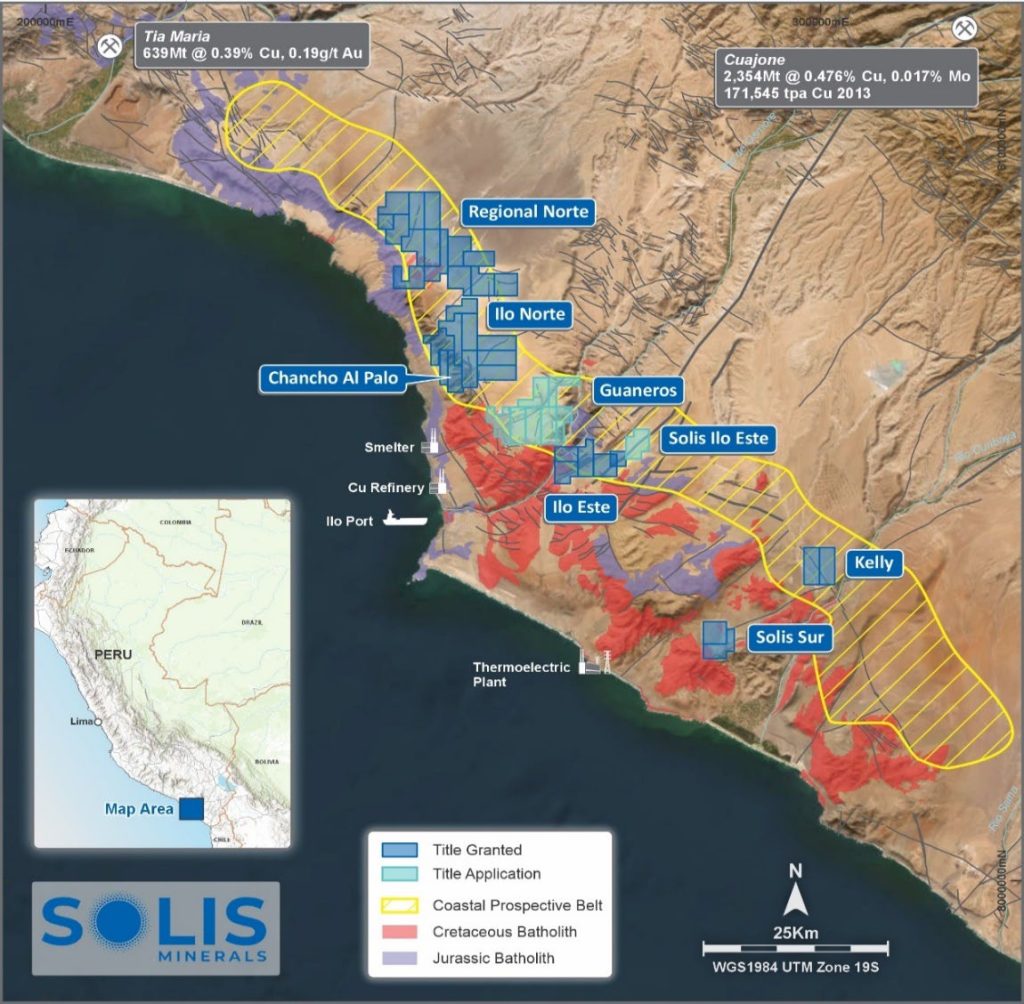
Solis notes that Guaneros is partially covered with recent sediments that effectively block IP surveys, due to conductive beds. Drill targeting may depend solely on magnetic data, structural, and mapping interpretations.
At the Regional Norte area, IP surveys are not suitable due to conductive cover. Drill permitting is expected to start in due course to enable drilling to take place in the first quarter of 2026.
Further, Solis is continuing to review targeted lithium and copper opportunities throughout South America.
Out of all permits, four were released on 1 July 2024. The permits include Kelly 00, Uchusuma A and B applications, and the Pallagua 1 application.
At the Kelly 00 permit, a review of the magnetic data showed that the substantive part of the anomaly is outside of the permit and is covered by new Solis permits.
Meanwhile, at the Uchusuma and Pallagua 1 permits, field visits revealed unfavourable geology.
Solis Minerals is an emerging explorer focused on unlocking the potential of its South American critical minerals portfolio.
Write to Aaliyah Rogan at Mining.com.au
Images: Solis Minerals