



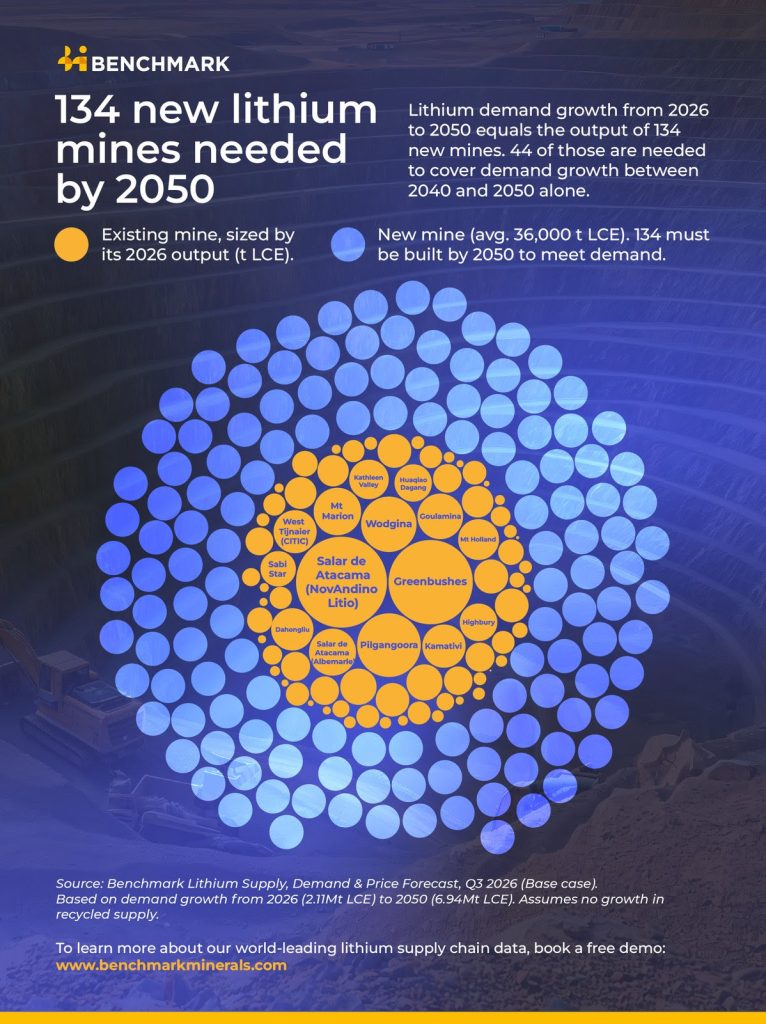
A new report by Benchmark Mineral Intelligence highlights that, between today and 2050, the equivalent of 134 new lithium mines will be needed to keep pace with the growing demand.
Benchmark forecast global lithium demand to reach around 7 million tonnes (Mt) of lithium carbonate equivalent (LCE) in 2050, noting that 76% of this demand will be driven by electric vehicles (EVs).
This figure represents quite a dramatic rise from the 2.11Mt of LCE demand forecast for 2026, more than tripling demand over the period.
Product Director – Lithium Cameron Perks says that to meet demand in 2050, the equivalent of 134 new lithium mines will be needed, equating to over US$100 billion ($142.45 billion) in investment. He also points out that Benchmark’s upside scenario could bring that number to more than 180 mines.
“The biggest challenge is sustaining that investment through price cycles, while competing for capital with AI, defence, and the wider energy transition,” Perks says.
Lithium demand is predominantly being driven by the EV industry, with batteries accounting for 92% of all lithium demand. At present, EVs account for 55% of lithium demand. At the same time, stationary storage has boosted demand more recently, but Benchmark expects that growth to moderate over time.
“Lithium demand from stationary storage has grown more than 60% a year for the past two years, but we expect that pace to slow significantly, to around 5% a year to the end of the decade,” Perks says.
The global supply challenge
The report notes that Australia is currently the global leader in mined lithium 2026, accounting for 29% of mined supply, though that share is expected to decline to 20% by 2050. This is despite some of the larger brownfield expansions planned, such as PLS’ (ASX:PLS) P2000m which is expected to start around 2030.
China’s share of mined lithium supply is expected to remain stable at around 25%, while North America’s is set to increase from 1.7% in 2026 to 13% by 2050. This growth is largely driven by government efforts to reduce foreign dependence and secure the supply chains for strategic metals.
In Europe, domestic development across metals and mining supply chains is also driving growth, with its share of mined supply expected to rise from less than 1% today to 5.5% by 2050.
Perks notes that many of Australia’s current mines will be depleting by 2050, while price volatility and a growing regulatory burden are making investment more difficult today. As for Europe and North America, Perks warns that environmental and community concerns remain barriers, delaying the growth of their industries.
Another potential source of supply is recycling, which is a key factor in reducing the total amount of new mines needed by 2050. Benchmark forecasts recycling will account for nearly 50% of lithium supply by then.
“Recycling will grow, but our base case asks a lot of it,” Perks says.
“It’s limited by how quickly batteries reach end of life, and it still needs to compete with mines on cost. Every tonne that recycling doesn’t deliver has to come from a mine.”
Advancing the lithium pipeline
That pipeline of new mines sits with explorers, who are expected to deliver lithium supply for the future.
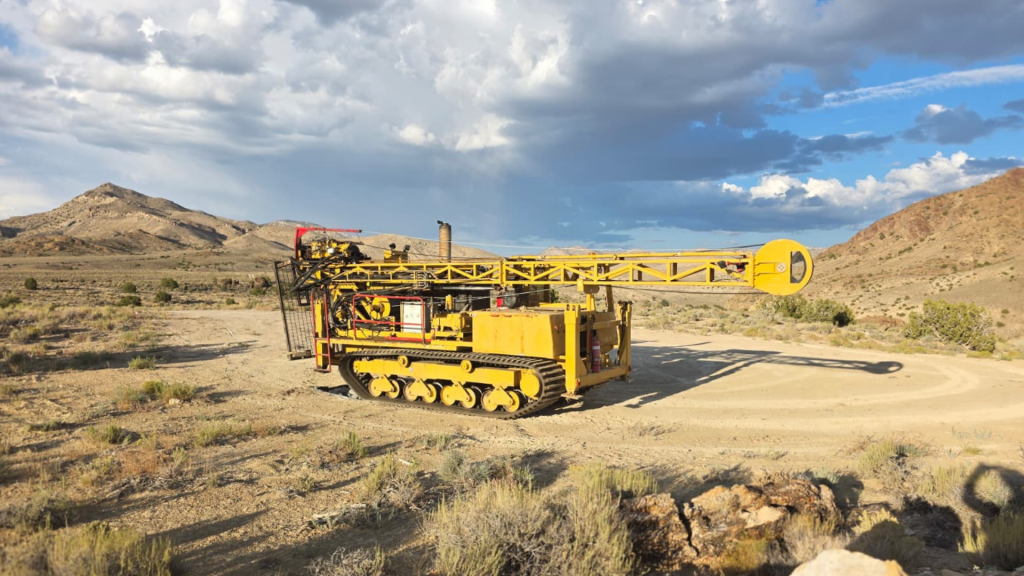
Venari Minerals (ASX:VMS) is advancing the Red Mountain Project in the ‘Lithium Capital’ of North America, over 33km2 of mining claims in Bureau of Land Management land in Nevada, US.
Metallurgical testing is well-advanced, with Venari having achieved a 99.5% battery-grade lithium carbonate produced from Red Mountain mineralisation through sulphuric leach and crystallisation test work.
The company is currently working toward a mineral resource estimate (MRE) upgrade and Scoping Study in February and March 2027, with infill drilling, assays, and metallurgical test work ongoing.
Alongside lithium, Venari Minerals has also identified a strategic by-product potential in strontium, which has strategic defence applications. The US is currently wholly import-dependent for all of its strontium requirements.
Venari Minerals has just reported its inclusion in the US Defense Industrial Base Consortium (DIBC), providing it with strategic access to Department of War (DoW) funding opportunities.
Q2 Metals (TSX-V:QTWO) is focused on the Cisco Lithium Project, which it describes as North America’s largest spodumene lithium deposit, located in the greater Nemaska traditional territory of the Eeyou Istchee, James Bay region of Québec, Canada.
The company has recently extended the shallow lithium mineralisation at the project 100m to the north, demonstrating its expansion potential as the latest drill program progresses.
In total, Q2 has completed 19,521m across 43 holes in the 2026 summer program, with drilling expected to continue until mid-December. All results will feed into an updated resource estimate. The company’s original inferred MRE outlined 295Mt @ 1.36% lithium oxide.
In South America, Solis Minerals (ASX:SLM) is advancing a diversified portfolio of lithium and copper projects across Brazil and Peru.
The company’s Brazil Lithium Project is a district-scale project adjacent to PLS’ Colina Project. To date, Solis has identified seven prospective areas for exploration, with key targets including Mandacaru and Campo Grande. Soil geochemistry has returned up to 362 parts per million lithium, with a number of fertile structural corridors across the tenure.
The company commenced drilling at Campo Grande in September 2026, with five drill holes planned across 1,000m as it tests a prospective lithium-cesium-tantalum pegmatite system across a 500m corridor.
Solis notes that, in addition to the project’s proximity to Colina, both Mandacaru and Campo Grande display a number of comparable geological and geochemical characteristics.
The Colina Project has progressed to a Feasibility Study, with PLS continuing drilling, test work, and flowsheet development. Key outcomes are expected by the end of 2027. The project is considered a growth opportunity for PLS.
For Solis, the remainder of 2026 is focused on drilling across the Brazil Lithium Project, with results expected to feed into further work and discovery potential in 2027.
While recycling and brownfields expansion are expected to play a growing role in meeting future lithium demand, Benchmark’s forecast underscores the scale of the challenge facing the lithium industry. With the equivalent of 134 new mines needed by 2050, the next generation of supply is likely to come from today’s exploration and development companies as they work to convert discoveries into producing assets needed to support the global energy transition and EV industry.
Write to Amy Rotman at Mining.com.au
Main image: Q2 Metals


