



This article is a sponsored feature from Mining.com.au partner Scottie Resources. It is not financial advice. Talk to a registered financial expert before making investment decisions.
Scottie Resources (TSX-V:SCOT) has launched its largest exploration campaign to date as the Canadian gold developer works towards a potential production start in 2028.
The company launched the fully funded C$26 million ($26.3 million) 2026 exploration program on 16 June, including 50,000m of diamond drilling at the Scottie Gold Mine Project in British Columbia’s Golden Triangle.
Yet Scottie’s development case is not based on geology alone.
The project sits about 40km by road from a deepwater port at Stewart, giving the company a potential route to market without first constructing the conventional processing infrastructure normally associated with a standalone gold mine.
Scottie Resources CEO Dr Thomas Mumford says the project’s proximity to existing roads and port facilities supports a direct shipping ore model that could reduce upfront development requirements.
“It is a huge advantage for us to be able to get our rocks to the water so efficiently and cost-effectively,” Mumford tells Mining.com.au.
A route to market
The Scottie Gold Mine Project is located 32km north of Stewart and about 20km north of the Premier Gold Mine. It also lies 27km south of the Brucejack Mine and 15km east of the past-producing Granduc Mine.
This position places Scottie within one of Canada’s most established mining districts, where operating mines, historic production, roads, power infrastructure, contractors, and port access distinguish the region from more remote exploration jurisdictions.
For Scottie, the port is central to the proposed development strategy.
Rather than building a conventional mill and tailings storage facility at the project, the company is assessing a direct shipping ore operation.
Under the model, material would be mined, crushed, and upgraded at site before being transported by road to the port.
The resulting product would resemble coarse, ‘high-grade’ gold-bearing gravel, with rock crushed to about 3 inches or less. It would then be shipped to a blending facility operated by Scottie’s largest shareholder, Ocean Partners, in Taiwan.
There, the material would undergo further crushing and grinding before being blended with concentrates and sold to smelters.
Mumford says the combination of grade, road access, and port proximity makes the model possible.
“We can offset the costs of building a mill or a tailings facility by having the high-grade nature of the rocks make it worthwhile to ship the material across the ocean,” he says.
The approach could be particularly important given Scottie’s current resource base.
The project contains an inferred resource of 3.6 million tonnes @ 6.1 grams per tonne gold for 703,000 ounces.
In many jurisdictions, Mumford says a resource of that size may struggle to justify the cost of a standalone mill, tailings facility, and associated infrastructure.
Scottie, however, is pursuing a development concept that makes use of infrastructure already in place.
“The road is already there. The port is already there, and we have already shown that we can ship material out,” Mumford says.
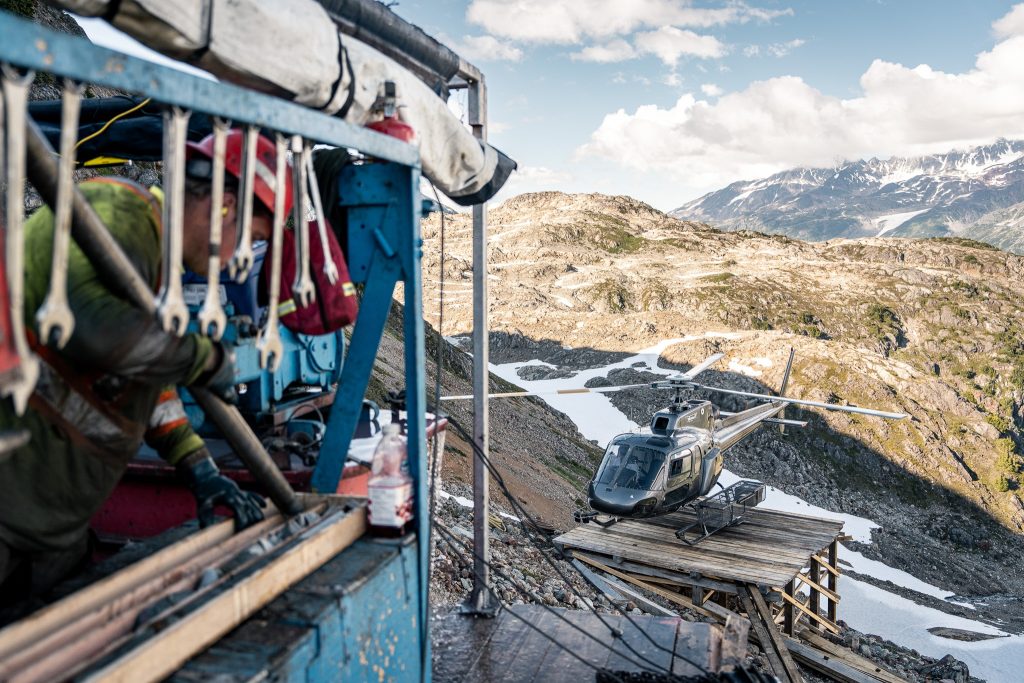
The company tested the logistics chain through a bulk sample completed in 2025, which Mumford says demonstrated that material could be moved from the project and exported through the port.
Historic mine, new model
The Scottie Gold Mine produced 95,426 ounces of gold between 1981 and 1985 at an average grade of 16.2g/t.
While that operation established the presence of ‘high-grade’ mineralisation, the current project extends beyond the historic underground workings.
Scottie’s broader landholding covers more than 59,000 hectares in the southern Golden Triangle, while the core Scottie Gold Mine Project comprises 20 mineral claims and 14 Crown-granted claims over 8,534 hectares.
More than 30 gold-bearing or silver-bearing mineralised zones have been identified across the project area. Before the 2021 field season, only seven had been drill-tested.
The company’s modern resource is centred on the past-producing Scottie Gold Mine and the nearby Blueberry Contact Zone. Its development plan begins with open-pit mining before transitioning underground to access higher-grade mineralisation.
According to Mumford, that sequencing could generate a relatively fast payback during the initial stages of development while the company establishes access to the underground resource.
The proposed direct shipping model also changes the scale at which the deposit may become commercially relevant.
Instead of requiring Scottie to define several million ounces before considering development, the company can assess a smaller initial operation while continuing to explore a district-scale land package.
This gives Scottie two parallel objectives: converting the existing resource into a development-ready inventory and demonstrating that the broader project can support substantial long-term growth.
Mumford says the company differs from many Golden Triangle explorers because it is working towards a defined development timeline rather than pursuing exploration without a near-term production plan.
“What makes Scottie different is how close to production we are,” he says.
“A lot of other stories are looking for something big, but their timelines can be five, 10, or 15 years away from production. What makes Scottie unique among these high-grade gold stories is the timeline.”
Largest campaign underway
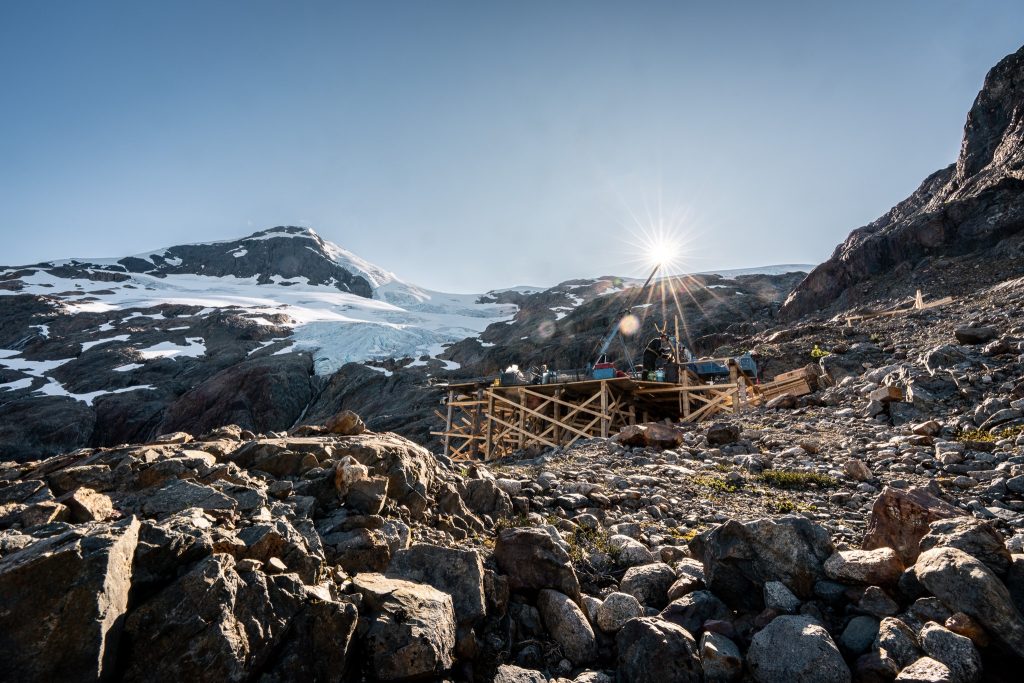
Scottie launched the 2026 exploration program on 16 June, marking the start of a campaign that represents an increase of more than 50% on all drilling previously completed by the company at the Scottie Gold Mine.
The 50,000m diamond drilling program is focused on expanding and upgrading resources at the Blueberry Contact Zone and Scottie Mine, while also testing regional targets across the district.
These include the Bend Vein, C and D zones, Serac Vein, Lakebed area, and Domino target.
A further 2,000m of drilling is planned at the Cambria property, marking Scottie’s first drill campaign at that project.
The immediate priority is to increase confidence in the existing resource.
Scottie plans to use infill drilling to convert inferred material into the indicated category, allowing more of the resource considered in the company’s economic studies to be incorporated into a Feasibility Study targeted for the first half of 2027.
At the same time, the company will conduct step-out drilling designed to test the scale of the mineralised system.
Mumford says Scottie is looking beyond incremental additions and wants to establish a credible pathway towards a multimillion-ounce resource.
“Our existing resource is about 700,000 ounces of high-grade gold,” he says.
“Finding the pathway to a million and a half, 2 million ounces over the next five years will be a big focus of our project.”
The campaign therefore carries both technical and strategic importance.
Successful infill drilling could support mine planning and the Feasibility Study, while exploration success could extend the project’s potential mine life and strengthen the case for future underground development.
Development steps take shape
Following completion of the 2026 drilling program, Scottie plans to incorporate the results into its technical work ahead of the Feasibility Study.
Mumford expects the study to be delivered in H1 2027.
The company would then seek to finalise a construction financing package, potentially including debt and equity, before moving into early works.
Scottie is also planning another exploration season in 2027 as it continues testing the wider district.
Under the current schedule, foundational work could begin during 2027, followed by installation of modular infrastructure in 2028. Proposed site facilities include accommodation, warehousing, and ore-sorting equipment.
Mumford says the company is targeting material shipments by the end of 2028.
The strategy remains subject to the Feasibility Study, financing, permitting, agreements, and further technical work.
Scottie is also advancing the project in consultation with the Nisg̱a’a Nation, its principal First Nations partner.
The company has entered a capacity funding agreement and is working towards an impact benefit agreement.
Mumford says the relationship carries added significance because a partnership involving the Nisg̱a’a Nation acquired an interest in the port used during Scottie’s bulk sample shipment.
That connection potentially aligns project development, regional economic participation, and the infrastructure required to move material to overseas markets.
Infrastructure shapes opportunity
Scottie’s current exploration campaign will test whether the project can translate its geographic advantage into a viable mining operation.
The road to Stewart and access to a deepwater port provide Scottie Resources with an alternative to the capital-intensive model typically used to develop an isolated gold deposit.
For a company targeting production in 2028, that infrastructure could help close the gap between a historic mine, a growing resource, and a commercial operation.
“With a strong team in place and a clear strategy for the season, we are well-positioned to continue demonstrating the scale and potential of the district,” Mumford says.
Write to Bruno Venditti at Mining.com.au
Images: Scottie Resources


